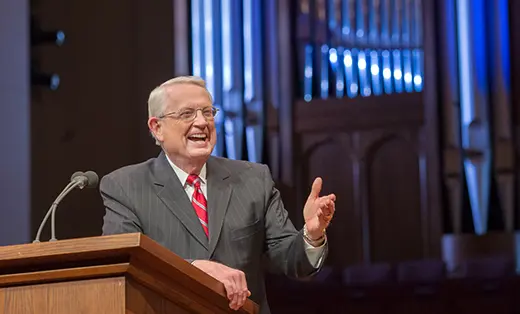
Chuck Swindoll’s Preaching Insights from Acts
By IFL Staff
Pastor Chuck Swindoll preached from the book of Acts for decades.
In a few of those sermons, you’ll find that Chuck doesn’t just exposit what’s happening in Acts—he also teaches us how to preach based on sermons from Peter and Paul.
So in this article, we want to share Chuck’s best insights on preaching from four of his sermons on Acts.
We’ll string together points from each sermon so that you read Chuck’s own words.
These are master classes in communication that will help you deliver God’s Word with clarity, relevance, and power.
“Peter’s First Sermon . . . and Best”
This sermon exposits Acts 2 where Peter stood up on the day of Pentecost and preached to the crowd. In this section, Chuck gives us four takeaways, starting with three things that made Peter’s sermon great.
Three Things That Made Peter’s Sermon Great
“Three things made it great. Number one, it was simple. You read this sermon, verses 15 down through 36, and you will find simple, understandable terms that to people in that day would have been clearly grasped. If you are engaged as a communicator, communicate in simple, understandable terms.
Strange to me how people sometime think because it was confusing it was deep. And they’re made to feel it’s their fault. I’ve heard speakers say that. “If you don’t understand this, it’s your fault.” And I want to answer back, “No, it’s your fault, baby. You’re the guy talking. Explain it so I can understand it.”
So it was simple. Even kids could understand it.
When you communicate, can teenagers understand? I’m bothered that teenagers are systematically emptying themselves from church services because they’re bored stiff . . . because they haven’t been understanding what’s been said since they started. It was simple.
Second, it was scriptural. All the way through he’s punctuating it with Scripture. You want to have a message that God will use as an impact in people’s lives? Hey, tell them what the Book says. God will honor His Word. People are starved for a clear presentation of the relevance of Scripture. They’ll love it. So it was scriptural.
Third, it was Christ-centered. Man, is it any amazement that verse 37 says, “When they heard this, they were pierced to the heart” . . . What an encouragement to Peter.”
Start Where They Are
“Isn’t it interesting also that the sermon begins with a question, “What does this mean?” and closes with the question, “What shall we do?”
Are you a communicator of the Bible in some way, a class or a congregation or in some way communicating it? Start with the question, “What does it mean, what I’m trying to say” Start where they are. And then when you’re all through, be sure that they know what to do about what it means. So important.”
You Don’t Have to Be a Slick Pro
“By the way . . . I’ll just throw this out. And take it for whatever it’s worth. God can use your tongue and your lips. Hey, please do not think you have to be a slick pro to get the job done. The professionals can never get in where you work and live. You can get in there. That’s your calling. Just give it to them as you know it, stumble over it if you have to, but get it out. And then just model it. Just model the message! And they can’t turn it off.”
You Have to Get Their Attention
“Now, look at it. He overcame the inertia of the crowd. Remember, the first inertia you have to overcome is ho-hum. People are not on the edge of their seat waiting to hear what you have to say. So you have to overcome that when you communicate. “Peter,” it says in verse 14, “raised his voice!” Now I’m not saying stand up in the office and shout. That’s not the application of this. But you have to get their attention. Begin where they are. He didn’t plead with them. He said, “I’ve got something to say and you can’t afford to turn it off.””
“Neck Deep in Greece”
In this sermon, Chuck preached on Acts 17:1–15, which covers Paul’s ministry in Thessalonica and Berea. Chuck gives us principles from Paul’s communication approach.
Respect People’s Dignity with Patience
“I am impressed right off the bat with Paul’s patience. It would have been very easy for Paul, who knew he had the truth, to take a package and to come into the synagogue the very first Saturday, unwrap it, shove everybody’s face in it, [and] say, “This is the truth. Take it or leave it.”
But he didn’t do that. Paul respected the dignity of his fellow man. And we are in need of that in our evangelical world. We are in need of realizing that people are to be treated with respect and dignity and care, [including] those without Christ. And the patience that is illustrated in the three weeks of ministry is a perfect model to follow.
Paul was there three Sabbaths doing three things. First, verse two says, he was “reasoning from the Scriptures.” In other words, he went to the Old Testament Scripture and he picked and chose those pertinent passages that reflected the Messiah. And on the basis of what the Old Testament was saying about Messiah, Paul built a bridge to Jesus Christ.”
Aim for Accuracy, Clarity, and Practicality
“The second thing is in verse three. He “explained” those verses. The word explained means “to open up completely, to make clear and plain.”
I place a very high priority on making my teaching clear. I want to be assured in my mind that anyone can come in off the street and can sit down in any service or any gathering where I am and I’m involved in the communication and that they can understand most, if not all, of what is being said. I think that’s a very high priority for us.
As a matter of fact, I have three priorities: accuracy, clarity, and practicality. I get that, really, from Paul’s method. Is it accurate with what the Scripture is saying? Is it clear so that anybody can understand it? And third, is it practical so that people care? What good is it when it’s all said and done if people walk out saying, “Aw, so what! Big deal!””
Avoid Insider Language and Clichés
“It’s hard work to explain. It’s hard to say it without clichés.
I was caught up short with a group of kids at Vacation Bible School a number of years ago. And kids will do it to you. They’ll ask those hard questions. I was teaching about the death of Christ and I said, “Now, kiddos, you understand, when Christ died on the cross, He shed His blood for our sins.” A little girl in the back said, “What does ‘shed’ mean?” To her, a shed was a place you put a pony.
Wait a minute. I got to thinking. I never use the word “shed” in that sense except in that statement. And it’s a cliché. And I stick that word in because I don’t stop and think what it really means.
You say, “Why nit-pick on little words?” Hey, it’s little words that keep them from understanding. You throw the word “reconciliation” around with a lost person, he’s not going to track [with] you. And we dump that verbiage on them and the sinner says, “I’m not interested.” And you walk away and say, “That’s just the way it is. People are not interested in Jesus.” They’re interested in Jesus. But they don’t understand it.”
Use Illustrations
“Well, the third thing he did [is that] he gave evidence. See verse three. It means “to place beside . . . to set something alongside something else.” And it’s like Spurgeon put it, “It’s like opening windows to let in the light.” That’s what an illustration, that’s what supplementary material will do. Don’t just drone on with those same cliched terms. Stop and illustrate! Explain!”
First of All, Present Christ
“But I don’t find Paul addressing any of the idols in the first three verses. Isn’t that significant? What’d he do? He presented Christ. And then Christ took care of all the idols. Leave the idols alone. Don’t nit-pick with lifestyle and habits and choice of decisions on how to live and marital status. Talk about Christ. Stay on the issue of Jesus Christ. God will honor that.”
Persuade Rather Than Pressure
“[Em Griffin, in The Mind Changers, wrote,] “As ambassadors for Christ, we need to have an ethical standard which guides our appeal, regardless of how people respond. I believe there is such a standard. And, simply stated, it is this: Any persuasive effort which restricts another’s freedom to choose for or against Jesus Christ is wrong.”
We don’t believe that. We prefer to corner them, and get a few troops around us so they can’t get away. Hey, let’s treat them with dignity. Give them space! If they choose to reject it, back off! Oh, we reveal our insecurity so much in our presentation of the message. It’s my job to share it, and we equate pressure with sharing. No.”
“Areopagus Eggheads versus a Seed-Picker”
In this sermon, Chuck preached on Acts 17:16–34, which records Paul’s famous sermon on Mars Hill in Athens. Chuck walks us through five factors that made Paul’s speech excellent.
Start Where Your Audience Is
“I want to point out five major factors related to this excellent speech.
Number one, he started where they were… ‘Men of Athens, I observe that you are very religious in all respects.’… He began where they were.”
Bridge the Familiar and Unfamiliar
“Second, he took them from the familiar to introduce the unfamiliar. Verse 23, “What therefore you worship in ignorance (the familiar), I proclaim to you (the unfamiliar).” He started where they were and he built a bridge from the familiar to the unfamiliar. That is a basic assignment of a good communicator. You learn how to go from the familiar world of where they are into the unfamiliar territory of where you want them to come. That takes thought. Paul was a master at it.”
Develop Your Theme Forcefully and Clearly
“Third, he developed his theme forcefully and clearly. “The God who made the world and all things in it, since He is Lord of heaven and earth, does not dwell in temples made with hands.” Point number one: being the creator, He cannot be contained. Second fact: being the originator, He has no needs. Third: being intelligent, He has a definite plan. Being the sustainer, He is not dependent.”
Recapture Attention with Illustrations
“Now, right at this moment, Paul interjects an illustration. I wondered why when I read this text. Why would he do it? The same reason anyone does it. To recapture attention, to give a little bit of refreshment. You know, there was just so much that could be taken in in one setting before you could let a window of light open and bring in some relief. That’s what an illustration does. It clarifies and it refreshes.
By the way, it’s time to say something about illustrations. So that’s the fourth point. He kept their attention with relevant illustrations. No matter how good your subject matter may be, illustrations are needed. There’s a word for individuals that never illustrate: boring.”
Apply Your Message Personally
“Now, fifth, he applied the message personally. This is where it gets really neat. He has given this series of truths. And now he comes to the part, verse 29, that says, “This is for you! We’re not giving a theological essay.” Twenty-nine, “Being then.” There it is. That’s a turning point, “Then.” Verse 30, “Therefore.” Those are transitional terms.”
“Preaching as Paul Preached”
This last sermon is from Chuck’s series on Paul. He returned to Acts 17:15–34 and extracted from it some fresh insights for us.
Notice What Others Don’t See
“The reason Paul could speak as he spoke was because he felt what he felt. And he felt what he felt because he saw what he saw. Great sermons begin with the insight of seeing what others no longer see and feeling what the majority no longer feel, which fuels the passion to say what few are saying.”
Four Principles
“I have four things I want to leave with you and I don’t want you to ever forget them. All four are taken from Paul’s model.
Number one, always start where your audience is. Always start where your audience is. They are on Island B. You may exist on Island A. They need a bridge. You bridge them there by the familiar. Start where they are. Find a way to get into their world and begin there.
Second, always speak the truth without fear. Do not be overly impressed with those who have come to the class or sit in the church or are a part of your ministry. Makes no difference how much they’re worth or how little. Makes no difference what their gender may be. Makes no difference what their level of interest is. Makes no difference how they respond to you. It makes no difference. Your task is to speak the truth without fear. Learn that from one who didn’t hear that early enough in his ministry. Speak the truth. That’s your responsibility. And do it unintimidated. As you have learned today, the most brilliant in Paul’s day had never even been exposed to the gospel.
Third, always stay on the subject. It’s God. It’s God. It’s He. It’s Him. It’s Himself. It’s He. It’s God. It’s Him. It’s His children. It’s Divine Nature. “He has fixed a time, He will judge, and there’s a Man whom He has sent to do so because He raised Him from the dead.” Same theme all the way through. Great preaching carries a theme.
The fourth: always surrender the results to God. Once they have heard, your responsibility has stopped. Your task is to communicate truth. It’s God’s job to break their hearts. They don’t need to be manipulated. God doesn’t need your help. You don’t need to follow them home. You don’t need to push them in a corner. God will reach them, just as He did in this case. And you finish your message, you walk out of their midst.”
Preach Because You Care
“Paul spoke what he spoke because he felt as he felt. And he felt as he felt because he saw what he saw. That’s good preaching. Good preachers see what the majority don’t see. Usually it’s the invisible. It’s that which is hard to get your arms around. It’s the gnawing emptiness of the human soul that the preacher sees and understands and can articulate. And when he sees it, he feels deeply, as Paul was provoked in his spirit. And being provoked, he was led to say what he said. It’s just that simple.”
Additional Resources
First, sign up for our Swindoll’s Insights on Ministry email where we bring you Chuck’s best thoughts on preaching, leadership, and ministry each week. By signing up, you’ll instantly receive a one-age checklist with 20 preaching insights from Chuck. See this page’s sidebar.
Second, check out our Preach the Word video series on YouTube where we’re posting Chuck’s best insights on this important calling.
Third, if you don’t own a copy of Chuck’s book on preaching, Saying It Well, we highly recommend you add it to your library. It’s his preaching memoir that is also like a practical preaching manual. You won’t be able to put it down.
Fourth, peruse more articles in this church leaders section.
About the author
 IFL Staff
The Insight for Living Staff is a collaborative team of writers, researchers, and editors dedicated to the mission of excellence in biblical exposition. Under the leadership of Pastor Chuck Swindoll, our team works to provide clear, accurate, and practical applications of God’s Word to help people across the globe understand and apply the Bible to their daily lives. Learn more about our mission and history on our About Us page.