Chuck Swindoll’s Number One Principle for Preachers
By IFL Staff
Pastor Chuck Swindoll has proven to be one of the best preachers of our time.
He has preached thousands of sermons spanning more than 60 years. If you asked him for one principle that’s really helped him preach well, he would not start by giving you a technique. Instead, he’d share a wonderful little statement, a punchy axiom, he likes to come back to. He discussed it in his book on preaching, Saying It Well, but before we dive into it, let’s see this principle in action with this fun story. In Chuck’s sermon, “Tough Grace,” from his Tough Grace in Difficult Places series (an exposition of Titus), he said:
I didn’t think I was going to tell you this, but I’m going to tell you. I got a nice letter this week from the Plano Police Department. I thought, How great. They want me to speak at the police banquet, I bet. How nice, personally addressed, nice envelope. I opened it up and I said, “Man, they really care. They’ve got a picture of my pick-up in here.” You know, I read it, and I read it again, and I realized that department is run by a bunch of legalists! I mean, there were harsh words and there was a deadline. And I looked at the pictures . . . that last one as I ran that light. And, of course, who should find the envelope but Mother Superior Cynthia. “Oh, ha, ha.” I thought, You know, my mother would just say, “I’m proud of you, son.” But my dad . . . . My mother used to burn rubber out of the driveway, ekkkkkk! Taking off, you know. Lights are too long. So, in honor of my father, I sent $75 to the Plano Police Department and I remember that I am not there yet.
“Then we shall be where we would be, Then we shall be what we should be; Things that are not now, nor could be, Soon will be our own.”
Not now . . . then. And if you don’t know Christ, your “then” is nothing like that. It’s nothing like that. You can’t imagine how horrible it would be. So let’s take care of that. I’d like you to bow your heads.
The grace of God has appeared, the epiphany has happened, the ladder has been dropped. How great is that! There’s no age requirement, there’s no gender required, there’s no church required, there’s just “nothing in your hands you bring; Simply to the cross you cling.”
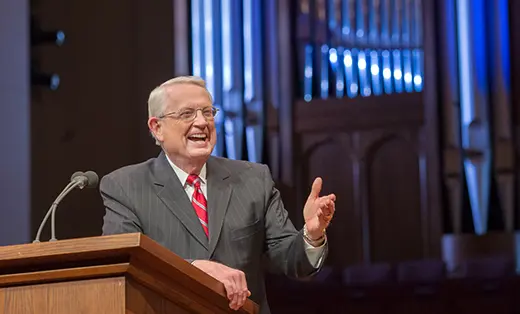
You can really sense the freedom that Chuck feels behind the pulpit. Chuck’s freedom expresses itself in two ways.
On the one hand, there’s this freedom that allows him to be transparent and honest about his ticket and even have fun with the story. Then, on the other hand, it’s the same freedom that allows him to slide right into the closing of his sermon, to help folks center their minds on Christ, and to respond to the message.
Chuck discovered a principle for reaching this freedom back in the early 1960s. When he was training for ministry at Dallas Theological Seminary, he spent a summer in California with Pastor Ray Stedman doing an internship. In Saying It Well (43–44), Chuck writes [emphasis added]:
My time with Ray made me aware of something I lacked: I didn’t have a strong sense of identity. I then set out to achieve a threefold objective that would guide the rest of my career: Know who you are. Accept who you are. Be who you are.
If you wanted one principle from Chuck on preaching, he starts right there. Without that principle, you’ll be insecure in your study when you’re all alone and you’ll be insecure behind the pulpit before your people. Furthermore, without that principle, your hearers will sense your discomfort, your lack of authenticity, and they will get distracted and even grow uncomfortable themselves.
The apostle Paul actually touches on this principle in 1 Thessalonians 2:4 where he wrote, “For we speak as messengers approved by God to be entrusted with the Good News. Our purpose is to please God, not people. He alone examines the motives of our hearts.”
Chuck’s threefold objective helps us to stand secure before God. And he starts right there in his advice to preachers because no technique can overcome the absence of security, sincerity, and authenticity.
Now, a warning siren might be firing off in you. It’s the caution against developing some kind of personality cult—where listeners are more enamored with you than with Jesus. Chuck is the first to say, “Watch out for that—guard against it.”
For all sermons and all churches and all pulpits—we want Christ, and His gospel, and his insight for living (I couldn’t resist), but we want him and his truth to be the dominant subject, the obvious magnet of our message that attracts our hearers.
With that said, here is the inescapable fact. Jesus spreads His gospel and builds His kingdom through people—from person to person, mind to mind, heart to heart. Phillips Brooks, in 1877, said in a lecture that “preaching is the bringing of truth through personality.”
Let’s not make that statement more than what it is. It hits nicely, though, on the fact that Jesus uses persons, personalities—and that ministry happens best through authentic people.
But if you’re a preacher, being authentic can be a really tough place to get to. It took Chuck years and years. Check out his conversation on this with Michael Easley from 2013:
Michael: So if something really deep comes out of Chuck Swindoll, [it’s] your laughter, your self-deprecating humor, the way you throw your head in the pulpit when you preach. I mean, it is a compelling. I wish I could love life like that guy. I wish I had that much joy in my own idiocy. Help us.
Chuck: Yeah. You know there’s a word that describes all [those] things . . . it’s “freedom.” I am free. I am really free. I can’t wait till Sunday.
Michael: Was there a defining moment in your life when you started tasting the freedom?
Chuck: Yeah. I write about it in my book, Saying It Well. I found out who I was. I accepted who I am, didn’t like everything about it, but I accepted the person God made inside this skin. Then I began to be who I am. I wasn’t this way at the first. We were in New England and boy, I was miserable. I was making it miserable. And I said to Cynthia one Sunday afternoon, “What is wrong? This is just really tough.” She said, “Well, you’re not who you really are when you get in the pulpit.” I said, “What does that mean?” [Michael,] you and I both have studied under the greats, so I was like the beast in Daniel 2. I was a little bit of everyone of them, especially the clay feet. I was trying to be a little bit of Bruce Waltke, and a little bit of John Walvoord, and a little bit of Dwight Pentecost.
Michael: The Pantheon.
Chuck: And this is the way Hendricks would say it. This is the way Zane Hodges would have said it. You name them. She said, “You know what? You’re so much fun at home. I just wish you would be you in the pulpit.” I said, “I can’t do that.” As is true of many guys, you learn your best stuff from your wife. She didn’t let up. She said, “You know, you can be that. You can be.” I said, “Honey, I mean, this is New England.” She said, “All the more reason to be who you are.” The old country preacher says, “Be who you is, ‘cause if you ain’t who you is, you is who you ain’t.” And I was who I wasn’t and I didn’t even know because when I got in the pulpit it was severe. A lot of reproof. Driving the sheep. Lot of frowns. I said, “We’ve got to get this straight. These are biblical principles. Eternity’s at stake.” She said, “We all know all of those things, but we just need to be charmed into righteousness,” which is a line Reinhold Niebuhr used in one of his works. Michael, I risked that. We moved and I came to a little church in Irving, Texas, and I decided on my way, I’m going to use this whole new approach. I’m going to be who I am. For four years there and then when we moved to Fullerton, California, I really began to hit my stride, if you will.
Michael: Now, was that scary? When you started [that approach]
Chuck: Yeah, it was. …
It can be scary. Fear and uncertainty creep in. You compare yourself with others who preach so well and you feel inadequate. Or, you’re thinking of so-and-so in your congregation and you let their opinion shape what you say or even how you say it.
In both cases, you can’t preach with authenticity.
Instead of standing behind the pulpit and responding to Christ, and delivering his message, and connecting with his people—you’re letting someone else or something else control that moment and restrict your freedom in the task at hand.
That’s why Chuck would start right here for preaching:
Know who you are.
Accept who you are.
Be who you are.
But it’s not an instant switch you can just turn on. It’s takes time. It takes practice. It takes effort . . . failure . . . and resilience. Listen to what Chuck writes about this in Saying It Well (44):
In many ways, the quest to know yourself, accept yourself, and then be yourself is a lifelong journey; it never really ends. But, over time, you can reach a place of reasonable confidence from which you can speak from the heart with relative ease.
If there’s anything we want you to take away from this article, it’s a deep sigh of relief.
We want you to feel confident in God’s wisdom in making you as you are. God doesn’t want you to be anyone other than you. And when you are being authentic, your personality is able to connect with and reach people that other personalities can’t reach.
Let’s conclude with one more word of encouragement from Chuck. He preached on the life of David in 1977 and 1978. This clip is from his sermon on David and Goliath, during the part of the story where tall and muscular king Saul put his own armor on David and David was like, “I can’t use this!” Chuck drew this application from this moment:
Hey, if you’re called to preach, be you! It took me four years to get [a] graduate school education and almost 40 years to get over it. Get into seminary, get it done, and get over it, for the Lord’s sake, and declare the truth as YOU have been built to declare it, not like someone else. That’s his armor and it works for him. Boy, that was a great breakthrough in my life when I suddenly discovered I could be me and God would use it.
Additional Resources
First, sign up for our Chuck’s Insights on Ministry email where we bring you his best thoughts on preaching, leadership, and ministry each week. By signing up, you’ll instantly receive a one-page checklist with 20 preaching insights from Chuck. See this page’s sidebar.
Second, check out our new Preach The Word articles and video series on YouTube where we’re teaching Chuck’s best insights on this important calling.
Third, listen to Chuck’s messages to those in ministry through our Seminary Chapels page. For decades, he offered students at Dallas Theological Seminary his best thoughts on church leadership and ministry. Now, we have put them at your finger tips. Also, you can find them through this YouTube playlist we created for you.
Fourth, if you don’t own a copy of Chuck’s book on preaching, Saying It Well, we highly recommend you add it to your library. It’s his preaching memoir that is also like a practical preaching manual. You won’t be able to put it down.
Copyright © 2026 by Insight for Living and Charles R. Swindoll, Inc. All rights are reserved worldwide.
About the author
 IFL Staff
The Insight for Living Staff is a collaborative team of writers, researchers, and editors dedicated to the mission of excellence in biblical exposition. Under the leadership of Pastor Chuck Swindoll, our team works to provide clear, accurate, and practical applications of God’s Word to help people across the globe understand and apply the Bible to their daily lives. Learn more about our mission and history on our About Us page.