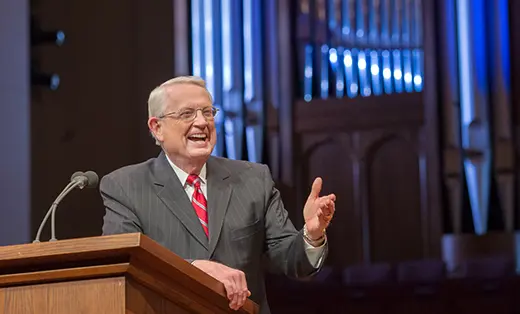
Chuck Swindoll on Prayer During Sermon Preparation
By IFL Staff
Pastor Chuck Swindoll is one of the most powerful preachers of our age.
And it’s tempting to think his power is primarily based on his skill, his diligence, his gifting. Of course, all of that plays a part in his effectiveness, but he would tell you it’s not the most important part of being a faithful and useful preacher.
Instead, he would tell you to start with prayer.
So in this article, we’ve assembled some of his best thoughts on this subject for you so that you can be a preacher who relies first and foremost on the power of God.
To begin, check out this statement from his sermon titled, “What’s First in a Meaningful Ministry?” taken from his series on 1 Timothy:
“What’s first in a meaningful ministry? What’s first? According to 1 Timothy, chapter 2, it’s prayer. Doesn’t sound very creative. It certainly isn’t terribly exciting to those who are engaged in it. It’s hard work. I don’t know of any harder work than prayer. It isn’t glamorous. It never is applauded. It is done in the closet, if it is effective. It represents a solitude, one-way conversation, time, concentration, effort.
Now, is it balanced to say that this is first? Is that New Testament? Without turning, let me give you a brief review, and I promise brief. In Acts, chapter 6, when the congregation was at odds with one another because some of the people in the church were not being ministered to, the elders said to the congregation, “Choose for yourself men who will be able to help in this problem. But we will continue to devote ourselves to prayer, and the ministry of the word,” in that order. You know, we often misquote that. “We will devote ourselves to the ministry of the word and prayer.” But that’s not what Acts 6:4 says.
“We will devote ourselves to prayer, and the ministry of the word.””
We have more to read from that sermon, but that point frames Chuck’s whole perspective on this.
What’s first in a meaningful ministry? Prayer.
Broadly, that applies to the church. Specifically, that applies to the preacher. It applies equally to both. You can’t be an effective, strong, and faithful expositor of God’s Word without prayer.
If I were to summarize Chuck’s teaching on this into a single principle it would be:
Pray first and pray often during your sermon prep
But upholding that attitude isn’t always easy or natural. It takes intention and diligence. Chuck has wonderful insights on this in his book, Saying It Well. Believe it or not, he didn’t always pray first and pray often during his sermon prep. He shares:
“I’m naturally given to duty and responsibility, so I am seldom tempted to avoid the discipline of digging [or studying] each week. Instead, I—like many preachers—struggled to overcome another problem, a debilitating condition of the heart known as self-reliance. When I first began to shoulder the responsibility of preaching every Sunday, I was an eager young pastor up in Waltham, Massachusetts, full of pent-up energy and idealism.
I bore no illusions about the difficulties of preaching every week, but I determined to meet the rigors of pastoral ministry with the same roll-up-your-sleeves work ethic I learned from my father and honed to a razor-sharp edge as a combat-ready marine. As I understood prayer at that time, talking to God punctuated the end of human effort, either to bless it or to accomplish what could not be done otherwise.
I thought (in this order), I do my part while God does His part, and the job gets done. I, therefore, prayed as either a matter of duty or for rescue when my own efforts proved inadequate. Fortunately, the Lord diverted my course, kept me from crashing, and, in the passing of many years, forever changed my understanding of prayer—along with my whole approach to life, preaching, ministry, and even marriage.” (Saying It Well, 142–143)
Before we look at how his understanding changed, we want you to read what Chuck said about our posture in prayer. This statement is from his sermon on Colossians 4, where Paul said, “Devote yourselves to prayer with an alert mind and a thankful heart.” Chuck’s comments are about prayer in general, but they’re very useful to keep in mind for preachers during sermon prep:
“Look at how Paul writes of this. First, he writes of prayer with a word like devotion: “Devote yourselves to prayer . . . .”
The Greek says, “continue watching in it with thanksgiving.” There’s passion in the statement. Prayer is active, not passive. Prayer is bold, not weak. Remember Hebrews 4? We are to “come boldly before the throne of grace,” not in weakness, not pleading, not begging, not hoping we’re going to be heard, but boldly. Walking boldly into the presence of God, yet humbly, acknowledging that He has the right to answer however He pleases.
We are to pray with an alert mind and with a thankful heart. We’re not to be dreamy and wandering in our prayers. We are to have a series of thoughts that are expressed devotedly. In today’s terms, I would use the words, “Get with it.” When it comes to prayer, get with it. Don’t mumble the prayer. Don’t come halfheartedly, but come with vigilance, with a mission in mind.
“Devote yourselves to pray with an alert mind and a thankful heart.”
I’ll be honest with you. I don’t know of any harder work than prayer—devoted prayer, passionate prayer, prayer that’s uttered behind the scenes with confidence. Speaking to Someone you cannot see. Counting by faith on something you have not felt or heard, and yet, it’s there. It’s claimed by prayer.”
God wants us to come with boldness before him. And that’s true when we’re preparing our sermons. God loves the people you’re preaching to more than you love those people. He wants those people to be fed, to be equipped, to be encouraged, to be corrected, to be strengthened, to be united.
That church family does not belong to you—it belongs to God. God has entrusted it into your care. But that doesn’t mean you’re left on your own to care for it. No, God is with you in the entire process. That’s what Chuck realized that changed his understanding of prayer.
Here’s what he says in Saying It Well (150):
“My responsibility, therefore, is to become the means of God’s doing what He already wants to do. I am merely His co-laborer. He called me to do this, not because He desperately needs me, and not because He cannot proclaim His own Word or do so through others, but because it pleases Him to use me—my voice, my personality, my style, my whatever.
Prayer, then, isn’t a punctuation at the end of my effort; prayer is my first introduction to what He wants to do on any given occasion—Sunday or otherwise. Rather than pray as a last resort, after all else has failed to produce a worthwhile sermon, I now pray first and often, asking God to let me in on His plan.”
That perspective shift makes all the difference. It’s God’s mission. It’s God’s church. It’s God’s sermon. And it’s your privilege to get to be a part of it.
Chuck noted a handful of ways prayer has helped him, and for now, we just want to focus on two (Saying It Well, 151–152).
First, “Praying keeps my focus on God’s approval rather than the applause of people.” It just keeps your mind elevated and aware that Jesus is right there. He’s not distant. He’s right next to you. Their reaction matters less than His approval.
Second, “Praying keeps me from shooting from the hip when I know a passage very well.” It’s about sticking with the process, to study and prepare and outline and formulate and wordsmith and to do it all with excellence—even though you could probably step behind the pulpit and deliver a helpful sermon with very little preparation.
Let’s conclude with Chuck’s applications from the sermon we opened with, “What’s First in a Meaningful Ministry?” This sermon covers 1 Timothy 2:1–8 where Paul urged Timothy, first of all, to “pray for all people.” Like before, Chuck’s words here are about prayer and ministry in general, but we think these practical suggestions are useful for preachers who want to rely on prayer during sermon prep:
“Practical suggestions on making prayer a priority—a couple or three little three-word tidbits.
First of all, form a habit. Form a habit. If you’re ever planning to make prayer a priority, you’ll have to form a habit. Oh, I hesitate to use this illustration, but I’m going to. In order to get ahold of the problem you have with weight (now I’m using it, okay?), you have to form a new habit about eating and about exercise and about nutrition and about your whole intake or you’ll never lose it. You got to form a new habit. And it is very, very, VERY hard work! But it is nothing like forming a habit to pray. It’s a piece of cake compared to that. For . . . Oh, that’s a bad, bad use of words! PIECE OF CAKE! Did I say that? That is great! I can’t believe it. You guys, you were gunning for me on that one. Form a habit. Leave it at that.
Number two: Set no limit. Set no limit. The enemy’s going to come and say, “Aw, pray about that? Come on, you can handle that!” Don’t believe it. You’re setting a limit. “Well, you can do that. You know how to handle that. You’ve done it before.” That’s setting a limit. Don’t set a limit. Set no limit. He says, “Pray first.” So do it. You’ll have insight. You’ll have resilience. You’ll have perception. You’ll have strength you never had before. Don’t set a limit.
Form a habit. Set no limit.
Third, restrain all substitutes. That’s the third one. Before you reach over to pick up a phone and share the need with somebody, you pray. That’s a substitute. Before you ask somebody which book you ought to read about . . . don’t read a book. Pray. Before you talk about it, before you worry about it, pray. Take it to God. Leave it with Him.
“Prayer is putting the lens of your soul on time exposure,” writes one person. “Prayer is putting on earphones that shut out all noises but the voices of you and your God. Prayer is the recovery room after surgery and before recuperation. Prayer always has, along with its receptivity, four statements: Thank you. I’m sorry. Teach me. Go with me. Prayer is the frame of the bridge from weeping to doing, built across the canyon of despair.”
Now you may not have needed this, but I did. I needed it more than anybody who’s heard it. And God has really used it to challenge me. So thanks, God, for talking to us.”
Additional Resources
First, sign up for our Swindoll’s Insights on Ministry email where we bring you Chuck’s best thoughts on preaching, leadership, and ministry each week. By signing up, you’ll instantly receive a one-age checklist with 20 preaching insights from Chuck. See this page’s sidebar.
Second, check out our Preach the Word video series on YouTube where we’re posting Chuck’s best insights on this important calling.
Third, if you don’t own a copy of Chuck’s book on preaching, Saying It Well, we highly recommend you add it to your library. It’s his preaching memoir that is also like a practical preaching manual. You won’t be able to put it down.
Fourth, peruse more articles in this church leaders section.
About the author
 IFL Staff
The Insight for Living Staff is a collaborative team of writers, researchers, and editors dedicated to the mission of excellence in biblical exposition. Under the leadership of Pastor Chuck Swindoll, our team works to provide clear, accurate, and practical applications of God’s Word to help people across the globe understand and apply the Bible to their daily lives. Learn more about our mission and history on our About Us page.