Build Powerful Sermons with Simple Observations
By IFL Staff
Sometimes the best sermons come from simple observations.
Not from hours and hours in the commentaries nor from stacking one exegetical insight on another. Instead, you just slow down and carefully notice what’s actually in the text. Then you help people experience it.
It’s a great way to preach because you don’t have to be a poet or PhD to craft an effective sermon.
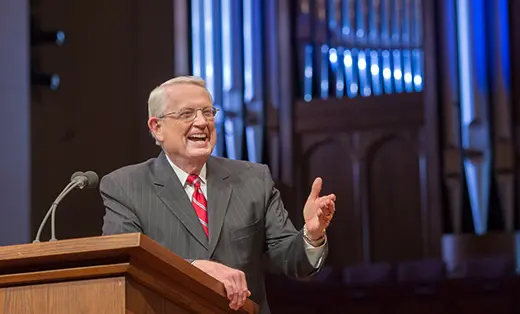
In this article, we want to show you an example from Chuck Swindoll. He’s built some powerful sermons doing nothing more than fleshing out simple observations. The one we’ll look at here is called “Heaven’s Magnificent Negatives,” based on the end of Revelation. We’ll go through a few excerpts from his introduction, exposition, and conclusion.
Start with Observation
Now here’s the context of Chuck’s sermon. He’s preaching through Revelation 21–22. When he prepares any sermon, he always starts with observation.
Observation is step one when you study the Bible using an inductive Bible-study method. First, you do observation, which answers the question, “What does the text say?” You always start with the text. Second, you do interpretation, which answers the question, “What does the text mean?” Third, you do correlation, which answers the question, “How does this text compare with other biblical passages?” Fourth, you do application, which answers the question, “How does this text relate to my life today?”
The tendency, especially during sermon prep, is to skip observation and run straight to the books. But Chuck doesn’t do that. He reads the biblical passage over and over and over again—slowly, carefully—to see what it says. He’s noticing the words—the terms and the logic—and letting them fill his mind. He’s letting it all flesh out in his imagination.
He’s looking at what you can see, touch, taste, hear, and smell. He’s looking at the who, what, when, where, why, and how. He’s looking for what’s related, alike, unalike, repeated, and emphasized. He’s checking the context. All of this is just flooding his mind and imagination as he reads the text.
For Revelation 21–22, he notices something repeated. It’s no, none, no longer, nothing, nor, never. They’re simple negations about the new heaven and new earth. No temple, no need of the sun or the moon, the gates will never be closed, nothing unclean will enter, no longer any curse, and no longer any night. And those are just some.
Chuck’s Opening Image
So Chuck used those basic observations, especially from Revelation 21:21–22:5, and he built his sermon around them. Here’s the way he opens this message, preached in 2004:
Clear communication is always a challenge. This challenge is intensified when the subject being addressed is well known to the speaker but not at all known to the one listening. And some subjects are so profound that the one listening not only can’t comprehend it but the subject becomes mind boggling.
Just try to imagine that you are one of those very familiar with the world of electronics and the latest in electronic devices and you’re trying to interest another person who doesn’t know anything about such into either being interested or perhaps purchasing such a device.
I asked our older son, Curt, to give me some examples and he sent me what is now available. For example, two cell phone/PDA combination hand-held devices that are about the size of the palm of your hand. They’re known as the “RIM BlackBerry” and the “Handspring Treo.” They can wirelessly send and receive e-mail messages and view attachments as well as cell phone calls. And then there’s the Apple 40 gigabyte iPod MP3 player. It’s a little smaller than your hand, weighs only 5.6 ounces but it has the capacity to hold around 10,000 songs. That’s so much music you could listen to it around the clock 24 hours a day for four weeks without ever repeating the same song. Or, if you wanted your sleep, you could hear one new song every day, seven days a week, for the next 27 years without repeating a song.
Hewlett Packard has come out with the HP-32-S scientific calculator capable of handling trigonometry, time, probability, factorial, gamma, and many other statistical functions to assist engineers. It weighs only 4.2 ounces and runs on two small lithium coin batteries. It has so many features built into it that it comes with a 386-page manual.
Accommodating Language
So that is Chuck’s opening image. He starts there to capture his listeners’ attention and anticipate the subject of his sermon. After spending some time making that point, he transitions his opening remarks to the context of the sermon:
And now, try to understand beyond the exotic gear what it meant for God to communicate His existence to us. Just try to understand. How in the world do you describe the inevitable sights and sounds of an existence beyond time and space? How about the magnificent music of angels as the myriad of voices singing in antiphonal sounds, songs never heard or composed before from the mind of God. Or the stupendous brilliance of transparent gold streets and massive pearl gates. And the mind boggling existence without concern for time and gravitational limitations and all of the familiar human anatomy that we know a little bit about. That challenge is going to describe what you would face if you were to try to communicate as a person living in the interior of Brazil to an untutored native Eskimo in the North Pole what life is like for you down there. What would he know about gigantic ivy-covered balsa trees? That would mean nothing to a man who knows only arctic berries and glaciers and the vast ice fields and snow.
What would the flash of brilliantly plumaged birds with huge curved yellow beaks or the 30-foot anaconda slithering through the swamp of the Amazon mean to one who has never known anything but tuxedo dressed penguins and 900 pound polar bears and big, fat walruses with long tusks. You would have to begin the other way. You would have to begin with what isn’t there.
There will be no ice. There will be no snow. There are no glaciers. There are no reindeer. There are no polar bears. And that is what God does for us when the subject of heaven arises. I challenge you on your own time to take chapters 21 and 22 with a pen or pencil and circle the words “no,” “not,” “never,” “no longer,” and “nor.” They’re woven through the fabric of heaven’s masterpiece. This is what I call accommodating language. God adjusts His truth to our two-by-four, planet earth limitations. And He communicates to earthbound creatures what it would be to soar across the remarkable glories of heaven. And He focuses on heaven’s magnificent negatives.
The Power of Contrast
So all Chuck has done so far in his introduction is grab their attention and anticipate the subject of his sermon. It’s heaven’s magnificent negatives.
But for those negatives to really become personal to us, who are listening, he uses contrast. Contrast is a powerful technique where you place one thing beside the other, and they both become clearer because of the comparison.
So, to talk about heaven’s magnificent negatives and to show how meaningful those negatives are to us, what do you think he turns to for contrast? That’s right, our world:
Stop and think of our world. Our familiar world is a world of asphalt and rock-hard cement roads and if the streets no longer have lights on them, we pay a toll to drive on them over long distances. Our world is a world of structures where we worship—churches and chapels and temples and tabernacles. Ours is a place where you go to church rather than a place that is all about worship. Ours is a world where there are well lit cities, traffic lights, street lights, building lights, even landscape lights. Lights that fill and flood the mall to allow us to shop into the night. Our world is a world of security. We not only have locks, we have sophisticated alarm systems. Banks have their unique vaults and high-tech top-secret organizations have their unique entry passes. There are even gated communities where we live that have their own punch key code to let us in and sometimes even to let us out. And there is forever the reminder of death around us—the scream of the siren from the ambulance, the cemeteries, the long funerals. Death is everywhere.
Fleshing Out the Negatives
So that gives you all the parts of his introduction. Chuck is building his sermon on the negatives John used to describe the eternal city in Revelation 21–22. To set up his exposition, Chuck turns to analogy, a modern-day example of using negatives to describe something complex, and then Chuck turns to contrast so that we feel the difference between heaven and our world.
Now here’s what’s great about the rest of the sermon. It doesn’t get more complex than that. In fact, it actually gets simpler. Chuck walks through the text highlighting what won’t be in heaven. Then, he uses the powers of description and comparison to fill out those negatives.
In Revelation 21:25, John said the New Jerusalem’s gates will never shut. Chuck then uses contrast with our world to flesh out what that means. For example, there won’t be locks or alarms or cameras or guards.
What that does is help your hearers enter the world of the text. By making it visible, you make it real and relevant and meaningful to them.
So next, here are two expositional points from Chuck. That way you can see how Chuck does it:
It’ll be a city without darkness. Again, phenomenal thought. Verse 23 tells us, “The city has no need of the sun or of the moon to shine on it, for the glory of God has illumined it, and its lamp is the Lamb.”
I love the way that reads. The Lamb is the lighted lamp. What a beautiful thought.
Verse 22:5 tells us, “There will no longer be any night; there will not be a need for light of a lamp nor the light of the sun, . . .”
Every city either here in these United States or up into Canada. Every city from London to Lisbon, from Bucharest to Bristol, from Milan to Melbourne, from our fair city all the way up and around and down, every city is lit and must be lit. Since people love darkness rather than light, can you imagine the sinister plots that would be laid if there were no lights? Can you imagine existence only in dark alleys? When you fly you see the city glowing before you arrive, the pilots tell us. When you drive in the darkness in the middle of the night, you can watch on the horizon for the glow of the upcoming city because the city is lit.
But that’s on this earth and that’s because of electricity. But there we will be flooded only with God generated light. By the way, that ties in perfectly with the thought of that eternal city that will never know darkness, this thought of having security but no locks. You see the words in verse 25, “Its gates will never be closed.”
People have a way of noticing something that has completely slipped my mind. For example, before our first service started in worship today, a lady, longtime member of our church walked over and said, “I’ve been wondering, Chuck,” she said, “You don’t mind my asking.” I said, “Sure, that’s fine.” She said, “We see what’s inside the city and that the gates are open. What’s outside the city?” Without hesitation I gave her my best answer, “I don’t know.” Nobody knows. But the vast fields of space will be ours. And when returning to that place of residence if we could call that 75 acre plot such, of course it’s in a cube, so forget the fences. We’ll go through gates that will never be locked. Ou me kleisthosin says the Greek. “No, not ever shut.” The double negative in the Greek intensifies the negative. In our language it makes it positive, but in the Greek it’s, “No not ever will you hear the sound of a lock.” For us guys, we’ll never again hear our wives say just before we fall off to sleep, “Did you lock the back door?” Of course I have a way of, you know, telling her yes so I can go ahead and get my sleep. But she has a way of coming back after checking and saying, “You lied to me.” No more will there be alarm systems. No more will there be locks.
Cynthia and I have a friend who lived for years in Omaha, Nebraska. He tells the story of how his dad would buy a pickup truck about every eight or ten years and he said, “Funny thing about my childhood. There was just wonderful security.” He said, “We would put the key in the ignition when we bought the truck, and the key would never come out of the ignition until we sold the truck. We parked it on the front lawn, never locked our house, never had . . .” He said, “Never dawned on me to carry a key to the house because we never locked it.” You know, I have a feeling those who live in Omaha don’t do that anymore. And you can’t even imagine doing that in your home where you must lock and even set the alarm. But at that place there will be no such thing. In heaven there won’t be anything like it. The gates will never be closed.
The Power of Simplicity
Isn’t that powerful? Chuck isn’t being complicated. Of course, Chuck has the talent of a poet and the diligence of a researcher, but here he’s using the power of simplicity.
Now, we don’t want to be mundane or obvious or boring in our simplicity. But by using visual descriptions, illustrations, analogies, and contrasts, we take a dozen negations on the page and make them come to life with vivid hope and tangible relevance.
Chuck’s Conclusion
Next, the last excerpt comes from his conclusion. It’s not his whole conclusion, but the opening application part. Here you go:
What a magnificent hope God’s people have. When you compare it to all the myths and the folklore and the false concepts of various religions, you realize why Christians live their lives pretty homesick for eternity. I did a little research and found what some religions see as heaven.
Buddhists and Hindus anticipate repeated rebirths and endless reincarnations into other bodies. That for them is the future. Even worse, the Taoists, T-A-O, the Taoists see death with indifference. To them it’s ultimate oblivion, a state of non-doing. Islam, as you may remember from recent studies, offers its seven heavens of paradise—70 virgins satisfying the carnal pleasures of the men. Native American cultures look forward to what is called the happy hunting grounds. And by the way, all religions, all of them false, are based on works. You earn your way in, and you work hard. And you give yourself intensely to such labors because you’re earning your way in. A question I love to ask people who are caught up in that false teaching is, “How much good works is good enough?” I’ve yet to hear an answer. How can I ever know I’ve worked hard enough and long enough to get into God’s heaven? They never have an answer, which explains why they live their lives in fear and uncertainty.
With all of that lingering as alternative, try to imagine, try, if you will, to imagine not pie-in-the-sky-by-and-by, not sitting around strumming harps on clouds, none of that. We didn’t read anything about that in this passage. Try to imagine eternity where there is a face-to-face relationship with the One who got you there. Try to find eternity where there’s no darkness, no disease, no threat of death. Try to imagine an eternity where there will be forever protection and security and safety for you and your loved ones and all in the family. An eternity that you can finally call home.
Someone has put it beautifully, “Think of stepping on shore and finding it heaven. Think of taking hold of a hand and finding it God’s hand. Think of breathing new air and finding it’s celestial air. Think of feeling invigorated and finding it immortality. Think of passing from storm and tempest to an eternal unknown calm. Think of waking up and finding it home.” Home.
That’s where my mother is. That’s where my daddy is. That’s where my grandparents are and Cynthia’s grandparents and for most of you, your parents and grandparents. Don’t weep for them, they’re home.
Jim Elliot longed for home.
Setting Hearts on Heaven
With that last line, Chuck starts his ending with a story from Jim Elliot to inspire the application he just taught.
But with this sermon, notice his application wasn’t, “Go do this.” With this kind of sermon, the application is to set your heart on heaven. He could have told them to do that and then given them some techniques to practice it, but not here. Instead, he simply helped them do it right at that moment. He cultivated within them, in that moment of worship, a heart set on heaven. Then, of course, the goal is that their hearts will stay in that posture and return to that posture following the service.
That wraps up this article. We looked at Chuck’s sermon called “Heaven’s Magnificent Negatives,” which is a powerful message built upon simple observations. And it’s just one example among many.
You can do this with all the iconic scenes the Scriptures are filled with: Jesus, Joseph, Ruth, Paul, Peter, Esther, Daniel, David. Flesh out simple observations to put your hearers in the world of the text so that its truths become real and relevant for them.
If you’d like to hear Chuck’s full sermon, it’s called “Heaven’s Magnificent Negatives,” from his series titled Revelation—Unveiling the End, Act 3.
Additional Resources
First, sign up for our Chuck’s Insights on Ministry email where we bring you his best thoughts on preaching, leadership, and ministry each week. By signing up, you’ll instantly receive a one-page checklist with 20 preaching insights from Chuck. See this page’s sidebar.
Second, check out our new Preach the Word articles and video series on YouTube where we’re teaching Chuck’s best insights on this important calling.
Third, listen to Chuck’s messages to those in ministry through our Seminary Chapels page. For decades, he offered students at Dallas Theological Seminary his best thoughts on church leadership and ministry. Now, we have put them at your fingertips. Also, you can find them through this YouTube playlist we created for you.
Fourth, if you don’t own a copy of Chuck’s book on preaching, Saying It Well, we highly recommend you add it to your library. It’s his preaching memoir that is also like a practical preaching manual. You won’t be able to put it down.
About the author
 IFL Staff
The Insight for Living Staff is a collaborative team of writers, researchers, and editors dedicated to the mission of excellence in biblical exposition. Under the leadership of Pastor Chuck Swindoll, our team works to provide clear, accurate, and practical applications of God’s Word to help people across the globe understand and apply the Bible to their daily lives. Learn more about our mission and history on our About Us page.