Overview:
The twelve disciples shared many special moments with their Master like personally experiencing miracles and receiving private lessons on the kingdom of heaven.
Few of these instances, however, were more intimate than the Last Supper. Matthew 26:17–30 tells of this special celebration that gave us the meal that all Christians so cherish.
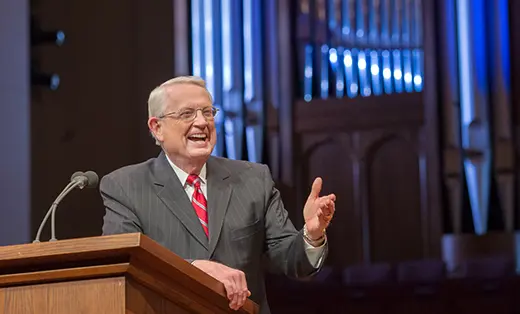
Join Pastor Chuck Swindoll like a fly on the wall and watch Jesus as He shares this moment with His friends and confronts Judas, His soon-to-be betrayer.
Message Summary:
In this message centering on Matthew 26:17–30, Chuck Swindoll invites the listener to become a "bug on the wall" of the Upper Room, observing one of the most intimate and shocking moments in history. Moving beyond the static imagery of famous paintings, Swindoll reconstructs the scene of the Last Supper, describing a U-shaped table where the disciples reclined rather than sat. He captures the stunning moment when Jesus disrupts the Passover meal with the announcement: "One of you will betray me." Swindoll focuses on the mystery of Judas Iscariot, portraying him not as an obvious villain, but as a trusted insider and likely a disillusioned political zealot who felt Jesus had failed to overthrow Rome [4, 11, 16–21]. Swindoll explains the transition from the Old Covenant to the New. He details the traditional Passover elements—the roasted lamb, the bitter herbs, and the unleavened bread—which looked back to Egypt. However, Jesus institutes a new meaning for the bread and wine, stating, "This is My body" and "This is My blood." Using a practical illustration of a photograph of his wife, Swindoll argues against a literal consumption of Christ's physical body, teaching instead that these elements serve as powerful representations of the Savior’s sacrifice [25–29, 39–43]. The sermon concludes with the emotional singing of a final hymn before the group departs for the Mount of Olives. Swindoll shifts the focus from the historical narrative to personal application, inviting the congregation to engage in their own "soul-searching." Drawing on Psalm 139, he challenges every listener to invite God to search their hearts for any "wicked way" or hidden sin, urging them to drop all pretense before the One who sees everything [47–51].
Message Key Facts:
- The "Bug on the Wall" Perspective: Swindoll uses the phrase "I'd like to have been a bug on the wall" to describe the desire to witness history's unseen moments, such as the moon landing or the nativity. He applies this to the Upper Room to emphasize the desire to hear the tone and see the reactions during the Last Supper [11–16].
- The Mystery of Judas: Swindoll characterizes Judas as "Traitor Incognito." He was the treasurer, trusted by the group, and perhaps the brightest among them. Swindoll suggests Judas’s motive was likely political disillusionment; he expected a conquering King to crush Rome, but when Jesus spoke of dying, Judas decided to force the issue or cut his losses [17–21].
- The Table Arrangement: Contrary to da Vinci’s Last Supper, the table was a low, wooden block in a U-shape. The disciples reclined on pillows on their left sides. The guest of honor sat to the left of the host, and the trusted friend to the right. This arrangement allowed John to lean back against Jesus' chest [22–24, 32].
- The "Sop" of Friendship: Referencing John 13, Swindoll explains that Jesus dipping a piece of bread and herbs and giving it to Judas was a cultural mark of honor. It was a final, silent appeal for Judas to repent before Satan entered him [33–35].
- Passover Symbolism:
- Charoseth: A paste of fruit and nuts representing the clay used by Hebrew slaves to make bricks.
- Unleavened Bread: Representing the need to cleanse the house of leaven (sin).
- Bitter Herbs: Horseradish or endive representing the bitterness of slavery [26–29].
- Representation vs. Literalism: To explain "This is My body," Swindoll uses the "Rule of Common Sense": If the normal sense makes good sense, seek no other sense. He illustrates this by holding up a picture of his wife, Cynthia. The photo represents her, but is not literally her. Similarly, the bread represents Christ, who was physically present with them at the table [41–43].
- The Final Hymn: The group sang a hymn before leaving, likely from the "Hallel" (Psalms 113–118 or 136). Swindoll imagines the emotion of singing "His lovingkindness is everlasting" knowing it was their final meal together [47–48].
- "Way of Pain": Swindoll notes that the phrase "wicked way" in Psalm 139:24 literally translates to "way of pain." God searches us not to find out what He doesn't know, but to reveal to us the things that cause grief and anguish.
Message References:
- Matthew 26:17–30: The primary text covering the preparation of the Passover, the prediction of betrayal, and the institution of the Lord's Supper [2–6].
- John 13:21–30: The supplemental account detailing the seating arrangement, the dipping of the morsel, and Satan entering Judas [30–35].
- Psalm 139:23–24: The prayer of examination used in the conclusion: "Search me, O God, and know my heart... see if there be any wicked way [way of pain] in me" [49–50].
- Psalm 113–118 & 136: The "Hallel" psalms likely sung by Jesus and the disciples at the conclusion of the meal.