Overview:
At His first coming on earth, Jesus was a humble and gentle messenger, extending grace to the lost and lowly. No longer a baby in swaddling clothes or a teacher wrapped in a servant’s towel, Jesus will appear for the second time showcasing His divine glory and power!
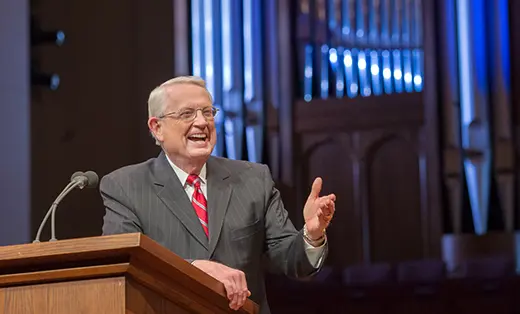
Listen as Pastor Chuck Swindoll highlights the majestic King and righteous Judge of Revelation 14:14–20.
Embrace God’s mercy and share the good news of salvation with others!
Message Summary:
In this sobering message centered on Revelation 14:14–20, Chuck Swindoll explores the terrifying reality of the final judgment, contrasting the gentle image of Jesus in the manger with the returning King who wields a "sharp sickle." Swindoll opens with a personal memory of December 7, 1941, listening to FDR announce the attack on Pearl Harbor, to set a tone of gravity and urgency regarding inevitable conflict. He transitions to the story of Julia Ward Howe, whose famous anthem, "The Battle Hymn of the Republic," was directly inspired by the "Grapes of Wrath" imagery found in this apocalyptic text [7–9]. Swindoll urges the listener to mentally create two columns to understand the full nature of Christ: one column for His first coming as a servant and sacrifice, and a second for His return as a Judge and Sovereign King. The text vividly describes two harvests: the Grain Harvest, representing the sudden reaping of the earth at the end of the age, and the Grape Harvest, depicting the violent trampling of the wicked in the "wine press of the wrath of God". The message concludes with a focus on the Battle of Armageddon, described not as a contest but as a slaughter where judgment is final and absolute. Swindoll draws two critical applications: first, that God’s justice holds everyone accountable, and second, that while God’s grace allows freedom to reject Him, it does not grant freedom from the consequences of that rejection. He ends with an urgent plea for the soul to be "swift to answer Him" before the harvest begins [27–30, 32].
Message Key Facts:
- Pearl Harbor Memory: Swindoll recalls sitting in his father’s 1941 Ford at age seven, watching his parents weep as President Roosevelt announced the "day of infamy." He uses this to illustrate how sudden, life-altering events can interrupt our lives.
- The Origin of the "Battle Hymn": Swindoll tells the story of Julia Ward Howe, who visited a Union camp during the Civil War. Inspired by soldiers singing "John Brown’s Body" and the imagery of Revelation 14, she wrote "The Battle Hymn of the Republic" to describe God "trampling out the vintage where the grapes of wrath are stored" [7–9].
- Two Comings of Christ: Swindoll contrasts the two advents:
- First Coming: Humility, baby in a manger, sower of seed, grace, and mercy.
- Second Coming: Majesty, King of Kings, reaper of harvest, justice, and wrath.
- The Sharp Sickle: The word "sickle" appears seven times in these seven verses. It represents the tool of divine judgment used to harvest the earth.
- Meaning of "Ripe": In the grain harvest (v. 15), the Greek word for "ripe" actually means "over-ripe" or withered. Swindoll explains this signifies that God has waited as long as possible; the earth is dry and ready for judgment.
- The Wine Press of Wrath: In the second harvest, grapes are thrown into a wine press. Swindoll explains the ancient method of trampling grapes in a trough, using this to illustrate the gruesome reality of the final slaughter where blood flows [23–24].
- 200 Miles of Blood: The text describes blood rising to the "horses' bridles" for 1,600 furlongs (approx. 200 miles). Swindoll interprets this as the outcome of the slaughter at Armageddon (Megiddo), noting it likely represents the splattering of blood during a massive, widespread conflict throughout the sheer length of the battleground.
- The Angel of Fire: Swindoll highlights the specific angel in verse 18 who has "power over fire," noting the intrigue of an angelic hierarchy that manages the elements of judgment.
Message References:
- Revelation 14:14–20: The primary text describing the Son of Man on the cloud, the angels with sickles, and the two harvests of the earth.
- Hebrews 10:31: "It is a terrifying thing to fall into the hands of the Living God".
- Revelation 16:16: Referenced to identify the location of the final conflict as Har-Magedon (Armageddon).
- Revelation 19:11–16: The description of Jesus returning on a white horse, clothed in a robe dipped in blood, to tread "The Wine Press of the fierce wrath of God" [25–26].
- Revelation 16:17: The finality of judgment when the voice from the temple declares, "It is done".