Overview:
Few people like to waste time, and even fewer want to waste their lives. The apostle Paul rallies believers to live up to their life calling while they have breath in their lungs.
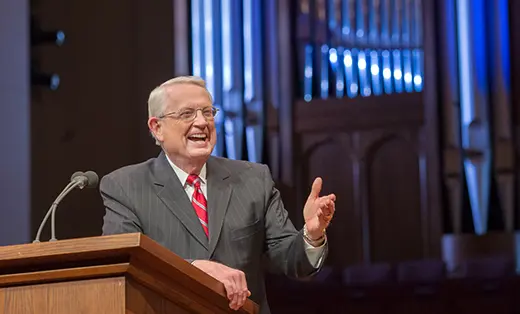
As he closes out his letter to Titus, Paul encourages Christians to devote themselves to doing good, so they won’t “live unproductive lives.” Expounding on Paul’s words in Titus 3, Pastor Chuck Swindoll exhorts Christ-followers to embrace the privilege of serving the Lord.
Grasp how God usually uses our relationships to enable us to carry out His work!
Message Summary:
In this concluding message of the series on the book of Titus, Chuck Swindoll explores Titus 3:12–15, a passage filled with personal greetings and obscure names that reveals the deep relational heart of the Apostle Paul. Swindoll argues that while many view Paul as merely a towering intellect or a disciplined theologian, the end of his letters unveils a man who was deeply connected to friends and dependent on others. The sermon establishes two essential truths: God’s sacred work occurs through people, and His sacred plan unfolds often in spite of people’s plans [4–6].
Swindoll breaks down Paul’s final instructions into three relational priorities. First, the priority of being together. Paul urges Titus to meet him in Nicopolis, sending Artemas or Tychicus to relieve him. Swindoll uses this to discuss the "sovereign flight plan" of God; while Paul planned a winter in Nicopolis, history suggests he likely spent that winter in a Roman dungeon, illustrating that God’s itinerary often overrides human schedules [9, 11–13].
Second, Swindoll highlights the priority of helping others, specifically Zenas the lawyer and Apollos. He emphasizes that the command to "diligently help" implies going the second mile so that "nothing is lacking" for God's servants. Finally, the message focuses on the priority of doing good. Swindoll notes that doing good is a "learned trait"—unlike disobedience, which comes naturally—and is vital for the survival of the community. He concludes with a powerful story of a boy named Bill who intended to commit suicide but was saved by a simple act of kindness, reinforcing that small deeds of love can have life-altering impacts [23, 31–32].
Message Key Facts:
• God’s Sovereign "Flight Plan": Swindoll compares life to a flight plan. Just as passengers don't dictate the route of a plane, believers do not control God’s sovereign direction. He cites Psalm 115:3 ("He has done whatever He has pleased") to remind listeners that God often changes our personal itineraries [6–7].
• Paul’s Failed Winter Vacation: In Titus 3:12, Paul plans to winter in Nicopolis, a beautiful sea-coast town. However, by comparing this to 2 Timothy 4, Swindoll points out that Paul likely ended up in a cold, damp Roman dungeon instead. This illustrates that even an Apostle's plans are subject to God's mysterious redirection [11–13].
• Artemas and Tychicus: These men are described as "meteors" that flash across the page of Scripture and disappear. Though obscure to us, they were vital to God’s work, capable of replacing Titus on Crete [9–10].
• Zenas the Lawyer: Swindoll notes that Zenas is the only lawyer mentioned in Paul's letters. Whether a converted scribe or a Roman jurist, he was significant enough to be entrusted with carrying this epistle [15–16].
• Apollos the Orator: Referencing Acts 18, Swindoll profiles Apollos as a brilliant, eloquent speaker who was humble enough to be mentored by laypeople (Priscilla and Aquila) to understand the full gospel [17–19].
• Grandfather "Judge" Lundy: Swindoll shares a personal tribute to his grandfather, L.L. Lundy, a Justice of the Peace. He recounts crashing a 1939 pickup truck into a garage and his grandfather’s gracious response: "I can buy new fenders, but I can’t buy new grandsons" [16–17].
• The "Fedders" Air Conditioner: Illustrating the concept of meeting "pressing needs," Swindoll recounts a story from his seminary days. A friend named Richard Parks gifted him a window air conditioner unit unprompted, an act of generosity that relieved the burden of a sweltering Dallas summer [26–27].
• Biblical "Y'all": Swindoll humorously connects the final benediction, "Grace be with you all," to the Southern colloquialism "all y'all," emphasizing that God’s grace is inclusive of the entire community.
• The Suicide Prevention Story: The sermon closes with the story of "Mark and Bill." Mark helped Bill carry dropped books, unaware that Bill had cleaned out his locker to commit suicide that afternoon. That small interaction saved Bill's life, illustrating the unseen power of "engaging in good deeds" [31–32].
Message References:
• Titus 3:12: "When I send Artemas or Tychicus to you, make every effort to come to me at Nicopolis...".
• Titus 3:13: "Diligently help Zenas the lawyer and Apollos on their way so that nothing is lacking for them".
• Titus 3:14: "Our people must also learn to engage in Good Deeds to meet pressing needs so that they will not be unfruitful".
• Titus 3:15: "Grace be with you all".
• Psalm 115:3: "Our God is in the heavens; He has done whatever He has pleased".
• Daniel 4:35: "All the inhabitants of the earth are accounted as nothing, but He does according to His will..." [6–7].
• 2 Timothy 4:9–21: Paul’s request for Timothy to come before winter while imprisoned in Rome [12–13].
• Acts 18:24–28: The background of Apollos and his ministry in Corinth [17–19].
• Hebrews 6:10: "God is not unjust so as to forget your work and the love which you have shown toward His name..."