Series Details
Times were hard—very hard. A corrupt government and a covetous judiciary made life miserable for all living in a nation that was once strong and stable. Idolatry was rampant, leaving the land with no spiritual vitality. What is worse, the prophets, who would normally guide the people toward righteousness, were weak and shamelessly compromising.
Most of these horrid conditions could be traced back to the failure of King Uzziah, who had once been a strong and competent leader. His extraordinary fame and success resulted in pride and arrogance. In the backwash of all this, a young, very-concerned prophet named Isaiah turned to the Lord to gain understanding. What happened to that young prophet leaves us with four truths we must never forget.
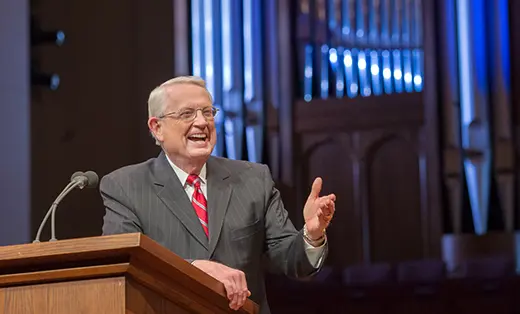
In this powerful study of Isaiah chapter 6, Pastor Chuck Swindoll explores a pivotal moment in the life of the prophet Isaiah. Set against a backdrop of national corruption, political instability, and spiritual apathy, Isaiah’s vision of the Lord provides four foundational truths that act as an anchor for every believer. This message serves as a reminder that when earthly leaders fail and culture crumbles, God remains sovereign, holy, and in absolute control.
1. God and God Alone (Isaiah 6:1–9a)
- Overview: Isaiah’s vision occurs in the year King Uzziah died—a time of great national mourning and uncertainty. In the midst of this vacuum of earthly leadership, Isaiah sees the true King seated on His throne.
- Key Fact: The death of an earthly leader often provides the “clear air” necessary for us to see the Lord in His rightful place of authority.
- Scripture: Isaiah 6:1 – “In the year of King Uzziah’s death I saw the Lord sitting on a throne, lofty and exalted, with the train of His robe filling the temple.”
2. The Holiness of the Lord (Isaiah 6:2–4)
- Overview: Describes the seraphim and their cry of “Holy, Holy, Holy.” This repetition in Hebrew denotes the superlative degree, emphasizing God’s total set-apartness from sin and His absolute perfection.
- Key Fact: God’s holiness is His defining attribute; it is the “atmosphere” of heaven and the standard to which His people are called.
- Scripture: Isaiah 6:3 – “And one called out to another and said, ‘Holy, Holy, Holy, is the Lord of hosts, the whole earth is full of His glory.'”
3. The Conviction of Sin (Isaiah 6:5)
- Overview: When confronted with God’s holiness, Isaiah does not feel empowered or “good about himself”; he feels “undone” and deeply convicted of his own impurity.
- Key Fact: True worship begins with a realistic assessment of our own unworthiness in the presence of a holy God.
- Scripture: Isaiah 6:5 – “Woe is me, for I am ruined! Because I am a man of unclean lips… for my eyes have seen the King, the Lord of hosts.”
4. The Provision of Grace and Call to Service (Isaiah 6:6–9a)
- Overview: God provides the solution to Isaiah’s guilt through the coal from the altar, leading to Isaiah’s immediate and voluntary response to God’s call.
- Key Fact: God does not just convict; He cleanses. And once cleansed, the believer is ready to say, “Here am I. Send me!”
- Scripture: Isaiah 6:8 – “Then I heard the voice of the Lord, saying, ‘Whom shall I send, and who will go for Us?’ Then I said, ‘Here am I. Send me!'”