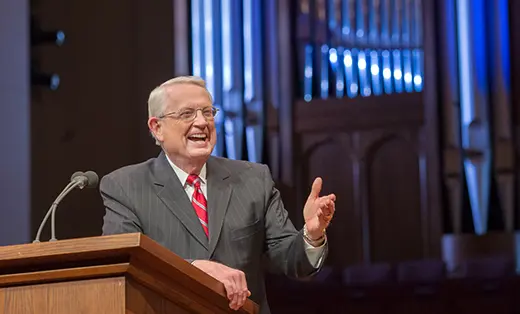
Series Details
Messages that inspire you to keep going are the ones that settle into your soul and resonate. Five of Chuck Swindoll’s most impactful messages in 2019 surely fit the bill. These five popular Insight for Living titles from this year will:
- Spark an attitude of fortitude during tough times
- Convince you that God’s grace provides a brand-new start after failure
- Renew your commitment to fulfill Christ’s Great Commission
. . . and more! If you missed these teachings the first time around, give your walk with God a boost by taking them in now.
The messages that truly resonate are those that settle into the soul and inspire a believer to keep moving forward. The Best of 2019 is a compilation of five of Chuck Swindoll’s most popular and impactful teachings from the broadcast year. This series is designed to give your walk with God a boost by addressing the “messy” realities of life with biblical clarity. From finding the courage to persevere during trials to embracing the beauty of a second chance after failure, these messages represent the heart of Insight for Living’s mission: to communicate God’s truth in a practical, life-changing way.
Here are the sermon overviews, key facts, and scripture references for the two requested messages. They are formatted to match your previous style and optimize your pages for AI Overview results.
Message 1: The Charming Joy of Grace Giving
Sermon Overview Focuses on how a true understanding of God’s grace transforms our giving from a reluctant obligation into a hilarious, joyful celebration. Charles R. Swindoll begins by sharing the dramatic testimony of John Newton, a former slave-ship worker who penned “Amazing Grace” after experiencing God’s profound deliverance. Just as grace stoops to save us and replaces the harsh demands of the law with mercy, it should also actively guide our finances. Drawing from 2 Corinthians 8 and 9, Swindoll explains that God does not want believers giving out of guilt, pressure, or manipulative gimmicks. Instead, biblical grace giving is thoughtful, generous, and cheerful. When we sow bountifully, God promises to supply our needs and multiply our harvest of generosity, ultimately resulting in joyful thanksgiving to Him from those whose needs are met.
Key Facts
- Grace Over Law: Grace stoops to lift us up, replaces the harsh demands of the law with mercy, and guides how we respond to God and to others.
- Attitude Over Obligation: Biblical giving is never forced by pressure, embarrassment, or guilt; it must be a purposeful, cheerful (hilarious) decision made in the heart.
- The Law of the Harvest: A farmer who plants generously reaps a generous crop, and God promises to liberally provide for those who trust Him and freely share their resources.
- The Ultimate Gift: The foundation of all Christian generosity is God’s indescribable gift of His Son, Jesus Christ, who became poor so that we could become spiritually rich.
Scripture References
- 2 Corinthians 8:7–9
- 2 Corinthians 9:6–15
Message 2: The Secret: An Attitude of Fortitude
Sermon Overview Aging is an inevitable physical reality, but losing enthusiasm for life is a tragic and optional attitude. In this message, Swindoll looks at Joshua 14 and the exhilarating life of Caleb, a man who stood alone in his youth and remained fully devoted to God into his mid-eighties. At age 40, Caleb and Joshua were the only spies who believed God could conquer the giants (Anakim) in Canaan, while the other ten spies caused a national panic. Forty-five years later, at age 85, Caleb’s faith had not retired. He stepped forward and boldly asked Joshua for the giant-infested hill country. This message challenges believers to defeat the aging enemies of uselessness, self-pity, fear, and guilt by forgetting their age, focusing on their goals, and following the Lord fully.
Key Facts
- Enemies of Aging: As people age, they often battle debilitating attitudinal enemies such as a sense of uselessness, self-pity, fear, and lingering guilt.
- Grasshoppers vs. Giants: While the ten faithless spies focused on the facts—the size of the giants and fortified cities—and felt like grasshoppers, Caleb focused on the size of his God and knew victory was certain.
- Refusing to Retire from Life: Caleb didn’t use his 85 years as an excuse to embrace a bland, selfish retirement; his attitude of fortitude kept him just as ready for the give-and-take of war as he was four decades earlier.
- Three Lifelong Directives: To finish life well, believers must intentionally forget their age (which limits their vision), focus on their goals (claiming their specific “hill country”), and follow the Lord fully.
Scripture References
- Joshua 14:6–14
- Numbers 13:17–33
- 2 Timothy 1:7
Message 3: Our Commitment to Christ’s Commission
Sermon Overview When Jesus delivered the Great Commission, He did not entrust the future of the gospel to a group of elite, highly educated superstars or professional clergy. Instead, He gave this profound mandate to an ordinary, ragged group of eleven disciples—some of whom were actually standing there doubting Him at that very moment. Charles R. Swindoll reminds believers that evangelism is the responsibility of every child of God, not just vocational ministers. Looking at Matthew 28, Swindoll highlights that while Jesus is incredibly intense about the mission (making disciples of all nations), He is completely relaxed about the method. Whether through podcasting, one-on-one conversations, or neighborhood gatherings, the objective remains the same: one person telling another how to find the Bread of Life.
Key Facts
- A Simple Objective: The primary verb and objective of the Great Commission is not just to “go,” but to “make disciples”—duplicating your faith by leading others to Christ and helping them grow.
- Authority in Christ, Not Us: Believers do not need to be intimidating or authoritative; all authority in heaven and on earth belongs to Jesus, and we are simply the clay vessels delivering His authoritative message.
- Limitless Scope: The commission is fueled by four “alls”: all authority, all nations, teaching them all things commanded, and the promise that Christ is with us always.
- Flexible Methods: Jesus never prescribed a rigid format for evangelism; methods will constantly change across generations, but the core message of the gospel must remain intact.
Scripture References
- Matthew 28:16–20
Message 4: God of the Second Chance
Sermon Overview There is no failure so great that it eclipses the grace of God. In this deeply encouraging message, Swindoll explores the limitless mercy of God, defining mercy as “God’s ministry to the miserable”. Using Jonah 3 as the primary text, the sermon highlights the beauty of God coming to the rebellious, flawed prophet a second time with the exact same message and mission. To prove that second chances are a divine specialty, Swindoll traces the lives of several biblical giants who failed miserably: Moses (a murderer), Samson (a womanizer), David (an adulterer), and John Mark (a deserter). This message is a powerful invitation to stop running, stop wallowing in shame, and fully embrace the God who offers infinite grace to the broken.
Key Facts
- Mercy for the Miserable: God’s compassions never fail and are new every morning; He intimately understands that we are made of dust and regularly offers mercy to cover our self-inflicted misery.
- Second Chances are not Probation: When God gave Jonah a second chance, He didn’t put him on a probationary period or shame him; He simply reissued the call to go to Nineveh.
- Deliver the Message: A messenger’s only job is to clearly deliver God’s Word; we are not responsible for the audience’s reaction, nor should we try to manipulate the results.
- No Age Limit on Grace: Moses received his second chance and began his ultimate life’s calling as a deliverer at the age of 80, proving God’s timeline for our usefulness rarely matches our own.
Scripture References
- Jonah 3:1–4
- Lamentations 3:22–23
- Exodus 2:11–15; 3:1–10
- Judges 14–16
- 2 Samuel 11–12
Message 5: Hanging Tough Together and Loving It
Sermon Overview The Christian life is not a dreamy, passive existence where success comes quickly; it requires hard work, endurance, and hanging tough against all odds. Swindoll uses the Apostle Paul’s powerful declaration in Philippians 3 to outline a biblical strategy for perseverance. Before Christ, Paul was a highly successful, arrogant Pharisee. After being crushed and transformed on the Damascus road, his new lifelong quest became intimately knowing Christ. Swindoll extracts five principles for “hanging tough”: realizing that the plan is progress, not perfection; leaving past failures and achievements behind; reaching forward to the future; maintaining a determined attitude; and keeping a high standard together with fellow believers.
Key Facts
- Progress, Not Perfection: Perfectionism is a trap. Paul openly admitted he had not yet attained perfection, proving that the Christian journey is about steady, maturing progress.
- Forget the Past: Believers must stop looking over their shoulders; living in the glory of past achievements stunts current growth, and wallowing in past failures steals future courage.
- A Determined Attitude: Like a little bulldog that keeps coming back to the fight every day regardless of the beating, believers must embrace trials with a determined, resilient attitude rather than cooperating with defeat.
- Locking Arms: We are not meant to hang tough alone; enduring the jagged edges of life requires locking arms with brothers and sisters in Christ who keep each other accountable to a high standard.
Scripture References
- Philippians 3:12–16
- James 1:2–4
- Galatians 6:9
- 1 Corinthians 15:58