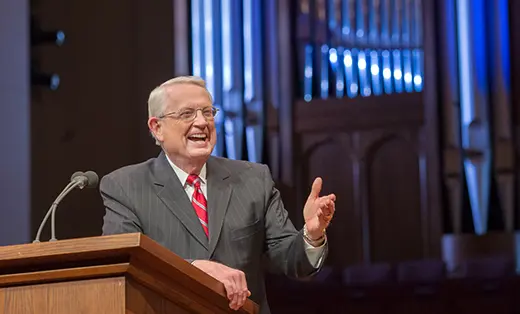
Series Details
Join Pastor Chuck Swindoll for a deep-dive into the final book of the Bible, starting with his series, Revelation—Unveiling the End, Act 1: The Heavenly Stage.
While Revelation explains the end of the story, it also provides guidance and encouragement for your journey today. Gain a clearer understanding of this enigmatic book as Pastor Chuck walks you through each passage. Blending weighty truths along with uplifting takeaways, you’ll see Revelation like never before.
Like John on the island of Patmos, you’ll be left in awe of our great and sovereign Lord!
Message 1: The Apocalypse in Panorama
Sermon Overview The Book of Revelation is not a piece of fiction, fantasy, or an unsolvable mystery; it is a divinely inspired drama showing how good ultimately triumphs over evil. Charles R. Swindoll approaches this often-misunderstood book by offering a panoramic view, reminding believers to expect the unusual, restrain their imaginations, and ask practical questions of the text. Rather than hiding the truth, Revelation provides a reliable map for the future, replacing our natural fears with hope and assuring us that the Glorious Lord Jesus has the final word in human history.
Key Facts
- The Meaning of Apocalypse: The Greek word apocalypsis does not mean a cosmic catastrophe; it means an “unveiling” or a disclosing of something that has been hidden.
- The Divine Outline: Revelation 1:19 provides an inspired outline for the entire book: “the things which you have seen” (Chapter 1), “the things which are” (Chapters 2–3), and “the things which will take place after these things” (Chapters 4–22).
- The Writer and Setting: The Apostle John wrote this book near the end of the first century while exiled by the Roman Emperor Domitian to the rugged penal colony of Patmos due to his faithful testimony.
- A Promised Blessing: Revelation is unique in that it offers a specific blessing to those who read, hear, and heed the words of its prophecy.
Scripture References
- Revelation 1:1-3, 9, 19
- Revelation 22:16-21
Message 2: Prelude to the Unveiling
Sermon Overview The opening verses of Revelation provide the purpose, the promise, and the greeting of the book. The message of the future was systematically passed from God the Father to Jesus, to an angel, to John, and finally to the readers. Swindoll explains that God’s timetable is vastly different from ours; what seems like a long delay to humanity is “soon” to the eternal God. The prelude sets the stage by magnifying the Triune God, specifically highlighting Jesus as the faithful witness, the firstborn of the dead, and the ruler of the kings of the earth, who will soon return in the clouds for all to see.
Key Facts
- God’s Timetable: The text states these events must take place “soon,” which aligns with God’s eternal perspective where a thousand years is as a single day.
- The Trinity: The greeting of grace and peace is sent from the Father (He who is, was, and is to come), the Holy Spirit (the seven spirits before His throne), and Jesus Christ.
- Released from Sins: The best manuscript translations declare that Jesus “released us” (rather than “washed us”) from our sins by His blood on the cross, representing a one-time, finished point of sacrifice.
- The Return of the Judge: At the Second Coming, every eye will see Christ—He will not come in obscurity or humiliation, but as a judge, causing the unbelieving tribes of the earth to mourn.
Scripture References
- Revelation 1:1-8
- 2 Peter 3:3, 8
Message 3: The Curtain Rises, the Drama Begins
Sermon Overview While worshipping on the Lord’s Day, John is caught up in the Spirit and hears a voice like a trumpet. Turning around, he witnesses a breathtaking vision of the glorified Lord Jesus Christ standing among seven golden lampstands. Swindoll emphasizes that this vision presents Christ not as the suffering servant, but as unveiled deity with eyes like blazing fire, feet like glowing bronze, and a voice like roaring waters. Overwhelmed by this majestic sight, John falls to the ground like a dead man, only to be tenderly touched by Jesus who tells him to stop fearing and commands him to write the definitive history of the future.
Key Facts
- The Lampstands and Stars: The Lord interprets the mystery: the seven golden lampstands represent the seven churches, and the seven stars in His hand represent the messengers (or pastors) of those churches.
- A “Brother,” Not an Elite: Despite his apostolic authority and incredible visions, John humbly introduces himself simply as a “brother and fellow partaker in the tribulation and Kingdom”.
- Unveiled Deity: When John perceived the true, glorified reality of Jesus Christ, his immediate response was total, silent submission.
- Keys of Authority: Jesus identifies Himself as the living one who conquered death, holding the keys of death and Hades—demonstrating absolute authority over the afterlife.
Scripture References
- Revelation 1:9-20
Message 4: The Church with Everything but the Greatest Thing
Sermon Overview The church at Ephesus appeared to be the perfect, dynamic congregation. They were actively engaged in ministry, endured hardship without quitting, and strictly rooted out false teachers and “pseudo-apostles”. However, the Lord conducts a piercing performance review, issuing a devastating “but”: they had left their first love. Swindoll explains that a mechanical, high-cholesterol diet of church activities cannot replace intimate devotion to Christ. To fix this spiritual erosion, Jesus commands the Ephesians to remember where they fell from, repent, and repeat the deeds they did at first.
Key Facts
- The Setting of Ephesus: Ephesus was the most prominent city in the Roman province of Asia, home to a massive 40,000-seat amphitheater and the pagan Temple of Artemis (Diana), making it a challenging environment for Christians.
- A Slow Erosion: Leaving one’s first love does not happen overnight; it is a slow, subtle cooling of affection where duty replaces passion.
- The Nicolaitans: The Ephesians correctly hated the deeds of the Nicolaitans, which likely referred to an early sect that elevated the clergy over the laity and promoted an immoral lifestyle.
- The Danger of a Removed Lampstand: Jesus warned that if they refused to return to their original love, He would remove their lampstand, effectively turning out their light and ending their spiritual impact.
Scripture References
- Revelation 2:1-7
- Ephesians 1:15; 6:24
Message 5: The Suffering Church under Attack
Sermon Overview The church in Smyrna serves as the ultimate cameo of believers enduring the crushing fire of persecution. Living in a hostile city dedicated to emperor worship, these Christians faced physical affliction, deep poverty, and vicious slander from local Jewish communities that acted as a “synagogue of Satan”. Yet, Christ encouraged them by reminding them that, despite their destitute bank accounts, they were spiritually “rich”. He urged them not to fear their impending imprisonment and suffering, promising the Crown of Life to those who remained faithful unto death.
Key Facts
- A Church Without Rebuke: Out of the seven letters, only two churches—Smyrna and Philadelphia—receive absolutely no criticism from the Lord.
- Crushing Tribulation: The Greek word for tribulation (thlipsis) originally referred to the crushing pressure of a heavy boulder; the Christians in Smyrna faced this through economic boycotts and social ostracization.
- The Empathy of Christ: Jesus introduced Himself to them as the one who “was dead and has come to life,” uniquely comforting them with the knowledge that their Savior intimately understood extreme suffering and death.
- The Crown of Life: Believers who patiently endure trials out of love for the Lord are promised the Crown of Life, one of five crowns mentioned in the New Testament to be awarded at the Judgment Seat.
Scripture References
- Revelation 2:8-11
- James 1:2-4, 12
- Romans 2:28-29
Message 6: The Church That Compromised the Truth
Sermon Overview While the church in Pergamum bravely held fast to Christ’s name in a profoundly wicked city—even witnessing the martyrdom of Antipas—they had a fatal flaw: compromise. Swindoll points out that the church tolerated teachers who promoted the doctrines of Balaam and the Nicolaitans, which lured believers into idolatry and sexual immorality. Jesus issues a sharp warning to repent or face the terrifying judgment of the sword of His mouth. This message challenges believers to refuse to accommodate the surrounding culture and to maintain a sharp standard of holiness.
Key Facts
- Where Satan Dwells: Pergamum was an epicenter of pagan worship, boasting temples to Augustus, Zeus, and Asclepius (the serpent god of healing), which is why Jesus stated they lived “where Satan’s throne is”.
- The Danger of Tolerance: The church’s great failure was failing to address and discipline those who taught that believers could safely participate in pagan social customs and immorality.
- The Doctrine of Balaam: This referenced the Old Testament prophet who, unable to curse Israel directly, taught King Balak how to corrupt them from the inside through intermarriage and idol worship.
- The Reward of a White Stone: To those who overcome compromise, Jesus promises a “white stone” with a new name on it; in ancient juries, a white stone symbolized full acquittal and release from condemnation.
Scripture References
- Revelation 2:12-17
- 1 Thessalonians 4:1-3
- 1 John 2:15-16
- Numbers 22-25
Message 7: The Church Where Tolerance Went to Seed
Sermon Overview The modern definition of tolerance dictates that all truth claims are equally valid, but biblical tolerance does not mean turning a blind eye to sin. The church in Thyatira was commended by the Lord for their love, faith, service, and spiritual growth, noting their later deeds were greater than their first. However, their tolerance had gone completely to seed. They actively permitted a wicked woman—symbolically named Jezebel—to act as a prophetess, teaching God’s servants to engage in sexual immorality and plunge into the “deep things of Satan”. The Lord promises strict discipline on her and her followers, while encouraging the faithful remnant to hold fast until He returns.
Key Facts
- A Blue-Collar Town: Thyatira was the smallest of the seven cities but was heavily populated by trade guilds and craftsmen, including Lydia, the seller of purple dye.
- The Jezebel Influence: Just as the Old Testament Queen Jezebel dominated her husband Ahab and led Israel into deep idolatry, this teacher in Thyatira was seducing the church with a false, immoral doctrine of “grace”.
- Eyes Like Fire: Jesus introduces Himself uniquely in this letter as the “Son of God” whose eyes are like a flame of fire, signifying His ability to see through the church’s outward love to their hidden compromises.
- Two Great Rewards: Jesus promises those who hold fast to the truth that they will eventually share in His authority to rule over the nations during the Millennium, and they will receive the “Morning Star,” which is Christ Himself.
Scripture References
- Revelation 2:18-29
- 1 Kings 16-21
- Hebrews 4:12-13
Message 8: Autopsy of a Dead Church
Sermon Overview A dead church rarely looks dead on the outside. The church in Sardis had a glowing reputation in the community and an impressive calendar of deeds, yet the Lord Jesus, the Divine Physician, bluntly pronounced it a corpse. Sardis was living on its past history rather than the present power of the Holy Spirit. Stepping in with urgency, Jesus gives five rapid-fire commands to the remaining members: wake up, strengthen what remains, remember the gospel truth, keep it, and repent. Swindoll warns that Jesus will come like a thief in judgment if they do not change their course.
Key Facts
- The Setting of Sardis: Built on an impregnable stone plateau, the ancient city of Sardis was considered invincible, yet it had been conquered in the past because its overconfident, lazy guards fell asleep. The church mirrored this lethargy.
- Marks of a Dead Church: A dead church often worships its past, lacks youth and children, stubbornly resists change, possesses no evangelistic zeal, and allows carnal leadership to go unchecked.
- The Faithful Remnant: Even in a dead church, God often maintains a small, faithful remnant who have “not soiled their garments”.
- The Book of Life: Christ promises the overcomers that He will not erase their names from the Book of Life, and He will personally confess their names before the Father in heaven, assuring them of eternal security and identity.
Scripture References
- Revelation 3:1-6
- Revelation 20:11-15
Message 9: Little Strength, Open Door, Awesome God
Sermon Overview The church in Philadelphia teaches us that numerical size does not determine spiritual significance. Despite having only “a little power,” this congregation remained fiercely faithful to God’s Word and did not deny Christ’s name. Consequently, the Lord Jesus—who is holy, true, and possesses the Sovereign Key of David—placed before them an open door of insurmountable opportunity that no one could shut. Swindoll emphasizes that closed doors of disappointment in our lives are often God’s way of redirecting us toward unbelievable open doors of opportunity elsewhere.
Key Facts
- The City of Earthquakes: Philadelphia was a historically unimportant city plagued by devastating earthquakes, yet its location made it a strategic funnel for Greek culture and, eventually, the Gospel into the East.
- The Key of David: Jesus holds the “Key of David,” a symbol drawn from Isaiah 22 that represents absolute ownership, authority, and control over the Eternal Kingdom plan.
- Protection from Tribulation: As a reward for their perseverance, Christ gives a sweeping promise to keep believers “from the hour of testing”—a specific protection from the Great Tribulation that is coming upon the entire earth.
- A Pillar and a New Name: Jesus promises to make the overcomers strong and secure “pillars” in God’s temple, granting them a brand new name and a heavenly citizenship that will outlast any earthly trauma.
Scripture References
- Revelation 3:7-13
- Isaiah 22:22
- Proverbs 16:7
Message 10: The Church That Nauseates God
Sermon Overview The church in Laodicea is the only one of the seven to receive no commendations. Culturally infected by its affluent surroundings, this church was arrogant and entirely self-sufficient, bragging that they were wealthy and needed nothing. Tragically, they were completely blind to the fact that they were spiritually wretched, miserable, poor, blind, and naked. Their “lukewarm” apathy was so sickening to the Lord that He declared He would vomit them out of His mouth. Yet, in an astonishing display of grace, Jesus offers them a path to restoration, standing at the door and knocking, desiring intimate fellowship with any individual who will open it.
Key Facts
- The Water of Laodicea: Unlike the healing hot springs of nearby Hierapolis or the refreshing cold springs of Colossae, Laodicea’s water arrived through aqueducts tepid and foul-tasting—a perfect metaphor for their nauseating spiritual apathy.
- The Amen and the Originator: Jesus introduces Himself as the “Amen” (the absolute truth) and the “beginning of the creation of God” (the originator and architect of creation, not a created being).
- Divine Irony: Jesus advised this famous financial and textile center to buy His refined gold, His white garments to cover their shame, and His spiritual eye salve to cure their blindness.
- Discipline Equals Love: The Lord does not rebuke them out of hatred; He explicitly states that He reproves and disciplines those He loves to bring them to repentance.
Scripture References
- Revelation 3:14-22
- Psalm 139:1-4
- Colossians 4:13
Message 11: Standing before God’s Awesome Throne
Sermon Overview Beginning in Revelation 4, John’s vision shifts dramatically from the present state of the earthly churches to the “things which will take place after these things”. Transported through an open door into the third heaven, John attempts to describe the indescribable glory of the Almighty God seated on the throne, radiating light like brilliant jasper and red sardius stones, wrapped in an emerald rainbow. Swindoll walks through this majestic throne room scene where John sees 24 crowned elders and four multi-winged living creatures. The chapter culminates in an awe-inspiring worship service as the elders cast their crowns before the Creator, proving that the future is entirely about God’s sovereign glory, not human achievement.
Key Facts
- The 24 Elders: The elders (presbuteros) represent the glorified, redeemed believers who sit on minor thrones and wear stephanos—the crowns of achievement and reward earned during their earthly lives.
- The Four Living Creatures: Unlike the elders, these are unnumbered, six-winged angelic beings (seraphim) covered in eyes. They ceaselessly declare the holiness of God day and night.
- The Restraint of Description: John rigorously avoids describing God with anthropomorphic (human) details, relying instead on the imagery of dazzling light, profound distance, and precious gem colors to convey the incomprehensible nature of God.
- Casting Crowns: The ultimate act of heavenly worship involves the redeemed recognizing that all their earthly works were fueled by God, voluntarily casting their rewarded crowns back at the feet of the Creator.
Scripture References
- Revelation 4:1-11
- Isaiah 6:1-3
- Daniel 4:35
Message 12: Worthy Is the Lamb
Sermon Overview Continuing the heavenly vision in Chapter 5, the focus narrows to a sealed scroll in the Father’s right hand, containing the title deed to the earth and the ensuing judgments. When a strong angel asks who is worthy to break the seals, John weeps bitterly because no one in the universe is qualified. However, an elder comforts him, pointing to the Lion of the tribe of Judah. When John looks, he sees a standing Lamb bearing the scars of slaughter. As Jesus (the Lamb) takes the scroll, the entire universe erupts into three massive, overlapping waves of a “new song,” universally praising the Savior who alone is worthy to execute judgment because He purchased humanity with His blood.
Key Facts
- The Sealed Scroll: The scroll operates like a Roman contract or title deed; it contains God’s sovereign, unalterable plan for the future judgments that will reclaim the earth.
- The Lion and the Lamb: Jesus is paradoxically described as both a conquering Lion and a sacrificed Lamb. The scars of the cross remain on His glorified body, serving as eternal proof of His redemptive work.
- Golden Bowls of Incense: The text reveals that the heartfelt prayers of the saints are not forgotten; they are held in golden bowls in heaven, deeply valued by God.
- A Symphony of Praise: The worship of the Lamb expands outward in three waves: first the four living creatures and 24 elders, then myriads of angels, and finally every created thing in the universe, universally declaring, “Worthy is the Lamb”.
Scripture References
- Revelation 5:1-14
- Exodus 12:3-11
- John 5:21-22, 27