Series Details
Jesus was the Son of God and the Man of God. He walked the earth as any other person, but, through every word and action, He expressed the nature of God. The scenes recorded in John 6–14 portray a beautiful balance of Jesus’ humanity and divinity. He heals the lame man, feeds the hungry masses, stills the stormy sea, gives sight to the blind, and raises Lazarus from the dead. Such divine power, such human compassion!
John invites us to walk by Jesus’ side as He models love, grace, and humility. Place yourself in each scene. Grasp every detail. It’s impossible to closely follow Jesus and remain unchanged.
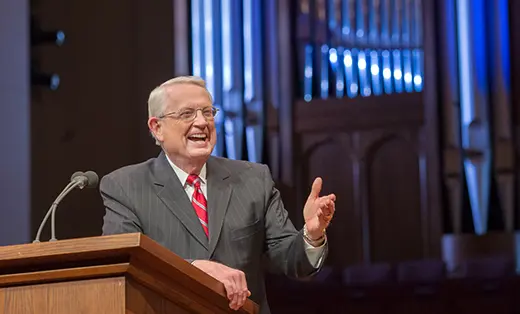
Jesus was the Son of God, yet He was also truly the Man of God. He walked the earth as any other person, but through every word and action, He perfectly expressed the nature of the Father. In this 14-part series covering John chapters 6 through 14, Chuck Swindoll explores the scenes where Jesus’ divine power and human compassion meet. From feeding the hungry masses and stilling the sea to washing the feet of His disciples, we see a Savior who models love, grace, and humility in their highest forms. This study is an invitation to walk by Jesus’ side and be forever changed by His example.
Message 1: God’s Specialty: Impossibilities
Sermon Summary We often limit God by our own finite understanding of what is possible. In the opening of John 6, we encounter a situation that was humanly impossible: feeding a massive crowd with a few loaves and fish. This message explores how God specializes in the impossible, using our meager resources to perform miraculous works. It challenges us to stop looking at our limitations and start looking at the limitless power of the Man of God.
Key Facts & Themes
- The Feeding of the Five Thousand: Observing how Jesus uses a small gift to satisfy a large need.
- Testing Faith: Understanding how God uses “impossible” situations to reveal His character.
Primary Scripture Reference
- John 6:1–15
Message 2: Bread Delivered from Heaven
Sermon Summary Following the miracle of the loaves, the crowds sought Jesus for more physical food. Jesus redirected their focus to a deeper, spiritual need, declaring Himself to be the “Bread of Life.” This message examines the necessity of spiritual nourishment and the truth that only Christ can truly satisfy the hunger of the human soul.
Key Facts & Themes
- The Bread of Life: Jesus as the ultimate source of spiritual sustenance.
- Eternal Satisfaction: Why physical resources can never fill the spiritual void.
Primary Scripture Reference
- John 6:22–59
Message 3: Jesus in the Lions’ Den
Sermon Summary As Jesus’ popularity grew, so did the hostility of the religious leaders. In John 7, we see Jesus navigating a “lions’ den” of opposition during the Feast of Booths. Chuck discusses how Jesus maintained His mission and His composure even when surrounded by those who sought to destroy Him, providing a model for how we should handle opposition today.
Key Facts & Themes
- Navigating Hostility: The courage and wisdom of Jesus in the face of threats.
- Divine Timing: Why Jesus refused to be rushed by the agendas of others.
Primary Scripture Reference
- John 7
Message 4: Letters in the Sand
Sermon Summary The account of the woman caught in adultery is one of the most tender and powerful displays of grace in the New Testament. As the religious leaders tried to trap Jesus with the Law, He responded with a display of mercy that silenced the accusers. This message explores the balance of truth and grace as Jesus refused to condemn but also called for transformation.
Key Facts & Themes
- Grace vs. Legalism: How Jesus prioritizes the soul over the system.
- Restoration: The power of a non-condemning Savior to bring life out of shame.
Primary Scripture Reference
- John 8:1–11
Message 5: Reasons for Rejection
Sermon Summary Despite His miracles and words of life, many rejected Jesus. This message explores the “reasons for rejection” found in John 8, where Jesus engages in a sharp dialogue about identity and truth. We learn that rejection often stems from a heart that is closed to the light and a mind that is tethered to a false spiritual heritage.
Key Facts & Themes
- The Light of the World: Jesus as the only source of spiritual sight.
- The Source of Rejection: Identifying the pride and blindness that keep people from the Gospel.
Primary Scripture Reference
- John 8:12–59
Message 6: Blind Men’s Bluff
Sermon Summary The healing of the man born blind in John 9 is a dramatic study in contrasts. While the formerly blind man began to see spiritually, the religious leaders who claimed to see became increasingly blind. Chuck discusses the irony of spiritual blindness and the simple, courageous faith of a man who was willing to testify to what Jesus had done.
Key Facts & Themes
- Spiritual vs. Physical Sight: The irony of those who see but are blind.
- The Power of Testimony: A simple “one thing I know” in the face of complex legalism.
Primary Scripture Reference
- John 9
Message 7: The Living Door
Sermon Summary Jesus described Himself as the “Good Shepherd” and the “Door of the Sheep.” This message looks at the security and intimacy found in Christ’s care. We learn that Jesus is the only legitimate entrance into God’s sheepfold and that He is the One who protects, leads, and eventually lays down His life for His own.
Key Facts & Themes
- The Good Shepherd: The intimate, protective nature of Christ’s leadership.
- Exclusive Access: Why Jesus is the only “Door” to salvation and security.
Primary Scripture Reference
- John 10:1–21
Message 8: Back from Beyond
Sermon Summary The raising of Lazarus is the climactic sign of Jesus’ earthly ministry. This message explores the profound declaration: “I am the resurrection and the life.” Chuck discusses how Jesus moved into a situation of total despair and death to demonstrate His authority over the grave, giving us a preview of our own future resurrection.
Key Facts & Themes
- Victory over Death: The ultimate demonstration of Christ’s divine power.
- Divine Compassion: Jesus weeping with those in sorrow even as He prepares to act.
Primary Scripture Reference
- John 11
Message 9: Seeking before Hiding
Sermon Summary As the shadows of the cross begin to fall, Jesus enters Jerusalem for the final time. This message addresses the tension of the Passion Week—the public “seeking” of the crowds and the private “hiding” of the religious leaders. We are challenged to seek Christ while He may be found and to recognize the significance of His final public appeals.
Key Facts & Themes
- The Triumphal Entry: Recognizing the King who comes in humility.
- The Final Appeal: Jesus’ urgent call to the light before the darkness falls.
Primary Scripture Reference
- John 12
Message 10: Humility Personified
Sermon Summary In the Upper Room, Jesus performed the lowliest task of a servant: washing the disciples’ feet. This message is a study in “humility personified.” Chuck explores how the King of glory took the form of a slave to teach us that true greatness in His kingdom is found in sacrificial service to others.
Key Facts & Themes
- The Servant-Leader: Christ’s model for biblical leadership.
- Sacrificial Service: The practical application of humility in our relationships.
Primary Scripture Reference
- John 13:1–17
Message 11: How High Is Your A.Q.?
Sermon Summary The “Acceptance Quotient” (A.Q.) is our ability to accept others as Christ has accepted us. Following the betrayal by Judas and the announcement of Peter’s denial, Jesus gave a new commandment: “Love one another.” This message discusses the challenge of loving the “unlovable” and the importance of maintaining unity in the body of Christ.
Key Facts & Themes
- The New Commandment: Love as the primary mark of a disciple.
- Acceptance: Learning to extend grace to those who fail.
Primary Scripture Reference
- John 13:18–38
Message 12: Agape . . . Authentic Love
Sermon Summary What does agape love actually look like in practice? This message takes a deeper look at the authentic, sacrificial love modeled by Jesus. We learn that this love is not a feeling we manufacture, but a fruit of the Spirit that puts the needs of others above our own, even at great personal cost.
Key Facts & Themes
- The Nature of Agape: Distinguishing biblical love from cultural imitations.
- Sacrifice: The defining characteristic of authentic Christian love.
Message 13: Tranquil Words for Troubled Hearts
Sermon Summary “Let not your heart be troubled.” These are some of the most comforting words in all of Scripture. As Jesus prepared His disciples for His departure, He provided a foundation for peace: the promise of a home in heaven and the assurance of His return. This message offers a cure for the anxiety that often grips our hearts.
Key Facts & Themes
- The Way, the Truth, and the Life: Jesus as the only path to the Father.
- Eternal Perspective: How the hope of heaven calms our earthly fears.
Primary Scripture Reference
- John 14:1–14
Message 14: Overcoming Fear
Sermon Summary In the series finale, we look at the gift of the Holy Spirit—the “Helper” who allows us to live without fear. Jesus promised a peace that the world cannot give. Chuck discusses how we can overcome the paralyzing power of fear by relying on the indwelling presence of the Spirit and the triumphant words of our Savior.
Key Facts & Themes
- The Gift of Peace: A supernatural calm in the midst of a storm.
- The Role of the Helper: How the Holy Spirit empowers us to follow the Man of God.
Primary Scripture Reference
- John 14:15–31
Common Questions about the Life of Jesus in John (FAQ)
What is the difference between Jesus as the “Son of God” and the “Man of God”? The term “Son of God” emphasizes His divinity—that He is truly God. The “Man of God” emphasizes His perfect humanity—that He lived a sinless life as a man, experiencing our struggles and modeling for us what it looks like to be perfectly yielded to the Father.
Why did Jesus use metaphors like “Bread” and “Door” to describe Himself? Jesus used familiar, everyday objects to explain profound spiritual truths. These metaphors helped people understand that He is essential for life (Bread), the only way to security (Door), and the One who guides and protects us (Shepherd).
Is the “peace” Jesus promised the absence of problems? No. Jesus was honest that in this world we would have trouble. The peace He gives is an internal tranquility and a confidence in God’s sovereignty that remains steady even when our external circumstances are chaotic.
How can I know the Holy Spirit is helping me? The Holy Spirit often works through the Word of God to bring comfort, convict us of sin, and guide our decisions. One of the primary ways we know He is at work is when we experience a “peace that surpasses understanding” and a growing desire to be more like Christ.