Series Details
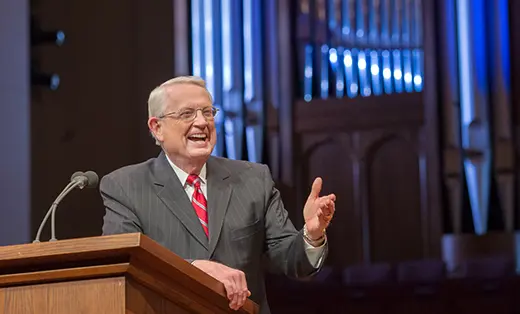
We tend to think that the people in the Bible were larger-than-life figures who demonstrated boundless faith despite their circumstances. But they were bound to a time and a place in history with flesh-and-blood challenges. In the series Experience the Land and the Book, take a virtual guided tour of Israel theologically curated by Chuck Swindoll. Each of Chuck’s six messages was recorded in the very places trod or sailed by kings David and Saul, the disciples, the apostle Paul, and our Savior, Jesus. Each message and context connects us to timeless principles that undergird and strengthen our faith for our time.
In this six-part series, Pastor Chuck Swindoll takes us on a journey through the Holy Land. Recorded on-site in Israel, these messages bridge the gap between ancient history and modern faith. By exploring the actual locations where kings fell, the Savior preached, and the disciples sailed, we see that the people of the Bible were not mythical figures, but real people facing real challenges in a real place.
Message 1. Saul: A Study in Tragedy (Recorded at Gilboa/Jezreel Valley)
- Overview: Explores the life of Israel’s first king, focusing on how a life with great potential can end in ruin through pride and disobedience.
- Key Fact: Recorded near the site of Saul’s final battle on Mount Gilboa, this message highlights the “special grief” of a life not well lived.
- Scripture: 1 Samuel 31:1–6; 2 Samuel 1:19–27 – The account of Saul’s death and David’s moving lament over the fallen king.
Message 2. The Beatitudes: Lessons by a Lake (Recorded at the Sea of Galilee)
- Overview: A study of Jesus’ most famous sermon, focusing on the character traits God blesses. The natural amphitheater of the Galilean hills provides the backdrop for this transformative teaching.
- Key Fact: The “blessedness” Jesus describes is an internal contentment that is independent of external circumstances.
- Scripture: Matthew 5:1–12 – The list of the Beatitudes, starting with “Blessed are the poor in spirit, for theirs is the kingdom of heaven.”
Message 3. Releasing Our Burdens Beneath the Waves (Recorded on the Sea of Galilee)
- Overview: While sailing the same waters as the disciples, Pastor Chuck discusses the storms of life and the peace that comes from trusting the One who commands the wind and waves.
- Key Fact: The Sea of Galilee is known for sudden, violent storms due to its geography (being 690 feet below sea level); this physical reality mirrors our sudden life crises.
- Scripture: Mark 4:35–41 – The account of Jesus calming the storm: “Peace, be still.”
Message 4. When Jesus Stopped to Pray (Recorded at the Garden of Gethsemane)
- Overview: A poignant look at Jesus’ final hours of agonizing prayer before His arrest. This message explores the necessity of submission to the Father’s will.
- Key Fact: Gethsemane literally means “oil press,” a fitting name for the place where Jesus felt the crushing weight of the world’s sin.
- Scripture: Matthew 26:36–46 – “My Father, if it is possible, let this cup pass from Me; yet not as I will, but as You will.”
Message 5. A Place for Pondering and Praise (Recorded at the Southern Steps)
- Overview: Set on the stairs leading to the Temple Mount where Jesus and His disciples often walked. This message focuses on the importance of reflection and worship in the life of a believer.
- Key Fact: These physical steps are some of the few remaining locations where we can say with historical certainty that Jesus actually trod.
- Scripture: Psalm 122:1–9 – A “Song of Ascents” expressing joy in the house of the Lord: “I was glad when they said to me, ‘Let us go to the house of the Lord.'”
Message 6. A Captive’s Call to Freedom (Recorded at Caesarea Maritima)
- Overview: Focuses on the Apostle Paul’s imprisonment and his bold defense of the Gospel before King Agrippa. It highlights the power of a personal testimony.
- Key Fact: Caesarea was a Roman capital in Israel; Paul’s stand here illustrates how God uses even our “captivity” to reach the highest levels of influence.
- Scripture: Acts 26:1–32 – Paul’s articulate and courageous defense before Agrippa and Festus.
Common Questions: Experience the Land and the Book
1. Why is it important to understand the geography of Israel when reading the Bible? As Pastor Chuck explains throughout the series, the “Land” is often called the “Fifth Gospel.” Understanding the terrain—like the depth of the Sea of Galilee or the pressure of the oil press at Gethsemane—helps us realize that biblical events happened to real people in tangible, historical locations.
2. What made King Saul’s life a “tragedy”? In “Saul: A Study in Tragedy,” it is noted that Saul had every physical and social advantage but lacked internal character. His tragedy was not his death on Mount Gilboa, but his repeated choice to value his own reputation over obedience to God.
3. What does “Gethsemane” mean, and why is that significant? “Gethsemane” means “oil press.” This is significant because, as taught in “When Jesus Stopped to Pray,” it was in this garden that Jesus felt the intense, crushing pressure of His mission, eventually surrendering His will to the Father.
4. Where are the “Southern Steps,” and why are they famous? The Southern Steps are the original stone stairs leading to the Temple Mount in Jerusalem. They are famous because they are an archaeologically verified site where Jesus, the disciples, and thousands of pilgrims walked to worship at the Temple.
5. How did Paul use his imprisonment in Caesarea to spread the Gospel? In “A Captive’s Call to Freedom,” Pastor Chuck highlights that Paul didn’t see himself as a victim. Instead, he used his trial as a platform to share his conversion story with King Agrippa, showing that God’s Word cannot be chained even if His servants are.