Series Details
People are messy. Anyone involved in ministry can testify to that. But people are what ministry is all about. Serving people. Teaching people. Caring for people as Jesus did. Easy to say, difficult to do.
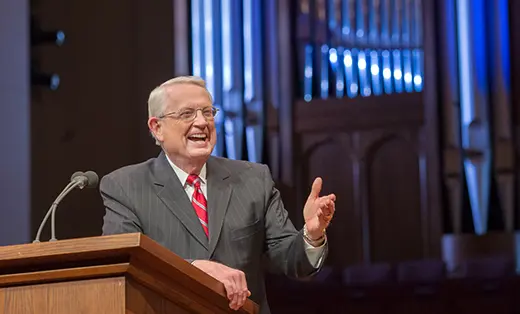
Chuck Swindoll’s series, Excellence in Ministry: Starting Strong—Doing What’s Right in the Work of Ministry, is the perfect guide to help you do the difficult task of ministry. In this series, Chuck provides answers and instruction on the pastor’s duties, the priority of prayer, the role of women, and how to find qualified leaders.
In this 10-part exposition of 1 Timothy 1–3, Pastor Chuck Swindoll provides a biblical blueprint for local church ministry. This series explores the “Pastoral Epistles,” written to help Timothy navigate the complexities of church life, from identifying qualified leaders to maintaining the priority of prayer. Whether you are in vocational ministry or a volunteer leader, these messages offer practical instruction on how to build a healthy, grace-filled community.
1. The Church as God Planned It (Overview of 1 Timothy)
- Overview: Introduces the historical context of Paul’s first letter to Timothy, written around AD 63. It highlights the church not as a social club, but as the “pillar and support of the truth.”
- Key Fact: 1 Timothy is one of three “Pastoral Epistles” (including 2 Timothy and Titus) focused specifically on church order and pastoral care.
- Scripture: 1 Timothy 3:15 – The church is described as “the household of God… the church of the living God, the pillar and support of the truth.”
2. What’s a Pastor to Do? (1 Timothy 1:1–11)
- Overview: Focuses on the primary responsibility of a leader: guarding the purity of the Gospel against “strange doctrines” and legalism.
- Key Fact: The goal of pastoral instruction is not just information, but “love from a pure heart and a good conscience and a sincere faith.”
- Scripture: 1 Timothy 1:5 – “But the goal of our instruction is love from a pure heart and a good conscience and a sincere faith.”
3. Undeserved Mercy for an Unbelieving Rabbi (1 Timothy 1:12–20)
- Overview: Paul uses his own testimony as the “foremost” of sinners to show that no one is beyond the reach of God’s grace.
- Key Fact: Paul refers to himself as a “pattern” or “example” of God’s perfect patience for those who would believe in the future.
- Scripture: 1 Timothy 1:15 – “It is a trustworthy statement… that Christ Jesus came into the world to save sinners, among whom I am foremost of all.”
4. What’s First in a Meaningful Ministry? (1 Timothy 2:1–8)
- Overview: Establishes the non-negotiable priority of a healthy church: a commitment to various forms of prayer for all people.
- Key Fact: Prayer is categorized into four types: entreaties, prayers, petitions, and thanksgivings.
- Scripture: 1 Timothy 2:1 – “First of all, then, I urge that entreaties and prayers, petitions and thanksgivings, be made on behalf of all men.”
5. God’s Desire, Man’s Debt, Christ’s Payment (1 Timothy 2:3–7)
- Overview: A theological look at the heart of God for the lost and the unique role of Jesus as the one Mediator between God and men.
- Key Fact: The Gospel is universal in its scope—God desires “all men to be saved and to come to the knowledge of the truth.”
- Scripture: 1 Timothy 2:5 – “For there is one God, and one mediator also between God and men, the man Christ Jesus.”
6. What about Women in the Church? (1 Timothy 2:9–15)
- Overview: Addresses the controversial and culturally sensitive topic of women’s roles and conduct within the public worship assembly.
- Key Fact: Paul emphasizes “quietness” and “submission” not as a statement of value or intelligence, but as a matter of divine order and functional roles within the church.
- Scripture: 1 Timothy 2:12 – Paul discusses the apostolic instructions regarding teaching and exercising authority in the local church context.
7 & 8. Checklist for Choosing Church Leaders (1 Timothy 3:1–7)
- Overview: A two-part look at the rigorous character qualifications for those who aspire to the office of overseer (elder).
- Key Fact: Leadership in the church is based on “reputation” and “character” (being above reproach) rather than worldly success or charisma.
- Scripture: 1 Timothy 3:2 – An overseer must be “above reproach, the husband of one wife, temperate, prudent, respectable, hospitable, able to teach.”
9. The Dignity of Servanthood (1 Timothy 3:8–13)
- Overview: Explores the qualifications and the vital role of deacons—those who serve the practical needs of the church body.
- Key Fact: The office of deacon carries great “standing” and “boldness” in the faith for those who serve well, reflecting Christ’s own servant-heart.
- Scripture: 1 Timothy 3:13 – “For those who have served well as deacons obtain for themselves a high standing and great confidence in the faith.”
10. A Hope, a House, a Hymn (1 Timothy 3:14–16)
- Overview: Concludes the section with a beautiful early Christian hymn that summarizes the mystery of godliness and the mission of Christ.
- Key Fact: The “mystery of godliness” includes Christ being revealed in the flesh, vindicated by the Spirit, and taken up in glory.
- Scripture: 1 Timothy 3:16 – “By common confession, great is the mystery of godliness: He who was revealed in the flesh… proclaimed among the nations… taken up in glory.”