Series Details
Wouldn’t it be fascinating to meet someone who actually walked and talked with Jesus? John the apostle knew Jesus firsthand, and in his gospel he opens our hearts to the Master he loved and followed.
This first part of a three-part series reveals Jesus as the Son of God who existed before time began. As Jesus launched His public ministry and interacted with people, we can see ourselves in each person Jesus met—the religious seeker Nicodemus, the shunned woman at the well, the lame man waiting his entire life for a healing touch from God. And with each word Jesus spoke, we can feel His compassion and power.
As you read John’s gospel, you’re right there with the Master. That’s why even a most hardened skeptic can find John’s account of Jesus’ invitation to believe in Him impossible to resist.
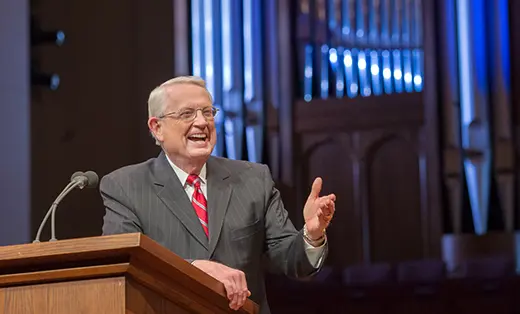
The Gospel of John is a firsthand account from an apostle who walked and talked with Jesus. In this first part of a three-volume study, Chuck Swindoll introduces us to the Master through the eyes of the disciple He loved. We move from the eternal “Prelude to Deity” into the start of Jesus’ public ministry, observing His interactions with outcasts, religious seekers, and the broken. This series invites us to behold Jesus not just as a historical figure, but as the Son of God, presenting a compelling case for faith that is impossible to ignore.
Message 1: “That You May Believe”
Sermon Summary Every book has a purpose, and John explicitly states his at the end of his Gospel. This opening message explores why John wrote his account: so that we may believe that Jesus is the Christ, the Son of God, and that by believing we may have life in His name. We set the stage for a comprehensive study that moves past mere information to life-changing transformation.
Key Facts & Themes
- The Purpose of John: Understanding the difference between a biography and a testimony of faith.
- The Call to Believe: Moving from skepticism to a personal relationship with Christ.
Primary Scripture Reference
- John 20:30–31 (The Series Key)
Message 2: Prelude to Deity
Sermon Summary The story of Jesus did not begin in Bethlehem; it began in eternity past. This message explores the profound opening verses of John, where Jesus is identified as “the Word” who was with God and was God. Chuck discusses the significance of the Incarnation—the Word becoming flesh—and what it means for a holy God to dwell among His fallen creation.
Key Facts & Themes
- The Pre-existence of Christ: Jesus as the eternal Creator.
- The Word Made Flesh: The mystery and majesty of the Incarnation.
Primary Scripture Reference
- John 1:1–18
Message 3: A Man Sent from God
Sermon Summary Before Jesus entered the spotlight, John the Baptist prepared the way. This message focuses on the “man sent from God” who pointed others away from himself and toward the “Lamb of God who takes away the sin of the world.” We learn about the humility and clarity of mission required to be an effective witness for Christ.
Key Facts & Themes
- The Forerunner: John the Baptist’s role in prophetic history.
- Beholding the Lamb: The first public identification of Jesus’ redemptive mission.
Primary Scripture Reference
- John 1:19–34
Message 4: Five Who Followed in Faith
Sermon Summary The first disciples of Jesus were a diverse group of ordinary men. This message examines the calling of Andrew, Peter, Philip, Nathanael, and an unnamed disciple. We see how a simple “Come and see” invitation led to a radical shift in their lives, teaching us that faith often begins with a personal encounter rather than a complex argument.
Key Facts & Themes
- The First Followers: Analyzing the varied ways people are drawn to Christ.
- The Invitation to Discovery: The power of “Come and see” in personal evangelism.
Primary Scripture Reference
- John 1:35–51
Message 5: Wine . . . Coins . . . and Signs
Sermon Summary Jesus’ public ministry was marked by “signs” that pointed to His divine authority. This message looks at the first of these signs: turning water into wine at a wedding in Cana, and the subsequent cleansing of the Temple. We see Jesus as the Lord of both the celebration and the sanctuary, revealing His power over nature and His zeal for the purity of worship.
Key Facts & Themes
- The Lord of Celebration: Why Jesus’ first miracle occurred at a wedding.
- The Zeal of the Lord: The significance of the Temple cleansing as a sign of authority.
Primary Scripture Reference
- John 2
Message 6: Brainstorming the New Birth
Sermon Summary Nicodemus, a religious leader, came to Jesus by night with deep questions. This message explores the famous dialogue on the “New Birth.” Chuck explains what it means to be “born again”—not through religious effort, but through the sovereign work of the Holy Spirit. We learn that even the most “moral” person needs a radical spiritual transformation.
Key Facts & Themes
- The New Birth: Understanding the spiritual necessity of regeneration.
- The Wind of the Spirit: The mysterious and sovereign nature of God’s work in the heart.
Primary Scripture Reference
- John 3:1–21
Message 7: The Preacher Who Lost His Congregation
Sermon Summary As Jesus’ popularity grew, John the Baptist’s ministry began to fade. This message highlights John’s remarkable reaction: “He must increase, but I must decrease.” We learn the secret to true spiritual success—finding joy in the exaltation of Christ rather than the expansion of our own influence.
Key Facts & Themes
- Spiritual Humility: The mark of a true servant of God.
- Christ-Centered Joy: Why seeing others follow Jesus is the greatest reward.
Primary Scripture Reference
- John 3:22–36
Message 8: Water for a Thirsty Woman
Sermon Summary At a well in Samaria, Jesus engaged a shunned woman in a life-changing conversation. This message explores the “living water” that Jesus offers to the thirsty soul. We see how Jesus broke through cultural, racial, and moral barriers to offer grace to those whom society had discarded.
Key Facts & Themes
- The Living Water: Identifying the internal thirst that only Christ can satisfy.
- Breaking Barriers: How the Gospel transcends social and moral boundaries.
Primary Scripture Reference
- John 4:1–42
Message 9: Healing at a Distance
Sermon Summary A royal official sought Jesus to heal his dying son. This message focuses on the miracle of healing “at a distance.” We see a father’s growing faith—moving from a desperate plea to a quiet trust in Jesus’ word. It serves as a reminder that Christ’s power is not limited by physical proximity.
Key Facts & Themes
- The Growth of Faith: Moving from seeing miracles to trusting the Word.
- Authority Over Sickness: The supernatural reach of Christ’s command.
Primary Scripture Reference
- John 4:43–54
Message 10: An Exposé of Legalism
Sermon Summary Healing a lame man on the Sabbath sparked a firestorm of controversy. This message exposes the heart of legalism—prioritizing religious rules over human mercy. We learn how Jesus challenged the rigid systems of His day to demonstrate that the Sabbath was made for man, not man for the Sabbath.
Key Facts & Themes
- The Bondage of Legalism: How religious tradition can blind people to God’s grace.
- The Lord of the Sabbath: Christ’s authority to define true rest and worship.
Primary Scripture Reference
- John 5:1–16
Message 11: The Claims of the Christ
Sermon Summary In response to His critics, Jesus made some of the most radical claims in history, essentially declaring Himself equal with God. This message examines Christ’s claims regarding His relationship with the Father, His authority to give life, and His role as the final Judge of all humanity.
Key Facts & Themes
- The Deity of Christ: Analyzing Jesus’ own words about His divine identity.
- The Giver of Life: Why the Son has the authority to raise the dead.
Primary Scripture Reference
- John 5:17–30
Message 12: Witnesses for the Defense
Sermon Summary Jesus did not ask people to believe Him on His word alone; He provided a “defense” consisting of multiple witnesses. This message looks at the testimony of John the Baptist, the miracles of Jesus, the Father’s own voice, and the witness of the Scriptures. We are left with a compelling body of evidence that demands a verdict.
Key Facts & Themes
- Historical Evidence: The multifaceted witnesses that support Christ’s claims.
- The Witness of Scripture: How the Old Testament points directly to Jesus.
Primary Scripture Reference
- John 5:31–47
Common Questions about the Gospel of John (FAQ)
How is the Gospel of John different from Matthew, Mark, and Luke? While the first three Gospels (the Synoptics) focus on a chronological and historical narrative, John is more thematic and theological. He focuses on long discourses of Jesus and specifically selects seven “signs” to prove that Jesus is the Son of God.
What does it mean that Jesus is “The Word”? In the Greek culture (Logos), the “Word” was the rational principle governing the universe. For the Jews, “The Word of the Lord” was God’s creative power. By calling Jesus “The Word,” John is saying that the Creator and the meaning of the universe has become a person we can know.
Is it really possible to be “born again”? Jesus describes the new birth as a spiritual transformation from above. Just as we did not cause our physical birth, we cannot cause our spiritual birth; it is a gift of grace received through faith in Jesus Christ, where the Holy Spirit gives us a new nature and a new life.
Why did Jesus’ miracles cause so much trouble with religious leaders? The miracles weren’t the problem; it was the authority they represented. By healing on the Sabbath or forgiving sins, Jesus was claiming to be God. To the religious establishment, this was either a glorious truth or a dangerous blasphemy.