Overview:
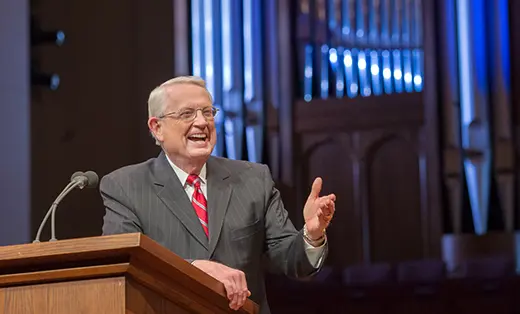
After Paul exhorted the Christians in Colossae to shed the clothes of their old, corrupt nature and don their new nature in Jesus Christ, he addressed how to accomplish this transformation in each area of life: husbands and wives, parents and children—even workers and bosses. Pastor Chuck Swindoll takes us through Colossians 3:15–4:1 to help us walk in Christ in each of those key areas.
Message Summary:
In this profoundly practical and stabilizing message, Chuck Swindoll moves us from the theological heights of Christ’s preeminence into the “boots-on-the-ground” reality of daily Christian living. Drawing from Colossians 3:15–17, Chuck argues that the Christian life is not meant to be lived in segments—sacred on Sunday and secular on Monday—but as a seamless, integrated display of the life of Christ. He begins by observing that while many believers have a “good system of theology,” they often lack the “functional wisdom” to represent Jesus in the messy details of their homes and workplaces. This study serves as a spiritual anchor, moving the believer away from the “fickle emotions” of the flesh and toward a “Resident Dynamic” of the Spirit that allows the peace of Christ to act as the ultimate umpire in every decision we face.
The core of the teaching focuses on the three-fold command to let Christ’s peace rule, His Word dwell, and His name be represented. Chuck observes that we live in a “troubled and disturbing era” characterized by anxiety and “mystical mumbling.” By examining the transition from internal thought to external action, Chuck reveals that the Holy Spirit acts as the ultimate “Harbor Pilot,” navigating us through the “mines” of worldly distraction and toward a life of “quiet and consistent obedience.” The goal of this message is to stabilize the believer’s faith, providing an “inner filter” for our conduct and ensuring that whether we are in the privacy of our minds, the intimacy of our homes, or the scrutiny of the world, we are “advertisements of the real thing.”
Message Key Facts:
- The Umpire of Peace (Brabeuō): Chuck highlights a vital linguistic detail in verse 15: “Let the peace of Christ rule in your hearts.” The Greek word brabeuō refers to an umpire or a referee who settles a dispute. Chuck argues that when we are faced with a conflict of choice or a “rattling test” of our character, the “Resident Dynamic” of Christ’s peace should be the final arbiter. He warns that if we lack peace about a decision, it is often a sign that the “Harbor Pilot” is signaling us to “wait” or “stop.”
- The Resident Word: A major highlight is Chuck’s analysis of the Word of Christ “dwelling” within us. He notes that the Word is not meant to be a “visiting guest” that we entertain once a week, but a permanent “resident” that permeates every room of our lives. He links this to the “Air Conditioner” of the soul—filtering out the “heat and humidity” of worldly thinking and replacing it with the refreshing truth of Scripture.
- Admonishing Through Song: Chuck reflects on the unique role of music in the church. He observes that we “teach and admonish one another” through psalms, hymns, and spiritual songs. This “Resident Dynamic” of music provides a “melody of truth” that sustains the believer during the “minor keys” of life. He encourages the congregation to sing “heartily,” recognizing that corporate worship is the only place on Earth where we can “admonish” one another through the beauty of song.
- The Representative Principle: Chuck dives into the “umbrella command” of verse 17: “Whatever you do in word or deed, do all in the name of the Lord Jesus.” He argues that every Christian is a “walking representative” of the Savior. This means that our “office hours,” our “parenting style,” and even our “private thoughts” carry the signature of the King. He asserts that we must “turn the corner” toward authenticity, realizing that we never “clock out” of our role as Christ’s ambassadors.
- Representation in the Mind: Chuck points out that the first sphere of representation is the internal world. Before we act or speak, we make decisions within the “hinges and locks” of our minds. He encourages the listener to invite the Spirit to “search” their thoughts, ensuring that their internal motives match their external profession.
- Representation in the Home and Work: The sermon concludes with a call to practical integrity. Chuck argues that the “life of Christ” should be most visible where we are most known—within the family and the workplace. He posits that a Spirit-filled life doesn’t need to “yell” its convictions; it simply needs to display a “contagious joy” and a “seasoned grace” that causes a world that has “lost its way” to stop and take notice.
Message References:
- Colossians 3:15–17: The primary text for the study. Chuck walks through the “rule” of peace, the “dwelling” of the Word, and the “representation” of the Name in all things.
- Ephesians 5:18–21: A parallel passage on being “filled with the Spirit.” Chuck links the results of the Spirit’s filling—songs, hymns, and gratitude—to the commands in Colossians, showing that the “Resident Dynamic” is the source of our joy.
- John 14:27: Jesus’ promise of “Peace I leave with you; My peace I give to you.” Chuck uses this to show that the “umpire of peace” is a divine gift, not a human achievement.
- Psalm 119:11: “Your word I have treasured in my heart, that I may not sin against You.” Chuck uses this to support the “Resident Word” concept, showing that the “intake” of Scripture is our primary defense against “spiritual drift.”
- Philippians 4:6–7: The promise that the “peace of God… will guard your hearts and your minds.” Chuck link this to the “Harbor Pilot” who protects the believer from the “panic” of life.
- 1 Corinthians 10:31: “Whether, then, you eat or drink or whatever you do, do all to the glory of God.” Chuck uses this to reaffirm the “Representative Principle” in the most ordinary details of existence.
- Matthew 5:16: The command to “let your light shine before men.” Chuck concludes by reminding the audience that their conduct in the world is the “advertisement” that points others toward the Father.