Overview:
When Goliath shouted his taunts, fear seized the Israelite army. It took an outsider to provide a different perspective on the situation.
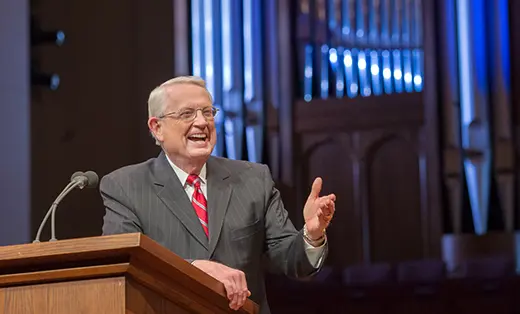
Rather than fearing the enemy, David took refuge and strength in the power of God! In this sermon on 1 Samuel 17, Pastor Chuck Swindoll describes how David looked past the giant to trust in the Lord of Hosts.
Whatever your giant may be—domestic, personal, economic, or spiritual—you can grow in your faith in the One who is above them all.
Message Summary:
In this powerful and perspective-shifting message, Chuck Swindoll takes us to the Valley of Elah to witness one of the most famous battles in history: the confrontation between David and Goliath. Chuck begins by establishing a vital theological framework, distinguishing between Revelation, Inspiration, and Illumination. While Revelation and Inspiration (the giving and recording of God’s Word) have ceased, Illumination remains the active, “Resident Dynamic” of the Holy Spirit today. It is through this illumination that the Spirit takes an ancient story and makes it a living reality, teaching us how to face the “giants” that taunt us in our own lives. Chuck argues that David’s victory was not a fluke or a sudden burst of “voodoo power,” but the result of a young man who had spent years cultivating a private, seasoned faith in the wilderness.
The core of the teaching focuses on the psychological and spiritual contrast between King Saul’s army and the shepherd boy, David. While the Israelites were paralyzed for forty days by the sight of a nine-foot-nine-inch giant, David looked at the same opponent through the lens of God’s sovereignty. Chuck emphasizes that David didn’t just have courage; he had a “God-sized” perspective. By examining David’s rejection of Saul’s armor and his reliance on the “name of the Lord,” Chuck reveals that our greatest weapons are not human techniques or borrowed gear, but a personal history of trusting God in the small, private battles of life. The goal of this message is to stabilize the believer’s faith, encouraging us to cross our own “valleys of Elah” with the confidence that “Greater is He who is in us than he who is in the world.”Message Key Facts:
- The Theology of Illumination: Chuck provides a clear breakdown of how the Spirit works today. Since God is no longer adding to the Bible (Revelation) or breathing into new authors (Inspiration), His primary work is Illumination. This is the process where the Spirit “turns on the lights” in our minds, allowing us to apply the Bedrock of the Bible to the “aches and pains” of our modern existence.
- Goliath’s Psychological Warfare: Chuck highlights the sheer scale of the giant—nearly ten feet tall, wearing 150 pounds of bronze armor, and wielding a spear like a weaver’s beam. He notes that Goliath’s greatest weapon wasn’t his sword, but the forty days of taunting that stripped the Israelites of their dignity and faith. Chuck observes that our “giants” often use the same tactic, using time and repetition to make our problems seem insurmountable.
- The “Un-Saul” Hero: Chuck challenges the traditional artistic depiction of David as a small, frail child. He argues that David was a “young man” of incredible skill and physical strength, seasoned by his life as a shepherd. While Saul was the tallest man in Israel but the smallest in spirit, David was the youngest in years but the largest in faith. This contrast serves as a reminder that God’s choice of leaders is based on the “internal filter” of character rather than external appearance.
- Rejecting Borrowed Armor: A significant highlight is David’s refusal to wear Saul’s armor. Chuck applies this to the modern church, warning against trying to fight spiritual battles using someone else’s techniques or “slick packages.” David knew that he could not be effective in gear he hadn’t “tested.” True power comes from being authentically yourself before God, using the unique skills and history the Spirit has developed within you.
- The Power of Past Victories: Chuck points out that David’s confidence against Goliath was rooted in his previous encounters with the lion and the bear. He didn’t ask for a miracle; he relied on the faithfulness he had already experienced. Chuck encourages the listener to remember their own “lion and bear” moments—those times when God proved Himself true—using them as the “stones” in their sling for the current giant.
- The Harbor Pilot of Courage: Revisiting his central series analogy, Chuck describes the Spirit as the “Pilot” who navigates us across the valley. When we are prone to leave the God we love or to “wander” into the scales of unbelief, the Spirit provides the courage to stand. He reminds us that the “battle is the Lord’s,” and that our role is simply one of “quiet and consistent obedience.”
Message References:
- 1 Samuel 17:1–51: The primary narrative text detailing the standoff in the Valley of Elah, Goliath’s challenge, David’s arrival and indignation, his conversation with Saul, and the ultimate victory through a single stone.
- 1 John 4:4: The “New Testament anchor” for the message. Chuck uses this to remind the believer that the resident Spirit is greater than any “giant” the world or the enemy can produce.
- 1 Samuel 16:7: A reference to God’s perspective: “The Lord looks at the heart.” Chuck links this to the series theme that spiritual power is an internal dynamic rather than an external show.
- Psalm 23: Chuck reflects on David’s role as a shepherd, suggesting that the intimacy with God found in the “green pastures” was the training ground for the “valley of the shadow of death.”
- Proverbs 3:5–6: A call to “lean not on our own understanding.” Chuck notes that if David had leaned on human logic, he never would have stepped into the valley; he trusted instead that the Lord would “direct His steps.”
- Ephesians 6:10–13: The command to “be strong in the Lord and in the strength of His might.” Chuck uses this to support David’s decision to fight in the “name of the Lord” rather than the armor of man.