Overview:
Time after time, group after group, the Jerusalem religious authorities sought to ensnare Jesus with His own words, so He’d be arrested and stop the agitating.
But He beat them at their own game. In Matthew 22:34–46, we read the Pharisees’ last test during Jesus’ public ministry.
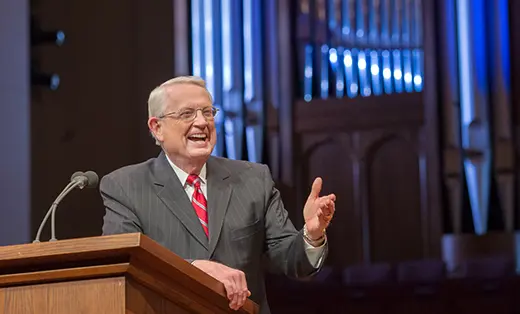
Dive into the scene with Pastor Chuck Swindoll to learn about two ultimate questions we all must answer regarding what God wants from us and the true identity of Israel’s Messiah.
Message Summary:
In this message centering on Matthew 22:34–46, Chuck Swindoll explores a high-stakes dialogue between Jesus and the religious leaders, framing it around the power of asking the right questions. Swindoll begins by reflecting on the role of great questions in life—from Socrates to Dwight Eisenhower—noting that the best questions force us to think deeply and examine our own souls [8–9, 16].
The text opens with the Pharisees stepping in after Jesus had effectively “muzzled” the Sadducees. An expert in religious law attempts to trap Jesus by asking, “Which is the most important commandment?” Jesus responds immediately, quoting the ancient Jewish Shema to love God with all one’s heart, followed by the command to love one’s neighbor. Swindoll emphasizes that these two commands—the vertical love for God and the horizontal love for others—summarize the entire Law and the Prophets [18–22, 27–28, 32].
The dynamic shifts as Jesus turns the tables, asking the Pharisees a question they cannot answer: “What do you think about the Messiah? Whose son is he?” When they reply, “The son of David,” Jesus utilizes Psalm 110 to present a theological paradox: If the Messiah is David’s son, why does David call Him “Lord”? Swindoll explains that Jesus was leading them to see that the Messiah is not merely human, but Divine—the Son of God. The sermon concludes with a personal challenge to the listener to answer the ultimate question: “What do you think of Jesus?” Swindoll urges that possessing the Son is the only way to possess eternal life [36–41, 53].
Message Key Facts:
- The Seminary Interview: Swindoll opens with a personal story from 1959 when he was applying to Dallas Theological Seminary. The registrar, Dr. Don Campbell, asked him a probing question: “Chuck, would you be happy and fulfilled doing anything other than Ministry for the rest of your life?” Swindoll answered “No,” which was the only answer that would have secured his acceptance [10–14].
- “Muzzling” the Sadducees: Swindoll notes the Greek word used to describe how Jesus silenced the Sadducees is phimoo, which means “to muzzle.” It is the same word used for muzzling an ox or when Jesus commanded a demon to be silent [18–19].
- The Shema: Jesus’ answer to the greatest commandment comes from Deuteronomy 6, known as the Shema (Hebrew for “Hear”). Swindoll notes that pious Jews quoted this creed twice a day and often kept these words in a scroll (mezuzah) at their doorposts [23–26].
- The “Good Teacher” Response: While Matthew’s account ends with the lawyer’s silence, Swindoll points to Mark 12:32, where the scribe responds, “Good Teacher,” acknowledging the perfection of Jesus’ answer.
- Cultural Warning: Swindoll recommends the book The Vanishing American Adult by Ben Sasse. He uses this to illustrate how a culture, like a garden, will drift toward “weeds” and immaturity if not intentionally cultivated toward truth and responsibility [34–35].
- The Theological Paradox: The core theological argument rests on Psalm 110:1. Jesus argues that David, speaking by the Spirit, calls the Messiah “Lord.” In that culture, a father would not call his son “Lord.” Therefore, the Messiah must be greater than David—He is God [38–40].
- The Shiver of Mystery: Swindoll quotes a commentator who suggests that even the densest critics felt a “shiver in the presence of Eternal mystery” when Jesus spoke, sensing for a moment they were glimpsing the face of God [43–44].
- The Ultimate Equation: Closing with 1 John 5, Swindoll presents a simple equation for salvation: “He who has the Son has the life; he who does not have the Son of God does not have the life”.
Message References:
- Matthew 22:34–40: The Pharisees ask Jesus about the greatest commandment, and He responds with the command to love God and neighbor.
- Matthew 22:41–46: Jesus asks the Pharisees whose son the Messiah is, silencing them with the logic of David’s Lord [4, 6–7].
- Deuteronomy 6:4–5: The Shema: “Hear, O Israel! The Lord is our God, the Lord is one! You shall love the Lord your God with all your heart…” [23–25].
- Leviticus 19:18: The second greatest commandment: “Love your neighbor as yourself”.
- Psalm 110:1: The verse Jesus quotes: “The Lord said to my Lord, ‘Sit in the place of honor at my right hand…'”.
- 1 John 5:11–12: “He who has the Son has the life; he who does not have the Son of God does not have the life”.
- 2 Timothy 3:16: Referenced regarding all Scripture being “God-breathed”.