Overview:
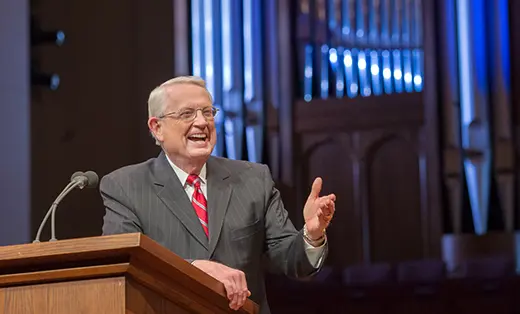
Because the Holy Spirit convicts and guides believers into all truth, His job is greatly needed! Pastor Chuck Swindoll opens to 1 Corinthians 2:1–13 and delves into the force behind the apostle Paul’s ministry. Hint: it wasn’t Paul’s strength! From his mission-driven journeys to his insightful words, Paul was supernaturally guided.Leave room for the mysterious, profound, and unexplainable ministry of the Spirit. Exchange weakness for power, human knowledge for wisdom, and superficial ideas with profound insights.
Message Summary:
In this illuminating study, Chuck Swindoll explores the often-overlooked reality that modern Christians are living participants in the fulfillment of biblical prophecy. While we often look toward the future with a sense of anticipation or anxiety regarding the end times, Chuck reminds us that the primary promise of the New Covenant—the coming and ministry of the Holy Spirit—is a prophecy being realized in our daily lives. He argues that the Holy Spirit is the “Spirit who surprises,” bringing fresh insights, unexplainable peace, and supernatural power into the routine and the complex moments of a believer’s existence. By understanding the Spirit as our “Helper” (paracletos), we transition from a life of independent struggle to a life of dependent discovery, where the wisdom of God is made accessible to the finite mind.
The message focuses heavily on the Spirit’s role as the divine Illuminator of truth and the Revealer of God’s hidden wisdom. Chuck contrasts the superficiality of human knowledge with the “depths” (bathos) of God, which only the Spirit can search and disclose. Drawing from Paul’s experience in Corinth, he emphasizes that the Spirit’s power is most visible when human strength is at its lowest ebb. The goal of this message is to encourage believers to stop relying on Earthly scholarship or personal eloquence and instead lean into the resident dynamic of the Spirit, who is prepared to guide us through the “uncharted waters” of life just as a harbor pilot navigates a ship through hidden mines toward safety.
Message Key Facts:
- Alexander the Great and Prophecy: Chuck begins with a powerful story (likely legendary but spiritually illustrative) of Alexander the Great. When shown the prophecy of Daniel chapter 8, which depicted him as the “male goat” coming with strong splendor, Alexander supposedly dropped to his knees in stunned amazement, realizing he was living out the pages of Holy Scripture. Chuck uses this to show that we, too, should be in awe of how we live out the fulfillment of Jesus’ prophecies regarding the Spirit.
- The Harbor Pilot of Yokohama: To illustrate the Spirit’s guidance (John 16:13), Chuck recounts his arrival at the Yokohama Harbor in 1958. Despite the war having ended years prior, the harbor was still filled with live underwater mines. A specialist pilot had to board the troop ship to “worm” it through uncharted, dangerous waters. This serves as a metaphor for the Holy Spirit, who guides the believer into all truth, navigating us safely through the deceptive currents of a sinful world.
- The Broken Apostle in Corinth: A significant highlight is Chuck’s analysis of Paul’s state when he founded the church in Corinth. Fresh from the “defeat” in Athens where he was laughed off the stage, Paul arrived in Corinth in “weakness, fear, and much trembling.” Chuck points out that it was in this broken state—devoid of “superiority of speech”—that the Spirit’s power was most demonstrated. He warns against the modern temptation to be more impressed by eloquent leaders than by the awesome, unexplainable presence of God.
- The “Deep Sea Diver” of Truth: Chuck compares the Holy Spirit to a deep-sea diver who descends into the depths to recover treasures from a sunken vessel. While the human eye can only see the surface, the Spirit “searches all things, even the depths of God.” He brings up the treasures of God’s wisdom and deposits them into our minds, allowing us to grasp spiritual realities that “eye has not seen nor ear heard.”
- The Date-Setting “Hogwash”: In discussing the Spirit’s role in disclosing “what is to come,” Chuck offers a firm warning against those who claim to know the specific dates of Christ’s return. He labels such date-setting as “hogwash,” insisting that the Spirit gives us the “frame” of the prophetic puzzle but reminds us that the exact time and era are fixed by the Father’s authority alone.
- The Literate Ministry and Harvard’s Drift: Chuck shares a personal reflection on standing by the cornerstone of Harvard University. He explains that it was originally founded to perpetuate a “literate ministry” so that the wisdom of God would not be lost to future generations. He laments the “erosion” of modern academia, which has shifted from waiting upon God’s truth to celebrating man’s truth, underscoring our desperate need for the Spirit’s revelation.
Message References:
- John 14:25–26 & 16:7–15: The foundational prophecies of Jesus regarding the paracletos. Chuck unpacks the meaning of “Helper” (one called alongside) and the Spirit’s threefold work of convicting the world of sin, righteousness, and judgment, as well as His role in teaching and bringing truth to remembrance.
- 1 Corinthians 2:1–5: Paul’s testimony regarding his “weakness and fear” in Corinth. Chuck highlights that our faith should not rest on the “persuasive words of wisdom” but on the “demonstration of the Spirit and of power.”
- 1 Corinthians 2:6–12: The core text on “God’s hidden wisdom.” Chuck explains that the Spirit searches the bathos (depths) of God to reveal what the “rulers of this age” could never understand. He notes that verse 11 contains the rare mention of the interaction between the spirit of man and the Spirit of God.
- Isaiah 55:8–9: God’s declaration that “My thoughts are not your thoughts.” Chuck uses this to show that the Spirit brings a dimension of wisdom that is literally “higher” and deeper than human intuition.
- Acts 20:22–24: The example of being “Bound in Spirit.” Paul’s conviction to go to Jerusalem, despite the Spirit testifying that “bonds and afflictions” awaited him, shows that the Spirit’s guidance leads to obedience and endurance, not necessarily to comfort.
- Romans 11:33–36: The concluding “Crescendo of Truth,” praising the depth of the riches and wisdom of God, which the Spirit makes known to the humble believer.