Overview:
David and Jonathan had reasons not to be close companions. Jonathan could have been jealous of heroic David’s right to the throne. David could have felt threatened by Jonathan’s princely position as son of King Saul.
Yet, these figures, who stand as examples of brotherly love, had pure motives and looked out for each another. Pastor Chuck Swindoll examines this strong friendship found in 1 Samuel 18–20.
Learn four key characteristics of faithfulness and find inspiration to be a faithful friend to others!
Message Summary:
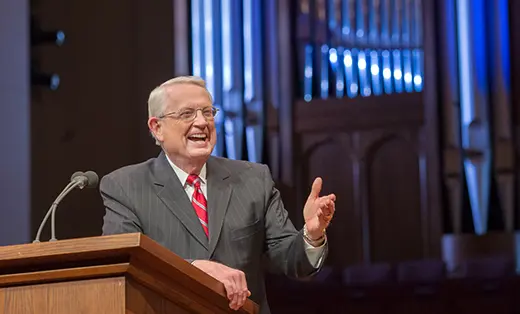
In this message on the seventh aspect of the Fruit of the Spirit, Chuck Swindoll explores the virtue of faithfulness. While many sermons focus on God’s “vertical” faithfulness to humanity, Swindoll shifts the focus to “horizontal” faithfulness—the loyalty, reliability, and consistency believers should demonstrate toward one another [8–9]. To illustrate this, he examines the biblical gold standard of friendship: the bond between David and Jonathan found in 1 Samuel.
Swindoll notes that true, faithful friendship is rare; most people only have one, two, or perhaps three such friends in a lifetime. Using the narrative of 1 Samuel 18–23, he outlines four distinct characteristics of a faithful friend. First, they voluntarily sacrifice for the other, just as Jonathan gave his royal robe and weapons to David. Second, they stand in loyal defense of their friend, refusing to stay silent when others speak falsely against them. Third, they allow the freedom to be vulnerable, creating a safe space for tears and weakness. Finally, they offer a permanence that never erodes, providing encouragement even when the friend is isolated and afraid [14–19, 25].
The message concludes with a deeply personal application. Swindoll shares a vulnerable moment regarding his wife Cynthia’s cancer scare. He recounts how a staff member met him on a stairwell, embraced him while he wept, and told him, “You don’t always have to have everything together.” Swindoll urges listeners to become that kind of friend to others—one who offers presence and hope in times of hopelessness—while ultimately pointing to Jesus Christ as the friend who is “closer than a brother” [21–23, 30].
Message Key Facts:
- Faithfulness Defined: Swindoll defines faithfulness using three key words: Reliability (you can count on them), Loyalty (they are in your corner), and Consistency (they are not fickle or moody).
- Vertical vs. Horizontal: Swindoll distinguishes between vertical faithfulness (God’s lovingkindness toward us, as seen in Lamentations) and horizontal faithfulness (the fruit of the Spirit we show to others) [8–9].
- Jonathan’s Lack of Jealousy: Despite being the crown prince and heir to the throne, Jonathan felt no threat from David. Instead of envy, he recognized greatness and humility in David, forming an immediate “kindred spirit” connection [11–13].
- The Four Marks of Faithful Friendship:
- Sacrifice: Jonathan gave David his tunic, sword, bow, and belt—items of great personal value and protection.
- Defense: When Saul ordered David’s assassination, Jonathan confronted his father, arguing that David had only benefited the kingdom [16–18].
- Vulnerability: In 1 Samuel 20, both men wept together. Swindoll notes that faithful friends allow you to be “unguarded” [19–20].
- Permanence: In 1 Samuel 23, Jonathan sought David out in the wilderness to encourage him, affirming that he would be king.
- The “Stairwell” Moment: Swindoll shares a personal story of breaking down before a staff meeting due to his wife’s medical scare. A friend stopped him on the stairs and said, “You don’t always have to have everything together.” Swindoll cites this as a prime example of faithful friendship allowing for weakness [21–22].
- “Benign”: Swindoll humorously notes that “benign” is one of the greatest words in the English language, referencing the positive outcome of his wife’s diagnosis.
- Preaching Through Pain: Swindoll reveals to the congregation that he preached this specific message while in physical pain (shoulder bursitis), illustrating his own point about human weakness and the need for support.
Message References:
- 1 Samuel 18:1–4: The formation of the covenant between David and Jonathan, where Jonathan gives David his robe and weapons.
- 1 Samuel 19:1–4: Saul’s command to kill David and Jonathan’s verbal defense of his friend [2–3].
- 1 Samuel 20:41–42: The emotional farewell between David and Jonathan, where they wept together and reaffirmed their bond.
- 1 Samuel 23:15–16: Jonathan visits David in the wilderness at Horesh to encourage him in God [24–25].
- Lamentations 3:22–23: “The Lord’s lovingkindnesses never cease… Great is His faithfulness”.
- Romans 15:4: “Whatever was written in earlier times was written for our learning”.
- Psalm 40:1–2: David’s testimony of waiting patiently for the Lord to lift him from the pit.