• Skip to main content
  • Account
  • Cart
  • Change Country

Insight for Living

The Bible-Teaching Ministry of Pastor Chuck Swindoll

  • Home
  • Broadcasts
    • Current Broadcast
    • Broadcast Schedule
    • Broadcast Archive
    • Series Library
    • STS Bible Studies
    • Ways to Listen
    • Sunday Services
    • Paws & Tales
  • Resources
    • Daily Devotional
    • Insights on the Bible
    • Insights by Topic
    • Article Library
    • Church Leaders
    • Church Resources
    • How to Know God
    • Chuck’s Next Book
    • Video Library
  • International
    • About Vision 195
    • International Pastors
    • International Offices
  • Connect
    • FAQs
    • Contact Us
    • Social Media
    • Mobile App
    • Share Your Testimony
    • Bible Questions and Counseling
    • Pray for IFL
  • About
    • Essential Beliefs
    • Chuck Swindoll
    • Questions about Chuck
    • Leadership
    • Where Donations Go
    • Work With Us
    • Volunteer Opportunities
  • Store
  • Donate
    • Give Now
    • Give Monthly
    • My Account
    • Giving Through Stock Transfers
    • Planned Giving
    • Giving History
    • Why Give
    • This Month’s Letter
  1. Home
  2. »
  3. Broadcasts
  4. »
  5. Series Library
  6. »
  7. Full Messages
  8. »
  9. Sustaining an Attitude of Gratitude

Broadcasts

  • Current Broadcast
  • Broadcast Schedule
  • Broadcast Archive
  • Series Library
  • STS Bible Studies
  • Ways to Listen
  • Sunday Services
  • Paws & Tales

Sustaining an Attitude of Gratitude

Follow us:
Facebook
X
Instagram
YouTube
Pinterest

Overview:

Opening the door to ingratitude and letting it get comfortable in your heart might be one of the quickest ways to kill a spiritually vibrant ministry. But the Spirit has provided all you need to fight that deadly attitude and thrive with gratitude in the Lord’s work.

In his message, Chuck Swindoll takes us to the shortest verse in the Bible, “Rejoice always” (1 Thessalonians 5:16 NASB), that it may fill our every hour as we toil day by day, month by month, and year by year in God’s vineyard.

Message Summary:

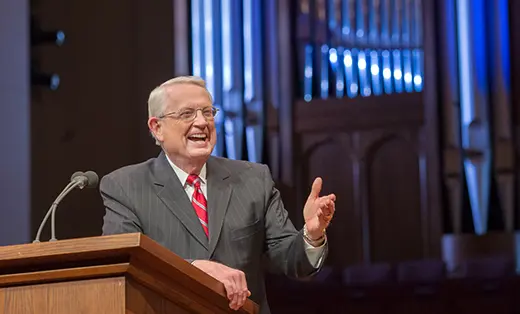
In this stirring message delivered to a seminary chapel audience, Chuck Swindoll argues that an “attitude of gratitude” is essential for mental and spiritual health, serving as a powerful antidote to the “savage times” in which we live. Drawing from Romans 1 and 2 Timothy 3, Swindoll identifies ingratitude as a hallmark of a depraved society and roots it specifically in the sin of pride, noting that while proud people feel entitled, humble people are quick to say “thank you” [2–5].

Turning to 1 Thessalonians 5, Swindoll likens the Apostle Paul’s closing commands to a music teacher’s instruction to “punch out” staccato notes. He urges listeners to apply these short, punchy commands to their daily lives: appreciating leaders and teachers, living in peace with peers, and maintaining a constant spirit of prayer. He emphasizes that thanksgiving is not merely for the good times but is God’s will in “every circumstance” [6–7, 12].

The message is anchored by two poignant historical illustrations. First, Swindoll recalls a childhood memory from 1944, watching his teacher weep during the Pledge of Allegiance for her husband lost at Normandy, which taught him that Thanksgiving “puts steel in our bones.” Second, he tells the harrowing story of Martin Rinkart, a German pastor during the Thirty Years’ War. Despite burying thousands of parishioners and facing starvation, Rinkart wrote the hymn “Now Thank We All Our God,” proving that there can be no true healing without thanksgiving [13–15, 23–26].

Message Key Facts:

  • The Root of Ingratitude: Swindoll identifies pride as the primary reason for a lack of thankfulness. He states, “Proud people don’t say thank you… Humble people, broken people, crushed, contrite people are quick to say, ‘Thank you'”.
  • The “Punch It Out” Analogy: Swindoll recalls his high school oboe teacher, Mr. Bulani, who urged him to “punch out” the notes in staccato musical passages. He applies this to 1 Thessalonians 5, where Paul delivers rapid-fire commands: Rejoice always, pray without ceasing, give thanks in everything [6–7].
  • Gratitude for Teachers: Speaking to students, Swindoll emphasizes 1 Thessalonians 5:12, urging them to appreciate those who “diligently labor” among them. He advises writing handwritten notes of thanks to mentors, noting that he still thanks his professors for teaching him the “touch” of ministry [8–9].
  • The 1944 Thanksgiving Memory: Swindoll shares a defining moment from when he was 10 years old. On the day before Thanksgiving, his teacher broke down sobbing during the class prayer because she had lost her husband in World War II. This moment taught him that Thanksgiving is about courage, sacrifice, and heritage rather than just celebration [13–16].
  • Irma Bombeck’s Perspective: Swindoll quotes the humorist to describe Thanksgiving as a “holiday without the hoopla.” Unlike Christmas with its gifts or Halloween with its costumes, Thanksgiving is stripped of pretense—it is simply a time to pause and say “I love you,” much like a kiss from a spouse for no reason [18–19].
  • The Three Directions of Gratitude:
    1. Looking Up: Thanking God for sovereign control and His holy character.
    2. Looking Around: Thanking God for nation, school, family, and friends who are there “regardless” [21–22].
    3. Looking Within: Thanking God for health, senses, and the ability to think and work [22–23].
  • The Origin of “Now Thank We All Our God”: The sermon concludes with the story of Martin Rinkart (1636). Living in a walled city surrounded by the Swedish army during the Thirty Years’ War, Rinkart conducted up to 15 funerals a day (burying 5,000 people in one year). In the midst of plague and famine, he wrote a table grace for his children that became the famous hymn of gratitude [23–26].

Message References:

  • 1 Thessalonians 5:12–18: The primary text containing the “staccato” commands to appreciate leaders, rejoice always, pray without ceasing, and give thanks in everything.
  • 2 Timothy 3:1–5: Paul’s warning that in the “last days,” difficult times will come, characterized by men being “lovers of self… ungrateful, unholy.”
  • Romans 1:20–21: A reference to humanity refusing to honor God or give thanks despite His invisible attributes being clearly seen.
  • Proverbs 27:6: “Faithful are the wounds of a friend,” cited regarding the necessity of professors correcting students.
  • Hebrews 13:15: “Let us offer the sacrifice of praise to God continually, that is, the fruit of our lips giving thanks to His name”.

Message Speaker:

Pastor Chuck Swindoll

Do You Want Christlike Joy?

Cultivating Joy

The 90-day reflective journal Cultivating Joy helps you take time daily to enrich your outlook and strengthen your attitude by reading a passage from God’s Word and Pastor Chuck’s reflection on it.

Footer

Insight for Living Broadcast

I've been listening to the story of Jonah, particularly of his stubbornness and his disobedience. Pastor Chuck, I was acting like Jonah, and I am stubborn. When I decided to obey, God was there. I believe that God wanted me to experience the blessing of obedience. Thank you for your teachings. God bless you always. —C. G.

Help Us Impact Listeners’ Lives

Let’s Keep in Contact

Areas of Interest

Contact Permission

By clicking the "Sign up" button below, I am requesting to receive e-mail communications from Insight for Living, and I agree to their privacy policy.

Welcome

  • Our Mission
  • Chuck Swindoll
  • Essential Beliefs
  • Vision 195
  • How to Know God
  • The Book Shoppe & Coffee

Resources

  • Insights by Topic
  • Insights on the Bible
  • Article Library
  • Daily Devotional
  • Videos
  • Church Resources

Donate

  • Donate Now
  • Stock Transfers
  • Wills and Estate Planning
  • Why Support IFL?
  • Where Donations Go
  • My Donations

Contact

  • Contact Us
  • FAQs / Email
  • International Offices
  • Privacy Policy
  • Terms of Use
  • Copyrights & Permission Requests

© 2026 Insight for Living. All rights reserved.

Follow us:
Facebook
X
Instagram
YouTube
Pinterest