• Skip to main content
  • Account
  • Cart
  • Change Country

Insight for Living

The Bible-Teaching Ministry of Pastor Chuck Swindoll

  • Home
  • Broadcasts
    • Current Broadcast
    • Broadcast Schedule
    • Broadcast Archive
    • Series Library
    • STS Bible Studies
    • Ways to Listen
    • Sunday Services
    • Paws & Tales
  • Resources
    • Daily Devotional
    • Insights on the Bible
    • Insights by Topic
    • Article Library
    • Church Leaders
    • Church Resources
    • How to Know God
    • Chuck’s Next Book
    • Video Library
  • International
    • About Vision 195
    • International Pastors
    • International Offices
  • Connect
    • FAQs
    • Contact Us
    • Social Media
    • Mobile App
    • Share Your Testimony
    • Bible Questions and Counseling
    • Pray for IFL
  • About
    • Essential Beliefs
    • Chuck Swindoll
    • Questions about Chuck
    • Leadership
    • Where Donations Go
    • Work With Us
    • Volunteer Opportunities
  • Store
  • Donate
    • Give Now
    • Give Monthly
    • My Account
    • Giving Through Stock Transfers
    • Planned Giving
    • Giving History
    • Why Give
    • This Month’s Letter
  1. Home  /// 
  2. Stop Resisting and Start Submitting

Broadcasts

  • Current Broadcast
  • Broadcast Schedule
  • Broadcast Archive
  • Series Library
  • STS Bible Studies
  • Ways to Listen
  • Sunday Services
  • Paws & Tales

Stop Resisting and Start Submitting

Follow us:
Facebook
X
Instagram
YouTube
Pinterest

Overview:

Webster defines the term “submit” in this way: “To surrender or yield to the will or authority of another . . . give in.” Those words seem strange in today’s rebellious world where resistance to authority is not only tolerated and expected, it’s admired and defended. Children, once taught to be submissive to their parents, now resist their authority with hardly a second thought.

Message Summary:

In this message centering on the tragic fall of King Saul in 1 Samuel 15, Chuck Swindoll addresses the pervasive human struggle with rebellion. He argues that while society has culturally institutionalized a “question authority” mindset since the 1960s, God expects His children to obey Him fully. Swindoll uses the narrative of Israel’s first king to illustrate that partial obedience is actually disobedience. Although Saul was commanded to completely destroy the Amalekites, he chose to spare King Agag and keep the best livestock, rationalizing his decision by claiming he intended to sacrifice them to the Lord [1–3, 18].

Swindoll highlights the danger of rationalization, noting that Saul greeted Samuel cheerfully, claiming to have carried out the Lord’s command despite the audible evidence of bleating sheep nearby. When confronted, Saul attempted to pass the blame to his soldiers and spiritualize his rebellion. Swindoll emphasizes Samuel’s crushing rebuke: “Obedience is better than sacrifice.” The message underscores that religious rituals and offerings are meaningless to God if they are offered by a heart that refuses to yield to His authority [20–23].

The sermon concludes with a strong application for parents and individuals. Swindoll warns that the seeds of rebellion are often sown in the home when parents relinquish control to children. He urges listeners to stop resisting God’s will, noting that a rebellious life is often “crushed” by the Lord to bring about necessary humility. Ultimately, Swindoll calls for a return to a life marked by genuine submission to Christ, asserting that no one is too old or too established to learn the discipline of obedience [25, 32–34].

Message Key Facts:

  • The Decades of Loss: Quoting Ravi Zacharias, Swindoll traces the cultural decline of authority:
    • 1950s: Kids lost their innocence.
    • 1960s: Kids lost their authority (the decade of protest).
    • 1970s: Kids lost their love (replaced by self-love).
    • 1980s: Kids lost their hope (fear of nuclear war).
    • 1990s: Kids lost their reason (logic replaced by postmodernism).
    • 2000s: Kids lost their imagination (desensitized by violence) [9–11].
  • Definitions:
    • Rebellion: Opposition to one in authority; open defiance or resistance.
    • Rationalization: Providing plausible but untrue reasons for conduct; attributing actions to rational motives without analyzing what is actually true.
  • Valid vs. Invalid Resistance: Swindoll clarifies that not all resistance is wrong. It is right to resist when protecting property, liberty, religious convictions, or when resisting the devil. However, it is “carnal rebellion” to resist proper authority or God’s will with a defiant spirit [12–13].
  • Partial Obedience: Saul’s failure was specific: God said “destroy,” but Saul “captured” the king and “kept” the best livestock. Swindoll notes Saul did not misunderstand the instructions; he simply disagreed with them [18–19].
  • The Monument to Self: Before Samuel arrived, Saul traveled to Carmel to set up a monument to himself—a clear indicator of the ego and pride that fueled his disobedience [19–20].
  • The Dentist Illustration: Swindoll shares a humorous but poignant story from Dr. James Dobson about a defiant boy named Robert. A dentist finally curbed the boy’s rebellion by calling his bluff—threatening to take the boy’s clothes if he didn’t sit in the chair, and then actually doing it. This illustrates the necessity of parents “calling the bluff” of a rebellious child [26–28].
  • Crushed by God: Swindoll quotes A.W. Tozer: “It is doubtful God can use any of us greatly until He has hurt us deeply.” He explains that a rebellious life must be crushed by the Lord to break the stubborn will.

Message References:

  • 1 Samuel 15:1–3: The Lord’s explicit command to Saul to completely destroy the Amalekites.
  • 1 Samuel 15:13–15: Saul’s rationalization to Samuel: “I have carried out the Lord’s command… the army spared the best of the sheep… to sacrifice”.
  • 1 Samuel 15:22–23: The core theology of the message: “Obedience is better than sacrifice, and submission is better than offering the fat of rams. Rebellion is as sinful as witchcraft”.
  • James 4:10 / 1 Peter 5:5: Referenced regarding the command to “humble yourselves” and be subject to elders.
  • Job 23:10: (Implicitly referenced regarding being tested and coming forth as gold).

Message Speaker:

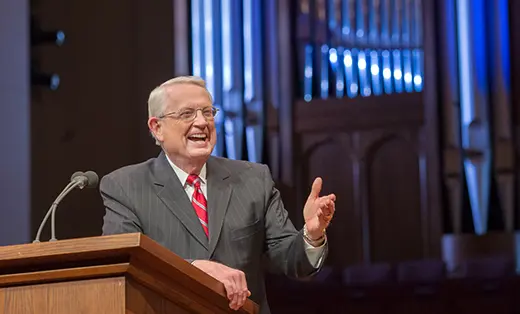
Pastor Chuck Swindoll

Do You Want Christlike Joy?

Cultivating Joy

The 90-day reflective journal Cultivating Joy helps you take time daily to enrich your outlook and strengthen your attitude by reading a passage from God’s Word and Pastor Chuck’s reflection on it.

Footer

Insight for Living Broadcast

I looked you all up on Spotify and clicked on the Insight for Living link. It hit me like a brick in the face; the title of the very top episode was "Dealing with Discouragement." I listened to the episode on my drive home. I 100% believe it was God speaking to me and bringing me back from a life in darkness. I felt like it was God telling me, "This is the path and plan I have for you so keep going." —R. Y. from Georgia

Help Us Impact Listeners’ Lives

Let’s Keep in Contact

Areas of Interest

Contact Permission

By clicking the "Sign up" button below, I am requesting to receive e-mail communications from Insight for Living, and I agree to their privacy policy.

Welcome

  • Our Mission
  • Chuck Swindoll
  • Essential Beliefs
  • Vision 195
  • How to Know God
  • The Book Shoppe & Coffee

Resources

  • Insights by Topic
  • Insights on the Bible
  • Article Library
  • Daily Devotional
  • Videos
  • Church Resources

Donate

  • Donate Now
  • Stock Transfers
  • Wills and Estate Planning
  • Why Support IFL?
  • Where Donations Go
  • My Donations

Contact

  • Contact Us
  • FAQs / Email
  • International Offices
  • Privacy Policy
  • Terms of Use
  • Copyrights & Permission Requests

© 2026 Insight for Living. All rights reserved.

Follow us:
Facebook
X
Instagram
YouTube
Pinterest