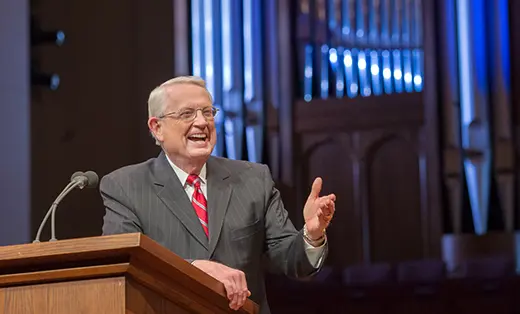
Overview:
What sights and sounds come to mind when you think of heaven? John didn’t have to wonder when he slipped the bonds of gravity and miraculously traveled to the heavenly realm. He encapsulated his vision with descriptions of the closest earthly likenesses he could relate to the celestial scene—a trumpet, precious gems, animals, and a sea.Launch yourself into the throne room of heaven as Pastor Chuck Swindoll teaches from Revelation 4:1–11. Escape the familiar world and discover the significance of God’s unforgettable glory.
Message Summary:
In this message centering on Revelation 4, Chuck Swindoll guides the listener through the “open door” of heaven to witness the majesty of the Almighty. Swindoll explains that while chapters 2 and 3 of Revelation cover the history of the church age (“the things which are”), chapter 4 marks a transition to the future (“the things which will take place after these things”) [13–15]. John is transported in the Spirit to the Third Heaven, the dwelling place of God, a realm so far beyond human experience that it can only be described using the word “like” to avoid “slavishly literal” interpretations of infinite realities.
Swindoll describes the scene of the throne room, noting that John makes no attempt to describe God in human shape. Instead, the One sitting on the throne is described in the brilliance of gemstones—jasper (diamond-like purity), sardius (blood red), and an emerald rainbow (green) encircling the throne. Surrounding this center of gravity are 24 elders sitting on lesser thrones and four living creatures full of eyes. Swindoll identifies the elders as representatives of the redeemed who have finished their race, while the living creatures are high-ranking angels (seraphim) who possess ceaseless awareness and energy [25–26, 29–31].
The message culminates in a symphony of worship. Swindoll highlights the “antiphonal” praise where the living creatures cry “Holy, Holy, Holy,” prompting the 24 elders to fall prostrate and cast their crowns before the feet of God [32–34]. Swindoll concludes that prophecy is not meant merely to inform the mind but to reorient the heart. He reminds the listener that in the final analysis, life is not about our health, wealth, or dreams, but entirely about the glory of the God who created all things for His will.
Message Key Facts:
- The Ritz-Carlton Illustration: Swindoll shares a story of being invited to the Ritz-Carlton in Maui, where every need was met with “my pleasure.” He uses this to illustrate that even the most luxurious experiences on earth are pale shadows compared to heaven. As he notes, “Nothing on this earth… is anything even like heaven” [8–10].
- The Divine Outline: Swindoll points to Revelation 1:19 as the key to unlocking the book’s structure:
- The things you have seen (Chapter 1).
- The things which are (Chapters 2–3).
- The things which will take place after these things (Chapters 4–22).
- Three Heavens: Swindoll clarifies the biblical concept of “heavens”:
- First Heaven: The atmospheric sky (clouds, birds).
- Second Heaven: The planetary universe (stars, galaxies).
- Third Heaven: The dwelling place of God, where John was taken.
- Gemstone Imagery: Describing God, John uses:
-
- Jasper: Likely a diamond-like, clear stone representing purity.
- Sardius: A brilliant red stone.
- Emerald: A green rainbow acting as a halo around the throne [22–23].
- The 24 Elders: Swindoll identifies these not as angels (who are never numbered or enthroned), but as representatives of redeemed humanity. They wear white garments (purity) and golden crowns (stephanos), suggesting they are believers rewarded for their life on earth [24–26, 29].
- Diadema vs. Stephanos: Swindoll distinguishes between two Greek words for “crown”:
-
- Diadema: The royal crown of a monarch.
- Stephanos: The victor’s wreath given for achievement or reward. The elders wear the stephanos, which they eventually cast before the throne [24–25, 34].
- The Living Creatures: Identified as Seraphim (burning ones), these four creatures correspond to the vision in Isaiah 6. They have six wings and are “full of eyes,” representing their all-seeing vigilance and ceaseless praise [30–31].
- Handel’s Vision: Swindoll notes that when George Frideric Handel wrote the Messiah, he claimed, “I saw the heavens opened and God upon his great Throne.” The experience was so intense he could barely eat or sleep while composing.
- Billy Sunday’s Bible: Swindoll concludes by reading a passage found in evangelist Billy Sunday’s Bible, which describes a journey through the “art galleries” of the Old Testament and the “music room” of the Psalms, ending in the “Throne Room of Revelation” [38–40].
Message References:
- Revelation 4: The primary text describing the open door, the throne, the 24 elders, the four living creatures, and the worship of the Creator [1–3].
- Revelation 1:19: The divine outline of the book: “Write the things which you have seen, and the things which are, and the things which will take place after these things”.
- Isaiah 6:1–3: Parallel vision of the Seraphim (six-winged angels) crying “Holy, Holy, Holy,” used to identify the four living creatures in Revelation.
- 2 Corinthians 12: Referenced regarding the “Third Heaven,” the realm of God’s dwelling.
- Psalm 115:3 & Daniel 4:35: Cited to describe the sovereignty of God who “does whatever He pleases” in the army of heaven and among the inhabitants of earth.
- 1 Timothy 3: Referenced regarding the term presbyteros (elder).