Overview:
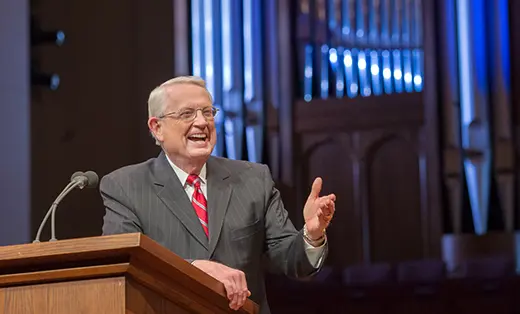
Today on INSIGHT FOR LIVING, Chuck Swindoll continues his study in the book of John. It’s here we discover that Jesus’ was far more than just a beacon for morality. He was, and is, light and life to all who believe.
Message Summary:
In this opening message of his study on the Gospel of John, Chuck Swindoll establishes the “one main truth” that anchors the entire book: Jesus Christ is God. Quoting A.W. Tozer, Swindoll reminds listeners that “what comes into our minds when we think about God is the most important thing about us”. To ensure we think rightly, Swindoll walks through the Prologue of John (John 1:1–18), which he describes as the entire book in miniature.
Swindoll presents four irrefutable proofs from the text regarding the identity of Jesus. First, He is Eternal. Before anything was created, the Word already existed in an “ever-present eternal now”. Second, He is the Creator. Swindoll clarifies that while the Father planned creation, the Son was the one who implemented it, flinging the universe into space and holding it together [13–14]. Third, He is the Source of Life. Swindoll argues that just as we cannot generate our own electricity but must plug into a power source, we cannot manufacture spiritual life; it is found exclusively in Him [16–17].
Finally, the message culminates in the Incarnation—God becoming flesh. Swindoll illustrates the tragedy of the Creator walking through His own creation unrecognized, like a sculptor whose statues do not know him [21–22]. However, for those who do receive Him, He offers the right to become children of God. The sermon concludes with the famous C.S. Lewis trilemma, challenging listeners that they must choose to see Jesus as a lunatic, a liar, or exactly who He claimed to be: the Lord of Glory.
Message Key Facts:
- The Main Thesis: John’s Gospel was written with one specific purpose: to certify that Jesus is the Son of God. Swindoll notes that John allows “no margin for fluff or equivocation” regarding Christ’s deity.
- The “Time Tunnel” of Verse 1: Swindoll analyzes the grammar of “In the beginning was the Word.” The verb “was” implies continuous existence. In a beginning that never had a beginning, Jesus already existed [7–9].
- The Steel Ball Illustration: To help the human mind grasp eternity, Swindoll uses the image of a sparrow brushing its beak against a steel ball the size of the earth once every million years. By the time the ball is worn down to the size of a BB, eternity would have just begun. Jesus existed before that process even started.
- The Creator in the Manger: Swindoll highlights the paradox of the Incarnation: “The little baby in the manger at Bethlehem held the universe in place.” The One who died on a cross of wood created the hill on which it stood.
- The Sculptor Analogy: To illustrate John 1:10 (“the world knew Him not”), Swindoll imagines a sculptor walking through a gallery of his own work. If the statues came to life and asked “Who are you?”, it would be the ultimate rejection—precisely what happened when Jesus walked the hills of Galilee He had created [21–22].
- The Law of Biogenesis: Quoting Dr. Huff, Swindoll explains that life must come from antecedent life. Physical life begets physical life, and spiritual life begets spiritual life. This explains why John 1:13 emphasizes being born “of God” rather than human will [24–25].
- “We Beheld His Glory”: Swindoll compares John’s testimony of seeing Jesus to a father holding his firstborn child. Just as a father feels the tangible reality of his new baby, John and the disciples held, touched, and saw God in the flesh [27–28].
- Jesus Explains God: Based on verse 18, Swindoll explains that Jesus is the “exegete” of the Father. If you want to know what God is like, you look at Jesus.
Message References:
- John 1:1–18: The primary text, known as the Prologue, outlining the preexistence and incarnation of the Word.
- John 1:1: “In the beginning was the Word… and the Word was God.” (The proof of His eternity and deity).
- Psalm 90: A Psalm of Moses referenced to describe God’s existence “from the vanishing point to the vanishing point” [10–11].
- Colossians 1:16–17 (Referenced): “All things were created through Him and for Him, and by Him all things hang together”.
- John 1:12: “But to all who believed him… he gave the right to become children of God.”
- John 1:14: “And the Word became flesh and dwelt among us.”