Overview:
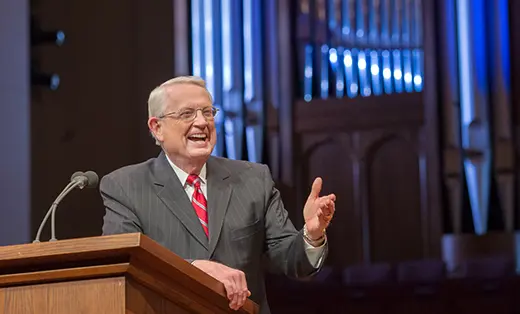
A tree fulfills its purpose when it produces wholesome, nourishing fruit. Similarly, Christians fulfill their roles when they produce the fruit of the Spirit: love, joy, peace, patience, kindness, goodness, faithfulness, gentleness, and self-control.Drawing from Romans and Galatians, Pastor Chuck Swindoll expounds on the role of the Holy Spirit in producing godliness in our lives.Just as fruit isn’t humanmade, neither can God’s work in our lives be produced through human ingenuity and strength. Learn how God’s Spirit creates meaningful, lasting fruit!
Message Summary:
In this challenging and transparent message, Chuck Swindoll addresses a common sense of dissatisfaction among Christians—those who love Christ but feel as though they are missing a vital reservoir of power in their daily walk. Drawing inspiration from J.B. Phillips’ classic work, Your God is Too Small, Chuck suggests that many believers have unintentionally “boxed God in” due to a defensive theology or a fear of being labeled by others. He argues that being careful should never hinder us from being open and teachable. The goal of this study is to move beyond the sacred biographies of the past and into the current reality of the Holy Spirit’s work in our own lives, transitioning from a “victim mentality” to the life of a conqueror. Chuck challenges the listener to consider if their dissatisfaction stems from a God who has been made too small by human tradition and fear.
The theological heart of the message focuses on the inescapable and often exhausting struggle with sin. Chuck provides a critical distinction between Romans 6, Romans 7, and Romans 8 to help the believer navigate this conflict. In Romans 6, we learn that sin no longer has dominion over us; we have been emancipated from its mastery. However, Romans 7 reveals the frustrating reality that sin is still very much present within us. Chuck describes this internal conflict as a “Battle Royal” between the flesh and the spirit. Romans 8 is then introduced as the climactic solution: the Holy Spirit provides a new dimension of living that makes it possible to control the flesh. This is not a mechanical process or a series of “three easy steps,” but a radical shift in mindset—moving from being “sin-conscious” (obsessing over our failures) to “Spirit-conscious” (resting in God’s resident power).
Message Key Facts:
- The Problem of the Label: Chuck notes that many Evangelical Christians are often more concerned about theological labels and staying within “acceptable” bounds than about obeying the clear leading of the Spirit. He encourages the “flock” to let God out of the box and stop keeping the brakes on their spiritual experience out of a desire for safety. He quotes Martyn Lloyd-Jones, warning that we must be careful not to find ourselves fighting against God by quenching the Spirit.
- The “Anchor of Sin”: Using the imagery of a ship’s anchor, Chuck identifies the “old sin nature” that every believer drags through life. He emphasizes that while we have been emancipated from sin’s mastery, we still carry the carnal desires of the flesh that will remain until the day we die. This explains the “tongue-twister” of Romans 7: “the good that I wish I do not do, but I practice the very evil that I do not wish.”
- The Spirit’s Strategic Introduction: Chuck highlights a fascinating structural detail in the book of Romans: the Holy Spirit is not mentioned in the first seven chapters. Paul deliberately waits for the moment of deepest human frustration—the cry of “Wretched man that I am!”—to introduce the Spirit as the intimate presence of God who sets us free from the law of sin and death.
- Life and Peace vs. Death: A central highlight is the definition of “the things of the Spirit” found in Romans 8. Chuck contrasts the “death-like existence” of a mind set on the flesh with the “life and peace” of a mind set on the Spirit. He posits that there are realms of Earthly experience and dimensions of supernatural power we have never touched because we have remained focused on our sin rather than the Spirit.
- The “Abba” Intimacy: Chuck discusses the transition from a “spirit of slavery” to a “spirit of adoption.” This allows for an “Abba relationship”—a sense of calling God “Daddy”—which brings a flood of peace and removes the reticence or fright many feel when approaching the Living God.
- Assistance in Prayer: Chuck explores the profound comfort of Romans 8:26, where the Spirit intercedes with “groanings too deep for words.” He explains that when we are in such deep need or pressure that we cannot even frame a thought, the Spirit communicates our needs to the Father on our behalf, interpreting our garbled emotions into the perfect will of God.
Message References:
- Romans 6:12–14: The command to not let sin reign in our mortal bodies. Chuck explains that because we are under grace, we have a “warning sign” that allows us to proceed with caution around the curves of temptation.
- Romans 7:14–25: Paul’s transparent description of the struggle with the flesh. Chuck uses this to show that even the most “holy” individuals experience a part of themselves that still wants to do wrong.
- Romans 8:5–11: The contrast between the mind set on the flesh (death) and the mind set on the spirit (life and peace). This passage also contains the rare mention of all three members of the Trinity in a single verse (v. 11).
- Romans 8:15–17 & 8:26–27: The transition to the spirit of adoption and the Spirit’s role in helping our weakness by interceding in prayer according to the will of God.
- Galatians 5:16–23: The “War in the Soul” where the flesh and Spirit are antagonistic to each other. Chuck contrasts the habitual “practice” of sin in a lost person with the occasional “skirmishes” in a believer’s life.
- John 14:16–17: Jesus’ promise of the Spirit of Truth who would not just “date” us, but “marry” us—becoming one with us and abiding in us forever.