Overview:
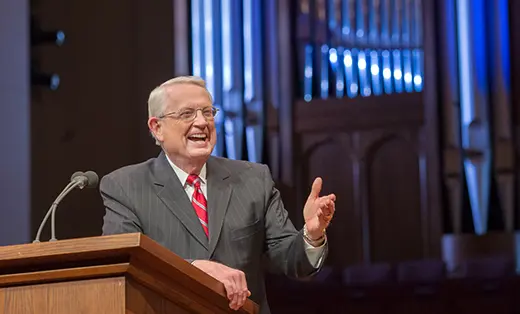
Your past has God’s fingerprints all over it. Have you learned the lessons He taught you . . . or did you even realize He was indeed teaching you? In this sermon on Deuteronomy 8:1–5, Pastor Chuck Swindoll looks closely at the words of the aged prophet Moses when he charged the wandering Israelites to remember what God had taught them in the wilderness. Take time to stop and reflect on your past to discern the specific lessons God designed just for you.
Message Summary:
In this introspective and deeply stabilizing message, Chuck Swindoll invites the believer to the “Plains of Moab”—that symbolic place of pause where we must look back at the journey before we are permitted to move forward into the future. Drawing from the final book of the Torah, Chuck explores the valedictory address of Moses as he prepares a new generation of Israelites to enter the Promised Land. Chuck argues that we are often so focused on the “race that is before us” that we fail to recognize the profound “Resident Dynamic” of God’s leading in the season we just completed. This study serves as a spiritual anchor, reminding us that the wilderness was not a detour or a divine mistake, but a carefully designed classroom intended to humble us, test us, and reveal the true state of our hearts.
The core of the teaching focuses on the imperative to “remember” (zakar) the Lord’s leading through the wilderness. Chuck observes that many Christians look back at their “wilderness years”—times of loss, financial strain, or emotional drought—with regret or confusion. However, by examining Deuteronomy 8:1–5, Chuck reveals that God’s primary agenda in the wilderness is the development of character through dependence. He posits that the Holy Spirit acts as the ultimate “Harbor Pilot” of our history, navigating us through the “Parenthesis of Time” to prove His faithfulness. The goal of this message is to help the believer transition from one year to the next with a “quiet calm,” knowing that the God who sustained them in the desert is the same God who will lead them across the Jordan.
Message Key Facts:
- The Plains of Moab Perspective: Chuck highlights the strategic setting of Deuteronomy. After forty years of wandering, the Israelites are camped on the Plains of Moab, staring across the river at their destination. Chuck notes that God “stops the clock” here to force a review. He argues that we all need a “Plains of Moab” moment at the end of a year—a time to take stock of where we’ve been before we are distracted by the demands of what is next.
- The Wilderness as a School: A major highlight is Chuck’s reframing of the wilderness journey. He rejects the idea that the desert was merely a punishment for the previous generation’s failure. Instead, he views it as a “school of character.” He notes that God led the people into the wilderness to “humble them and test them,” proving that spiritual strength is not measured by the absence of trials but by the depth of our obedience in the middle of them.
- The Manna Principle: Chuck explores the profound lesson of the manna in verse 3. He notes that God let the people go hungry before feeding them with a food they didn’t know. This “humbling” was designed to teach a foundational truth: “People do not live by bread alone, but by every word that comes from the mouth of the Lord.” Chuck applies this to our “slow recoveries,” reminding us that God often removes our physical crutches so that we learn to lean entirely on His Word.
- The Miracle of the Ordinary: Chuck points out a subtle but spectacular detail in verse 4: “Your clothing did not wear out and your feet did not swell these forty years.” He uses this to illustrate God’s “sustaining grace.” While we often look for the “shock and awe” miracles (like the parting of the sea), Chuck encourages us to remember the quiet, daily miracles of provision—the health that held up, the needs that were met, and the shoes that didn’t wear out during the long march of a difficult year.
- God’s Discipline as a Sign of Love: Chuck dives into the heart of divine discipline in verse 5, comparing God’s “testing” to that of a father disciplining his son. He argues that the trials of the past year were not signs of God’s abandonment, but credentials of our belonging to His family. He reminds the listener that God only “spanks” His own children, and that the “rattling tests” of our lives are intended to prune us for greater fruitfulness.
- The “Resident Dynamic” of Memory: Revisiting the central series analogy, Chuck describes the Spirit as the one who brings “remembrance” to our hearts. He posits that our “prone to wander” nature makes us prone to forget God’s benefits. The Spirit acts as the “inner filter” that helps us interpret our history accurately, transforming our “wretched” memories into a “crescendo of truth” and praise for God’s unsearchable wisdom.
Message References:
- Deuteronomy 8:1–5: The primary text for the study. Chuck walks through the commands to obey, the history of the 40-year journey, the humbling work of hunger and manna, and the disciplinary heart of the Father.
- Psalm 103:2: The command to “Bless the Lord, O my soul, and forget none of His benefits.” Chuck uses this to support the “zakar” (remembering) theme of the message.
- Lamentations 3:21–24: The “Minor Key” of faithfulness. Chuck notes that just as Jeremiah “called to mind” God’s mercies in the ruins of Jerusalem, we must call to mind God’s leading in the “wilderness” of our own lives.
- Romans 8:28: Reaffirming that God causes “all things”—including the wilderness journey—to work together for good for those who love Him.
- Matthew 4:4: Jesus’ citation of Deuteronomy 8:3 during His own wilderness temptation. Chuck uses this to show that the “Word of God” is the ultimate weapon for survival in any desert.
- Hebrews 12:5–11: The New Testament commentary on divine discipline. Chuck links this to Deuteronomy 8:5, showing that the “testing” we look back on was designed to produce the “peaceful fruit of righteousness.”
- Philippians 1:6: The promise that “He who began a good work in you will perfect it.” Chuck uses this to bridge the “Looking Back” sermon with the “Looking Ahead” reality, proving that the Alpha of the past year is the Omega of the year to come.