Overview:
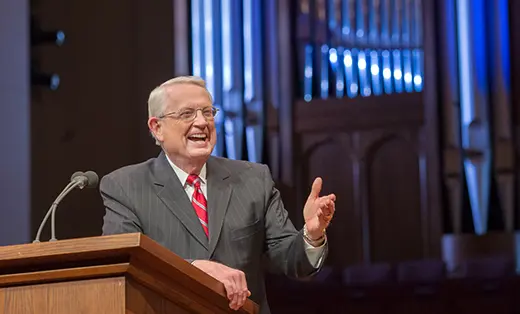
In this flyover of Matthew’s gospel, Pastor Chuck Swindoll prepares you for a fresh look at King Jesus. As a disciple, and a former keen-eyed tax-collector, Matthew gives us an intimate and carefully crafted portrait of Israel’s Messiah who came as the Son of God and whose resurrection made Him the Lord of history. Get the big picture of Matthew’s account—from Jesus’ arrival to His Great Commission—in this opening sermon of Pastor Chuck’s series titled The King of Kings: A Study of Matthew.
Message Summary:
In this introductory message to the Gospel of Matthew, Chuck Swindoll presents the Lord as a “God of surprises.” He marvels at the divine genius of a King who arrives not in pomp, but in a stable; who is worshipped not by local royalty, but by foreign wise men led by a star; and who selects a “ragtag” group of disciples to change the world.
The central figure of this specific Gospel is Matthew (also known as Levi), a man whose life exemplifies these divine surprises. Swindoll profiles Matthew as a wealthy but hated tax collector—a Jewish collaborator with Rome—who was transformed by a single command from Jesus: “Follow me”. Swindoll highlights the tension within the disciple band, noting that Matthew likely served alongside his own brother, James (son of Alphaeus), who was a Zealot committed to overthrowing the very government Matthew served. Only Jesus could bring such opposing forces together [18–19].
Swindoll outlines the Gospel of Matthew as a book of structure and rhythm designed to present Jesus as Israel’s Messiah and King [26–27]. The sermon breaks the book into three movements:
- The King’s Identity (Chapters 1–15): His ministry in Galilee and growing popularity.
- The King’s Destiny (Chapters 16–27): The shift toward Jerusalem, hostility, and the cross.
- The King’s Victory (Chapter 28): The Resurrection and the Great Commission [29–30].
The message concludes by applying the Great Commission (Matthew 28) to the believer’s life, noting that just as the Gospel went to “all nations,” Jesus demands “all authority” over our hearts today.
Message Key Facts:
- The Four Portraits of Christ: Swindoll distinguishes the unique perspective of each Gospel writer [9–10]:
- Matthew: Writes to Jews; presents Jesus as the King.
- Mark: Writes to Romans; presents Jesus as the Servant (a book of action).
- Luke: Writes to Greeks; presents Jesus as the Son of Man (humanity).
- John: Writes to the World/Church; presents Jesus as God (Deity).
- The Meaning of “Synoptic”: Matthew, Mark, and Luke are called “synoptic” gospels, from the Greek words sun (together) and optic (seeing). They “see together,” covering similar events, whereas 92% of John’s Gospel is unique material.
- The Zealot and the Collaborator: Swindoll identifies James, son of Alphaeus, and Matthew, son of Alphaeus, as likely brothers. This creates a fascinating dynamic where a right-wing Zealot (James) and a left-wing Roman collaborator (Matthew) were reconciled within the family of God [16–18].
- Matthew’s Jewish Flavor: As a Gospel written to Jews, Matthew contains 53 references to the Old Testament (compared to 36 in Mark, 25 in Luke, and 20 in John) and uses the phrase “Kingdom of Heaven” 32 times [26–27].
- The “Three Alls”: In analyzing the Great Commission (Matthew 28:18–20), Swindoll points to the repetition of the word “all”: Jesus possesses all authority, commands us to go to all nations, and instructs us to obey all commands.
- Personal Application: Swindoll parallels the structure of Matthew with the spiritual life: The King arrives (Salvation), demonstrates power (Growth), faces opposition (Testing), and ultimately rises Victorious (Security) [35–36].
Message References:
- Matthew 1:1–16: The genealogy of Jesus, establishing Him as a descendant of David and Abraham.
- Matthew 2:1–23: The narrative of the wise men, the flight to Egypt, and the return to Nazareth.
- Matthew 9:9: The calling of Matthew (Levi) at the tax collector’s booth.
- Matthew 10:2–4: The list of the twelve disciples, including “Matthew the tax collector” and “Simon the Zealot.”
- Matthew 16:13–16: Peter’s confession at Caesarea Philippi: “You are the Messiah, the Son of the Living God.”
- Matthew 28:16–20: The Great Commission.
- 2 Corinthians 8:9: “Though he was rich, yet for your sake he became poor.”