Overview:
Jesus, our hero and victor, rides in splendor on a white horse with heavenly armies in Revelation 19:11–21.
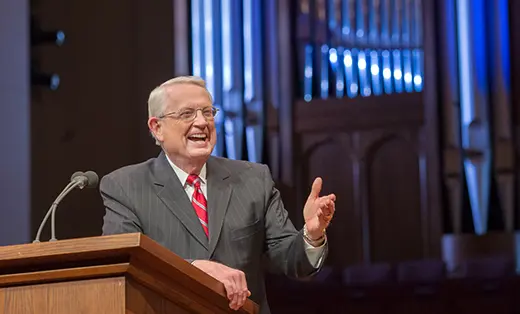
Pastor Chuck Swindoll illustrates how Christ’s return will fulfill biblical prophecies, judge the nations, remove Satan from earthly authority, and establish Christ’s kingdom on earth.
You’ll understand the symbolism in John’s description of the King with eyes like flaming fire, a sword coming from His mouth, and a head with many crowns. Learn more about the One whose return is sure!
Message Summary:
In this 33rd message of the Revelation series, Chuck Swindoll directs the listener’s gaze to the “Second Advent,” the long-awaited moment when Jesus Christ returns physically to earth. Swindoll begins by clarifying a critical theological distinction: this event is not the Rapture, where believers meet the Lord in the air, but the Second Coming, where Christ descends to the earth to judge the nations and establish His Kingdom [11–12].
Swindoll contrasts the two arrivals of Christ. In His first coming, Jesus arrived in a manger as the Lamb of God, full of grace and mercy. In Revelation 19, He returns on a white horse as the “King of Kings,” bringing judgment, justice, and the fierce wrath of God [18–19]. Swindoll outlines four specific reasons why this return is necessary: to fulfill biblical promises, to judge the nations, to remove Satan from power, and to establish a kingdom where righteousness covers the earth [13–15].
The message details the terrifying brevity of the Battle of Armageddon. Swindoll notes that despite pop culture depictions of nuclear holocausts or protracted wars, this “battle” is actually a slaughter won without a single shot fired. The King speaks a word from His mouth—represented by a sharp sword—and the rebellion is instantly crushed. The sermon concludes with a gruesome vision of the “Great Supper of God,” where birds devour the remains of the wicked, and a final plea for listeners to bow before the King now, while there is still time for grace.
Message Key Facts:
- Rapture vs. Second Coming: Swindoll distinguishes between the next prophetic event, the Rapture (meeting the Lord in the air, 1 Thessalonians 4), and the Second Coming (returning to earth to rule, Revelation 19). He urges believers not to confuse these two separate events [11–12].
- The Attitude of Royalty: Using the analogy of American tourists versus British citizens watching the Queen, Swindoll illustrates that “what you are determines what you see.” While tourists just take pictures, loyal subjects bow. Similarly, when Christ returns, His followers will worship, while His enemies will try to wage war [6–9].
- The Four Reasons for Return: Swindoll lists four necessities for Christ’s return to earth:
- To fulfill numerous Old and New Testament promises.
- To judge the nations and hold humanity accountable.
- To remove Satan from his usurped throne.
- To establish His earthly Kingdom of peace [13–14].
- The Unknown Name: Commenting on Revelation 19:12, Swindoll notes that Jesus has a name written on Him that “no one knows except Himself.” Despite many commentaries attempting to guess it, Swindoll insists the text means exactly what it says: the name remains a divine mystery.
- The Robe Dipped in Blood: Swindoll clarifies that the blood on the Rider’s robe is neither the blood of martyrs nor His own sacrificial blood from Calvary. It is the blood of His enemies, signifying that the time for judgment has arrived.
- The Passive Army: Believers are pictured as the armies of heaven, riding white horses and wearing white linen. Swindoll points out that this army is unarmed and does not fight; they are witnesses to the victory won solely by the King.
- The Weapon of the Word: The “sharp sword” coming from Christ’s mouth symbolizes His spoken word. Just as He spoke to the fig tree and it withered, or to the winds and they ceased, He will speak a word to the armies of the world, and they will fall.
- The Great Supper of God: In a scene Swindoll describes as “rated R,” an angel invites the birds of prey to feast on the flesh of kings, commanders, and horses. This marks the ignominious end of the rebellion against God.
Message References:
- Revelation 19:11–21: The primary text detailing the rider on the white horse, the armies of heaven, the defeat of the Beast, and the Great Supper of God [1–2].
- 1 Thessalonians 4: Referenced to contrast the Rapture (“caught up together… in the clouds”) with the Second Coming to earth.
- Ecclesiastes 8:11: “Because sentence against an evil work is not executed speedily, therefore the heart of the sons of men is fully set in them to do evil”.
- 2 Corinthians 4: Referenced regarding Satan as “the god of this age”.
- Habakkuk 2:14: Referenced regarding the promise that “righteousness shall cover the Earth as the waters cover the sea”.
- John 1:1: Referenced to connect the title “The Word of God” in Revelation 19 with the “Word” who was with God in the beginning.