Overview:
Imagine a paradise where there’s no need for locks or laws. People are full of love and no one is ever ill. It’s not a fantasy but, instead, a reality in the new heaven and earth!
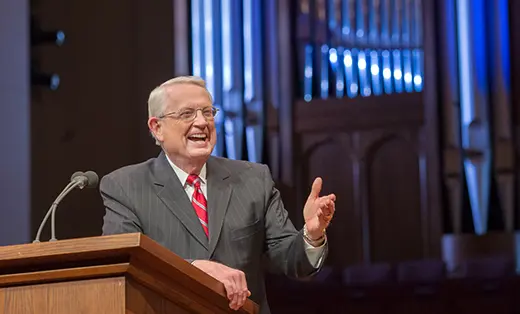
Overviewing Revelation 21:21–22:5, Pastor Chuck Swindoll paints a portrait of the heavenly city—a place emanating the goodness of the Creator. Like the garden of Eden, it’s the intended home for all believers where they can fellowship with God unhindered!
Let the reality of a heavenly future wash over you as you listen!
Message Summary:
In this message centering on the closing verses of Revelation 21 and the opening of Revelation 22, Chuck Swindoll addresses the difficulty of comprehending the infinite reality of heaven with finite human minds. He compares this challenge to an Amazonian trying to explain a 30-foot anaconda to an Eskimo who knows only polar bears, or a tech expert explaining complex electronics to a novice. To bridge this gap, Swindoll explains that God uses “accommodating language,” describing the glories of the Eternal City by focusing on what is not there—Heaven’s “magnificent negatives” [3–8].
Swindoll walks through the text to highlight specific things absent from the New Jerusalem. He notes there will be no temple, for the Lord God and the Lamb are the sanctuary, meaning worship will no longer be confined to a building but will be a constant state of being [12–13]. There will be no sun or moon, for the glory of God provides illumination, banishing all darkness and the sinister dangers associated with the night [14–15]. Furthermore, there will be no closed gates, signifying a security so absolute that locks and alarms are rendered obsolete [15–16].
The message moves from the negatives to the abundant positives found in Revelation 22, describing the River of the Water of Life and the Tree of Life, which provide healing and sustenance. Swindoll contrasts this vibrant, tangible hope with the empty promises of other religions or the “strumming harps on clouds” caricatures. He concludes by sharing the journal entries of martyr Jim Elliot, illustrating a deep “homesickness” for heaven—a place where believers will finally see God face-to-face and find true rest [20–25].
Message Key Facts:
- The Challenge of Communication: Swindoll illustrates the difficulty of describing heaven by listing complex modern devices (like an iPod or a scientific calculator) and noting how impossible it would be to explain them to someone from a previous century. Similarly, God must “adjust His truth to our 2×4 planet Earth limitations” [3–4, 8].
- The “Magnificent Negatives”: Swindoll challenges listeners to circle the words “no,” “not,” “never,” “no longer,” and “nor” in the text. He argues that because we cannot comprehend the positives of glory, God describes heaven by removing earth’s limitations (e.g., no pain, no night, no death) [7–8].
- Transparent Gold: While Solomon’s temple in 1 Kings 6 featured wood overlaid with gold veneer, the streets of the New Jerusalem are “pure gold, like transparent glass.” Swindoll notes this gold is so pure it is translucent, allowing God’s glory to shine through the very pavement [10–11].
- No Temple Needed: Swindoll points out that on earth, we “go to church” or visit shrines like the Vatican. In heaven, there is no specific structure for worship because the entire environment is the presence of God. As Dottie Rambo’s song suggests, there are “no symbols to greet us, only His hands” [12–13].
- The Lamb as the Lamp: commenting on Revelation 21:23, Swindoll loves the imagery that “the Lamb is the lamp.” Unlike earthly cities that must combat darkness with electricity to prevent crime, heaven is flooded with God-generated light, eliminating all fear.
- The Double Negative: Regarding the gates in verse 25, Swindoll explains that the Greek text uses a double negative (“no, not ever”), emphasizing that the gates will absolutely never be shut. This implies a life of perfect security where locks, keys, and alarm systems are forgotten memories.
- “Jesus is Watching You”: To illustrate earthly fears of burglary vs. heavenly security, Swindoll tells a humorous story of a burglar who hears a voice saying, “Jesus is watching you.” It turns out to be a parrot named Moses, whose owners also have a Rottweiler named Jesus.
- Jim Elliot’s Homesickness: Swindoll reads from Jim Elliot’s journal (written before his martyrdom in Ecuador). Elliot describes the “sheer excitement of knowing God” and longing for the time when “not stars nor children shall matter, only Himself.” Swindoll uses this to define the Christian’s longing for home [24–25].
Message References:
- Revelation 21:21: “The street of the city was pure gold, like transparent glass”.
- Revelation 21:22: “I saw no temple in it, for the Lord God the Almighty and the Lamb are its temple”.
- Revelation 21:23: “The city has no need of the sun or of the moon to shine on it, for the glory of God has illumined it”.
- Revelation 21:25: “Its gates will never be closed… for there will be no night there”.
- Revelation 22:1–2: The description of the river of the water of life and the tree of life bearing fruit every month [1–2].
- Revelation 22:5: “And they will reign forever and ever”.
- 1 Kings 6: Referenced to contrast Solomon’s gold-overlaid temple with the solid, transparent gold of the New Jerusalem.