Overview:
Just as a vehicle requires fuel to reach its destination, so too a divine mission from God requires a divine source of empowerment to be accomplished.
The divine power source fueling the Great Commission is the Holy Spirit. In Acts 2:1–12, the Holy Spirit makes His grand entrance and empowers the disciples to begin their gospel ministry.
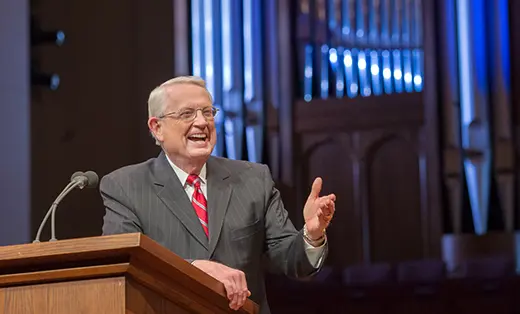
Join Pastor Chuck Swindoll as he describes the amazing things the Holy Spirit accomplished through the disciples and teaches how the same Holy Spirit works in and through us today.
Message Summary:
In this message centering on the dramatic events of Acts 2, Chuck Swindoll explores the transition from Jesus’ earthly ministry to the arrival of the Holy Spirit, which serves as the essential fuel for the church's mission. Swindoll begins by defining what it means to crown Jesus as Lord—not merely a theological concept, but a tangible release of the will, breaking habits of selfishness, prejudice, and grudges to allow Him to rule over every detail of life. The message traces the disciples' journey from the Mount of Olives, where they witnessed the Ascension and received the mandate to be witnesses "to the ends of the earth," back to the Upper Room in Jerusalem. Swindoll notes that just as Jesus was physically present with the disciples during His ministry, the Holy Spirit is now brought alongside believers to give them strength, vision, and the ability to recall Jesus' teachings. Swindoll then vividly describes the arrival of the Holy Spirit on the Day of Pentecost. He details three supernatural evidences that marked this unique historical event: an audible sound like a roaring wind, visible tongues of fire, and the oral miracle of Galileans speaking in known foreign languages. Swindoll clarifies that this phenomenon was not "gibberish," but the supernatural ability to speak the specific "heart languages" of the international crowd gathered in Jerusalem. He concludes by cautioning that while this event was necessary to launch the church, believers today should not confuse this unique historical transition with a normative requirement for being in the will of God [6–8, 10].
Message Key Facts:
- Crowning Him Lord: Swindoll explains that we crown Jesus spiritually and tangibly when we say "no" to our desires and "yes" to His, specifically in areas like giving and releasing prejudices.
- The Upper Room Discourse: Swindoll identifies John 13–16 as the teaching session Jesus gave to the eleven faithful disciples in a second-story flat after Judas left into the darkness.
- The Ascension: Occurring on the Mount of Olives 40 days after the resurrection, this event marked the final transition of Jesus' physical presence away from earth.
- Pentecost Defined: The word Pentecost is a transliterated Greek word meaning "the fiftieth," marking the festival occurring 50 days after the first Sunday following Passover.
- Three Evidences of the Supernatural: Swindoll identifies three specific miracles in Acts 2:
- Audible: A sound from heaven like a "Roaring Mighty Windstorm" (though no actual wind is mentioned).
- Visible: Something resembling flames or tongues of fire settling on the believers.
- Oral: The disciples speaking in understandable foreign languages.
- The Nature of "Tongues": Swindoll emphasizes that the "tongues" spoken were intelligible dialects. The crowd was amazed because they heard their own "heart languages"—such as the languages of Rome, Egypt, and Mesopotamia—being spoken by Galileans [7–9].
- The "Galilean" Surprise: The crowd's amazement stemmed from the fact that the speakers were Galileans, whom Swindoll characterizes as "not the brightest bulbs in the hallway" regarding education, yet they were suddenly articulating complex foreign idioms perfectly.
- Transition vs. Norm: Swindoll clarifies that Acts 2 represents a specific transition era. He notes that believers today do not need to duplicate the experience of sudden language fluency to be in God's will; modern missions generally require language study.
Message References:
- Acts 1:8: Jesus’ final mandate: "You will receive power when the Holy Spirit comes upon you and you will be my Witnesses... to the ends of the Earth".
- Acts 1:12–13: The disciples return to the Upper Room from the Mount of Olives.
- Acts 2:1–4: The Day of Pentecost, the sound of the wind, and the tongues of fire [5–6].
- Acts 2:7–12: The crowd’s reaction to hearing Galileans speak in their own native languages.
- John 14–16: Referenced as the content of the Upper Room Discourse.