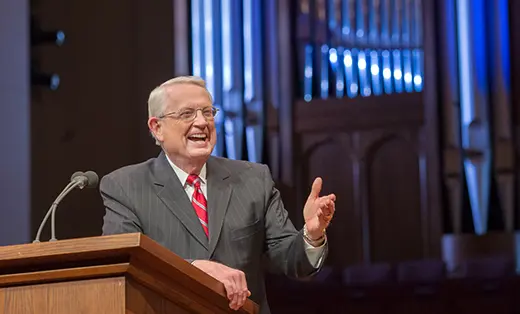
Overview:
In the courtroom of heaven, God’s holiness, purity, righteousness, goodness, and perfection are on His record. But on our ledgers are sin, rebellion, disobedience, and unrighteousness.Gratefully, that’s not the end of the story! Pastor Chuck Swindoll expresses the vital role of Jesus as the Mediator between God and humanity.As our Mediator, Jesus perfectly represents both parties—God and humanity—that you may cultivate an eternal, joyful relationship with your Maker. Rejoice in this bridge as a member of God’s family!
Message Summary:
In this profound and clarifying message, Chuck Swindoll addresses a fundamental human problem: the distance between us and God. He begins with a relatable personal story from his youth—a time when he worked as an apprentice machinist in a union shop. He describes a moment of escalating tension between management and labor that nearly resulted in a strike. The solution did not come from more arguments, but from the arrival of a professional mediator—a "go-between" who could stand in the middle, hear both sides, and forge a path to peace. Chuck uses this as a powerful metaphor for the human condition. Because of sin, there is a "strike" in the universe; an argument has intensified between the Creator and the created, and we are incapable of resolving it on our own. This study focuses on 1 Timothy 2, revealing that there is only one individual qualified to settle this cosmic dispute: the man Christ Jesus.
The core of the teaching explores the technical and theological definition of a "Mediator" (mesitēs). Chuck argues that for a mediator to be effective, they must have something in common with both parties. If Jesus were only God, He couldn't represent man; if He were only man, He couldn't represent God. By taking on human flesh while retaining His full divinity, Jesus became the only bridge in existence. This message serves as a reminder that we do not need to "work our way" into God's presence or rely on human priests, saints, or religious rituals. Through the finished work of the Mediator, the "deadline" for judgment has been replaced by the "headline" of peace.Message Key Facts:
- The Union Shop Analogy: Chuck recounts his 4.5 years as an apprentice machinist. He uses the threat of a strike to illustrate the necessity of a mediator. In human relations, a mediator is a neutral third party; in theology, the Mediator is the Son of God who takes the "hit" for both sides to bring about reconciliation. Chuck emphasizes that without a mediator, the gap between management and labor (or God and man) only grows more hostile.
- The Definition of Mesitēs: A major highlight is the word study of the Greek term mesitēs. Chuck explains that it literally means "one who intervenes between two to restore peace." It implies a "middle-man" who is trusted by both parties. He contrasts this with the "Daysman" mentioned in the book of Job—an ancient longing for someone to "lay his hand upon us both." Jesus is the fulfillment of that ancient cry, having one hand on the throne of God and the other on the shoulder of sinful man.
- The Exclusivity of the Mediator: Chuck dives into the phrase "there is one God, and one mediator." He challenges the common religious tendency to add more mediators—whether it be the Virgin Mary, the saints, the church, or a human pastor. He argues that any system that requires a "go-between" other than Christ is an insult to the sufficiency of His sacrifice. He asserts that the bridge to God is not a multi-lane highway of various religions, but a single, narrow path through Jesus Christ.
- The "Ransom" Price (Antilutron): Chuck explores the "driving force" of the mediation: the sacrifice. He points out that the mediator didn't just talk; He paid. Using the Greek word antilutron, Chuck explains the concept of a "ransom" given in exchange for the lives of many. This was the "price of Jesus' death" that made the mediation effective and permanently satisfied the righteous requirements of God.
- The Result of Peace (Eirēnē): Chuck emphasizes that the ultimate goal of the mediator is to bring peace. He distinguishes between "peace with God" (our legal standing) and the "peace of God" (our internal state). He posits that many believers live without peace because they haven't fully realized that the argument between them and God has been permanently settled. The Mediator has signed the contract, and the strike is over.
- The Spirit’s Role in Reconciliation: While the message focuses on Christ, Chuck acknowledges the "Resident Dynamic" of the Spirit as the one who makes this peace a living reality in our hearts. The Spirit is the one who bears witness to our spirits that the mediation was successful, giving us the "quiet calm" and "reassuring sense of peace" even in the midst of "stormy experiences" and "unexplained surprises."
Message References:
- 1 Timothy 2:1–6: The primary text for the study. Chuck unpacks the command to pray for all people (including leaders), the desire of God for all to be saved, and the definitive statement that there is "one mediator between God and men, the man Christ Jesus."
- Job 9:32–33: Job’s lament for a "Daysman" or an umpire who could bridge the gap between him and the Almighty. Chuck uses this to show the universal human need for the mediation that Christ provided.
- Romans 5:1: The foundational promise: "Therefore, having been justified by faith, we have peace with God through our Lord Jesus Christ." Chuck uses this to support the "Result of Peace" highlight.
- Hebrews 9:15: A reference to Christ as the "mediator of a new covenant," showing that His death was the means of redemption for the transgressions committed under the first covenant.
- Hebrews 8:6: A description of Jesus as the mediator of a "better covenant," enacted on better promises. Chuck uses this to show that Christ’s work is superior to any Earthly religious system.
- Isaiah 59:2: A reminder that "your iniquities have made a separation between you and your God." This provides the biblical "case for the gap" that the Mediator was sent to bridge.
- John 14:6: Jesus’ own declaration: "I am the way, and the truth, and the life; no one comes to the Father but through Me." Chuck links this to the "Exclusivity" point, affirming that there is no other mediator.