Overview:
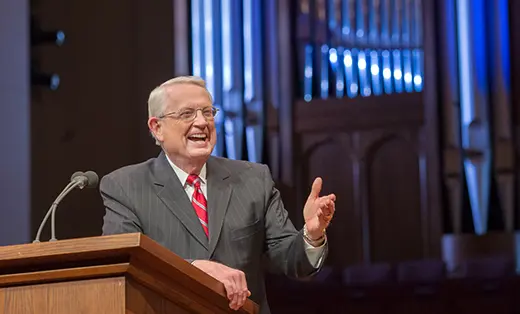
Do you find it easy to forgive? Of course not! No one does. It’s very unnatural. In God’s kingdom and by God’s power, however, offering forgiveness is normal. God is a God of grace and mercy. David’s dealing with his slanderer, Shimei, presents one of the brightest moments of his kingship. David displayed the heart of God. This sermon on 2 Samuel 16 and 19 from Pastor Chuck Swindoll offers sound, biblical advice to help you become a person of Christ-centered forgiveness.
Message Summary:
In this message based on 2 Samuel 16 and 19, Chuck Swindoll explores the difficult but necessary discipline of total forgiveness. The sermon is set against the backdrop of one of the lowest points in King David’s life: he is fleeing Jerusalem barefoot and weeping after his son Absalom has usurped the throne. In this moment of vulnerability, David encounters Shimei, a man who throws stones and curses at him. Swindoll contrasts the reaction of David’s general, Abishai, who wants to behead the offender, with David’s surprising humility. David refuses revenge, reasoning that perhaps God has allowed this abuse for a purpose.
Swindoll warns against the “downward plunge” that occurs when we refuse to forgive: an offense turns into resentment, which hardens into hatred, forms a grudge, and ultimately seeks revenge [8–9]. He challenges listeners to reject “conditional,” “partial,” or “delayed” forgiveness, urging them instead to make a literal list of those they need to release [7–8].
The message concludes with the scene from 2 Samuel 19, where David returns to power. When Shimei begs for mercy, David again rejects the advice to kill him, choosing instead to break the cycle of violence. Swindoll offers practical steps for modern believers: cultivate “thick skin,” try to understand the pain behind an offender’s actions, and verbalize forgiveness with the healing words, “Let’s go on from here” [23–25, 31].
Message Key Facts:
- The “Tiger” Within: Swindoll uses a story about an Indian man attacked by a Bengal tiger to illustrate the savage nature of the human heart. He notes that while we easily forgive big sins, we struggle to forgive the “little humanities” of others because there is a “mean cat” inside us waiting to pounce [5–6].
- Three Types of “Phony” Forgiveness:
- Conditional: “I will forgive you if…” (Waiting for the other person to earn it).
- Partial: “I forgive you but…” (Forgiving but refusing to forget or let go) [7–8].
- Delayed: “I will forgive you someday…” (Holding the debt over their head).
- The Downward Plunge: Swindoll outlines the destructive sequence of unforgiveness: Offense → Resentment → Hatred → Grudge → Revenge. He emphasizes that we must deal with the issue at the “offense” level before it slides down to revenge [8–9].
- Shimei as the “Kicker”: Shimei represents the type of person who “kicks you while you are down.” Swindoll notes that Shimei lied three times about David’s character, yet David refused to be offended, suggesting that God might return good to him because of this suffering [12–14].
- Thick Skin, Soft Heart: A central application of the sermon is the need for believers to develop a “rhinoceros” hide—a thick skin that isn’t easily pierced by insults—while maintaining a heart sensitive to God.
- Redeeming Stamps: Swindoll explains human explosions of anger using the metaphor of “saving stamps.” People often quietly collect offenses (stamps) in a book, and then “redeem” the whole book at once over a minor incident, confusing everyone around them [26–27].
- The Rockefeller Illustration: Swindoll tells the story of John D. Rockefeller reacting to an executive who made a $2 million mistake. Instead of firing him, Rockefeller made a list of the man’s past successes, deciding his good points outweighed the error—a model of vertical, grace-oriented focus [16–17].
- Verbalize Forgiveness: The sermon suggests that thinking forgiveness is not enough; we must say it. Swindoll recommends the phrase, “Let’s go on from here,” as a powerful way to signal a new start.
Message References:
- 2 Samuel 16:5–13: The account of David fleeing Jerusalem and being cursed and stoned by Shimei.
- 2 Samuel 19:15–23: The account of David returning to the throne and granting Shimei mercy despite Abishai’s desire to kill him.
- Psalm 40:1–2, 12: “I waited patiently for the Lord… He brought me up out of the pit.” Swindoll connects this psalm to David’s feelings during his flight from Absalom.
- 2 Samuel 16:10: David’s response to the offense: “If he curses, and if the Lord has told him, ‘Curse David,’ then who shall say, ‘Why have you done so?'”.
- 2 Samuel 16:12: David’s hope in God’s sovereignty: “Perhaps the Lord will look on my affliction and return good to me instead of his cursing this day”.