Overview:
Most discussions on the passion of Christ focus primarily on the moments leading up to His death and the events following His resurrection. But what happened in the meantime?
Matthew 27:51–66 records these spectacular, though often-overlooked, events: the torn temple curtain, a great earthquake, and many people waking from the dead.
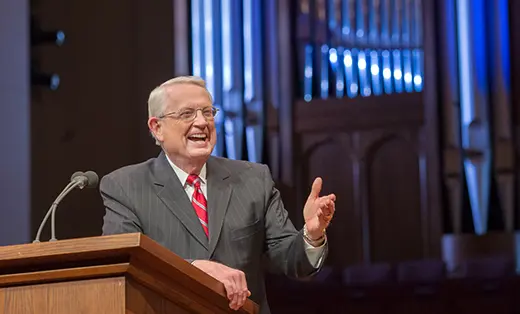
Pastor Chuck Swindoll explains these events and more as he teaches how God provides His people with hope in dark times.
Message Summary:
In this message exploring the immediate aftermath of the Crucifixion, Chuck Swindoll pauses to examine the events recorded in Matthew 27 that occurred between the death of Jesus and His Resurrection. While great historical events often eclipse the days that follow, Swindoll argues that the supernatural phenomena accompanying Jesus’ death—the tearing of the temple veil, the earthquake, and the opening of tombs—provide profound theological hope [14–17, 21]. He emphasizes that Jesus truly died, refuting skeptical claims of a “swoon,” noting that He “released His spirit” before these miraculous signs occurred.
Swindoll details the significance of the torn veil in the Temple, explaining that God tore this massive, handwoven tapestry from “top to bottom” to signal that the barrier between a holy God and sinful humanity was permanently removed. Believers now have bold access to the throne of grace without the need for human priests [21–26]. The sermon also focuses on the conversion of the Roman Centurion, a battle-hardened soldier who, upon witnessing the earthquake and Jesus’ demeanor, declared, “This man truly was the Son of God.” Swindoll uses this to encourage listeners not to give up on “hard cases” or lost loved ones, as no one is beyond the reach of God’s grace [41–43, 64].
The message concludes with the futile efforts of the religious leaders and Pilate to secure the tomb. Despite sealing the stone and posting guards to prevent the disciples from stealing the body, their attempts to hinder God’s plan were laughable. Swindoll draws three applications: when you reach a dead end, remember God is still working; never write off a “lost” person; and realize that no human plan can ever thwart the power of the Resurrection [58–61, 62–68].
Message Key Facts:
- The “Day After” Phenomenon: Swindoll observes that people vividly remember great events (like 9/11 or the JFK assassination) but rarely remember the specific details of the day after. Matthew, however, records the crucial details immediately following the death of Christ [14–15].
- The Temple Veil: Swindoll cites A. Robertson to describe the massive curtain separating the Holy of Holies. It was 60 feet long, 30 feet wide, and about 4 inches thick (the thickness of a phone book). It was made of 72 twisted plaits, requiring 300 priests to move it. Its tearing from top to bottom was a divine act, not human vandalism [23–24].
- The Earthquake: Having experienced earthquakes in California, Swindoll describes the terror of the ground moving. He notes that the quake at Jesus’ death was violent enough to split rocks, terrifying the soldiers [31–34].
- The Resuscitated Saints: Matthew records tombs opening and bodies appearing. Swindoll clarifies (referencing J. Dwight Pentecost) that while the tombs opened at the earthquake, these saints did not appear in Jerusalem until after Jesus’ resurrection, as Christ is the “first fruits” of those raised [37–39].
- The Centurion’s Conversion: The Centurion is described as a “rugged, battle-scarred, war-hardened veteran” who doesn’t base decisions on emotion. His confession that Jesus was the Son of God is viewed by Swindoll as a genuine moment of conversion for a Gentile [41–42].
- Burial Customs: Unlike modern burials, Jesus was wrapped like a mummy in linen strips with gummy spices. Swindoll notes that the stone rolled across the entrance was designed to keep predators and thieves out, often weighing a ton or more [49–51].
- The Stone’s Purpose: Swindoll hints that the stone was eventually rolled away not to let Jesus out (His glorified body could pass through matter), but to let the witnesses in to see the empty tomb.
- Nebuchadnezzar and Saul: To illustrate that no one is too far gone, Swindoll connects the Centurion to Nebuchadnezzar (who lived like an animal but was restored) and Saul of Tarsus (the terrorist turned Apostle), urging prayer for those who seem unreachable [66–67].
Message References:
- Matthew 27:50: The moment of death: “Jesus shouted again and He released His spirit”.
- Matthew 27:51: The supernatural signs: “The curtain in the sanctuary… was torn in two from top to bottom; the earth shook, rocks split apart”.
- Matthew 27:54: The Centurion’s confession: “The Roman officer… said, ‘This man truly was the Son of God'”.
- Hebrews 4:16: The theological result of the torn veil: “Let us therefore draw near with confidence… to the throne of grace”.
- Matthew 27:57–60: Joseph of Arimathea secures the body and places it in his own new tomb [7–8].
- Matthew 27:62–66: The Pharisees request a seal and guards to prevent the disciples from stealing the body [8–9].
- Daniel 4:35: Quoted to illustrate God’s sovereignty over human resistance: “No one can stop His hand or say to Him, ‘What are You doing?'”.