Overview:
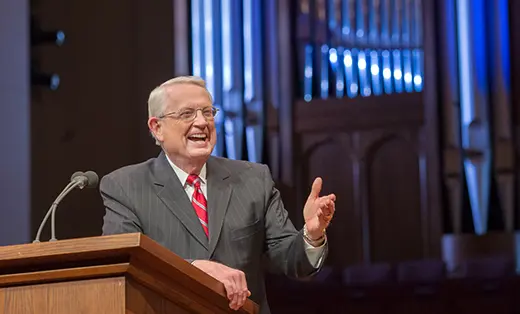
Even though the apostle John was just beginning to take in the heavenly visage before him, he understood quickly the dilemma he witnessed—there was no one worthy to open the momentous scroll in the Father’s hand. Put yourself in John’s sandals as Pastor Chuck Swindoll expounds on Revelation 5:1–14. Imagine the relief John felt when he realized the Lamb of God would step in! Understand the significance of the sealed scroll and the Lion of Judah, and join in the heavenly chorus, “Worthy is the Lamb!”
Message Summary:
Message Key Facts:
- Meaning of Hallelujah: Swindoll begins by breaking down the word "Hallelujah" (or Alleluia). It is a combination of Hal (praise) and Yah (short for Yahweh). It literally means "Praise the Lord".
- The Seven-Sealed Scroll: Swindoll explains that the scroll (biblion) in verse 1 is written on the front and back and sealed with wax. Drawing on historical context, he notes that ancient Roman contracts and wills were often written this way, with the details sealed inside and a summary on the outside. This scroll represents the "title deed" to the earth [12–14].
- The Lion and the Lamb: There is a deliberate paradox in the text. The elder announces a Lion (symbolizing the conquering King from the root of David), but John sees a Lamb (symbolizing the sacrificial Savior). Swindoll connects this image to Exodus 12, noting the Lamb still bears the marks of slaughter ("standing as if slain") [16–17, 22].
- The Passover Connection: Swindoll takes the audience back to Exodus 12 to explain the significance of the Lamb. Just as the Israelites had to kill a spotless lamb and apply its blood to the doorposts for deliverance, Jesus is the ultimate Passover Lamb whose blood purchased men from every tribe and nation [18–21, 26].
- Three Waves of Praise: Swindoll identifies a growing circle of praise in the chapter:
- The Redeemed (v. 8–10): The four living creatures and 24 elders sing a "new song" about being purchased by blood.
- The Angels (v. 11–12): Myriads of angels (too many to count) declare the Lamb's worthiness to receive power and riches.
- All Creation (v. 13): Every creature in heaven, on earth, under the earth, and in the sea joins the anthem [25–29].
- The Weight of Glory: Swindoll closes with a story about his Hebrew professor, Dr. Bruce Waltke, defining the word "glory" (kavod). It literally means "heavy" or "weighty." To give God glory is to acknowledge His supreme significance and "weight" above all else [36–37].
- Don Wyrtzen’s Song: Swindoll shares a personal memory of receiving a phone call from composer Don Wyrtzen, who played his newly written song "Worthy Is the Lamb" over the phone—a melody inspired directly by this text [6–7].
Message References:
- Revelation 5: The primary text detailing the scroll, the Lion/Lamb, and the worship of heaven [1–2].
- Exodus 12:3–11: The instructions for the Passover Lamb, used to illustrate the sacrificial nature of the Lamb in Revelation [18–21].
- Isaiah 53:7: Prophecy depicting the Messiah as a lamb led to the slaughter.
- John 5:21–27: Jesus’ teaching that the Father has given all judgment to the Son.
- Deuteronomy 6: Referenced regarding the "Mezuzah" (doorpost) tradition derived from the Passover instructions [19–20].