Overview:
Many of us are fascinated with life after death which causes us to wonder about marriage in heaven. Did you know that Jesus addressed this question?
In Matthew 22:23–33, the Sadducees tried to test Jesus with this very subject . . . even though they didn’t even believe in life after death. They simply wanted to trap Him.
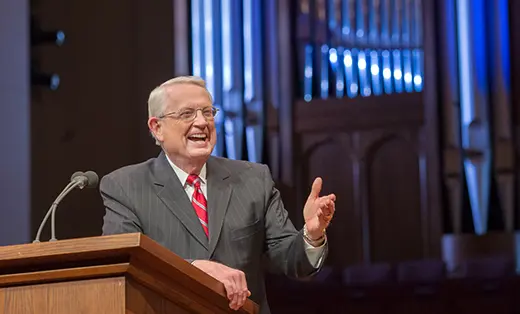
With unwavering courage, Jesus faced them head on. Pastor Chuck Swindoll explores this intriguing discussion and teaches how to think correctly about life after death.
Message Summary:
In this message from Matthew 22, Chuck Swindoll addresses one of the most common questions regarding the afterlife: the nature of relationships in eternity. The text centers on a confrontation between Jesus and the Sadducees, a group of wealthy, sophisticated religious leaders who denied the existence of the supernatural, including angels and the resurrection [23–24]. Attempting to make the concept of resurrection look absurd, they presented Jesus with a complex "word problem" involving a woman who was widowed seven times by seven brothers. They asked, "Whose wife will she be in the resurrection?" [25–27]. Swindoll breaks down Jesus’ masterful response, which diagnosed the Sadducees' error as stemming from two root causes: "You don't know the scriptures and you don't know the power of God". Jesus corrected their theology by revealing that in heaven, people "will neither marry nor be given in marriage" but will be "like the angels," living in a deathless, glorified state where procreation and earthly institutions are no longer necessary [34–36, 43]. Swindoll clarifies that this does not mean believers will be distant from their earthly spouses; rather, earthly marriage is a shadow of the ultimate relationship with Christ, and relationships in heaven will be deeper and more fulfilling [39–41]. To prove the reality of the resurrection to those who only accepted the Law of Moses, Jesus quoted Exodus 3:6: "I am the God of Abraham, Isaac, and Jacob." Swindoll highlights the grammatical power of this statement—God is the God of the living, not the dead, proving that the patriarchs are currently alive in His presence [49–50]. The sermon concludes with a practical challenge to the congregation to cure their own spiritual ignorance through disciplined Bible study, scripture memory, and acknowledging God's power through prayer and journaling [56–66].
Message Key Facts:
- The Sadducees: Described by Swindoll as "mean-spirited, rude, arrogant, self-righteous bigots," this group was smaller than the Pharisees but held significant power. They were theological liberals who rejected the supernatural, believing that death ended existence—hence, no judgment, heaven, or hell [23–24].
- The Two Roots of Error: Jesus pinpointed the source of all spiritual chaos to two specific ignorances: not knowing the Scriptures (the Word of God) and not knowing the Power of God (the God of the Word). Swindoll notes that if you lack these, you are at the mercy of any false teaching [30–32].
- Marriage in Heaven: Jesus taught that while there is a resurrection ("when the dead rise"), the institution of marriage ends at death. In heaven, we are not "given in marriage." Swindoll explains this requires us to "think outside the terms of the familiar" [35–38].
- The Randy Alcorn Insight: Swindoll quotes Randy Alcorn’s book Heaven to comfort those fearing the loss of intimacy. Alcorn suggests that earthly marriage is a "shadow" of the ultimate marriage to Christ. In heaven, we will not be distant from our spouses but closer, as "the closer we draw to Him, the closer we draw to each other" [39–41].
- "Like the Angels": Believers do not become angels, but in the resurrection, they share characteristics with them: they are sinless, deathless, ageless, and do not reproduce. Consequently, the need for marriage (propagation of the race) is removed [42–43].
- The Grammar of Resurrection: Jesus floored the Sadducees by quoting the Pentateuch (Exodus 3:6). He emphasized the present tense verb "I am." If Abraham, Isaac, and Jacob were gone forever, God would have said "I was their God." His statement proved they are still alive [49–50].
- Ignorance is Not Bliss: Swindoll refutes the common saying, arguing that ignorance about God keeps people atheistic and confused about suffering. He challenges listeners to become students of the Bible to gain stability [44–45].
- Practical Disciplines: To combat spiritual ignorance, Swindoll recommends:
- Scripture Memory: Following the example of Jesus, who quoted Scripture from memory.
- Journaling: Not a diary of events, but a record of what God is teaching you and how He answers prayer ("thoughts disentangle themselves over the lips and through the fingertips") [61, 65–66].
Message References:
- Matthew 22:23–33: The primary text detailing the Sadducees' question and Jesus’ answer regarding the resurrection.
- Exodus 3:6: The verse Jesus quotes to prove the resurrection: "I am the God of Abraham, the God of Isaac, and the God of Jacob".
- 1 Thessalonians 4:16–18: A key passage on the Rapture and resurrection used to establish that the dead in Christ will rise first.
- Matthew 22:29: Jesus’ rebuke: "Your mistake is that you don't know the scriptures and you don't know the power of God".