Overview:
Self-promotion is so natural we barely notice it. We angle for recognition, guard our reputations, and resist situations that might diminish our status. But Jesus—who had every reason to insist on His position—chose the opposite path entirely.
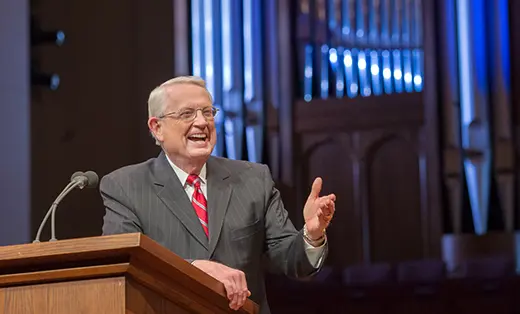
From Philippians 2:5–8, Pastor Chuck Swindoll unpacks one of the most majestic passages in Scripture: how Jesus, though existing in the very form of God, emptied Himself, took the form of a bond-servant, and humbled Himself to death on a cross.
Let this portrait of Christ confront your own pride. Have the same attitude—and live with the freedom that comes with a servant’s heart.
Message Summary:
Message Key Facts:
- Love vs. Grace: Swindoll distinguishes between these two attributes: Love is affection that reaches out, but grace is love that stoops. It is not complete until it reaches down to pick up the fallen.
- The Pat Summerall Story: Swindoll recounts the life of the famous sportscaster who, despite professional success, battled severe alcoholism. Summerall hit rock bottom in a hotel in Augusta, Georgia, vomiting blood and feeling like a "monster," before an intervention led him to the Betty Ford Clinic where he found Christ through reading a Gideon Bible [14–19].
- Defining Humility: Swindoll defines humility as "a willingness to give up my will for another's good in order to accomplish what's best." It is the desire to serve rather than be served [26–27].
- Greek Word Study (Morphe vs. Schema):
- Morphe (Form): The essential nature that never changes. Jesus existed in the "form of God" and never ceased to be God.
- Schema (Likeness): The external form that changes over time. Just as a human changes from embryo to adult but remains human, Jesus took on the changing schema of a man while retaining His divine morphe [33–35].
- The Meaning of "Emptied Himself": Explaining the "kenotic theory," Swindoll quotes the Ryrie Study Bible to clarify that Christ did not give up His attributes of deity, but rather "took on the limitations of humanity" [38–39].
- True Humanity: Swindoll emphasizes that Jesus was not "play-acting" as a human. He bled when cut, cried when sad, and slept when tired. Swindoll even suggests that as a true human, Jesus likely snored when He slept [41–42].
- The Horror of the Cross: Quoting F.F. Bruce, Swindoll notes that the cross was viewed with "unspeakable horror" and disgust in the first century. He compares hanging a cross in a church today to displaying an electric chair or a syringe used for lethal injection, highlighting the shock of God using such an instrument for redemption.
- The Sanctuary Cross: Swindoll describes the cross designed for the church building: rugged, unstained timber with leather straps, intentionally lacking polish or glitter to serve as a stark reminder of the reality of the crucifixion.
Message References:
- Philippians 2:5–8: The primary text urging believers to have the same attitude as Christ, who emptied Himself and became obedient to death.
- Matthew 11:28–30: Jesus’ invitation: "Come to Me, all who are weary and heavy-laden, and I will give you rest."
- Mark 10:45: "For even the Son of Man did not come to be served, but to serve, and to give His life a ransom for many".
- Galatians 6:14: Paul’s declaration: "But may it never be that I would boast, except in the cross of our Lord Jesus Christ".
- 1 Corinthians 11:23–25 (Implied): The institution of the Lord's Supper ("The night in which He was betrayed...").