Overview:
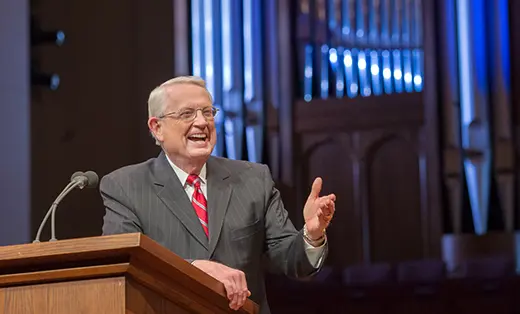
Jesus promised the indwelling “Spirit of truth” for all believers. So, how well do you know Him? With his characteristic practical approach, Pastor Chuck Swindoll introduces the Holy Spirit anew. Addressing the hesitation many feel at falling into error, Pastor Chuck provides scriptural basics to help you go deeper in your relationship with the Spirit. Overcome the fearful unknown and the wall of traditional resistance so you don’t miss out on growing your relationship with the Gift-Giver who reveals the Father’s will.
Message Summary:
Many Christians find the concept of the Holy Spirit to be the most elusive and misunderstood aspect of the Trinity. While most believers can easily visualize God as a guiding, sovereign Father or Jesus as the Savior who walked among us in human form, the Holy Spirit often remains shrouded in "foggy symbolism." In this foundational message, Chuck Swindoll challenges the church to move beyond sterile theological definitions—what he calls the "letter P" for pneumatology—to discover the practical, intimate dynamic of the Spirit. He argues that the Spirit is not a vague influence or a ghostly remnant, but a resident power—a "dynamic" within the believer—specifically designed to navigate the deep, often unspoken trials of life that human wisdom cannot solve.
Chuck emphasizes that the transition from the Gospels to the book of Acts represents a critical "passing of the baton" in the history of redemption. Before the Cross, the Holy Spirit was with God’s people, coming upon individuals for specific tasks or seasons of empowerment. However, following the resurrection and ascension of Christ, a new era began where the Spirit dwells in the believer permanently. This shift provides an unparalleled aid, offering a sense of invincibility and confidence that is not dependent on natural temperament or physical strength. By stripping away traditional resistance and the fear of the unknown, Chuck explains that we can begin to experience the Spirit’s work in healing deep emotional scars, interpreting our wordless groans during times of intense suffering, and providing the spiritual "unction" required to stand firm in an increasingly intimidating world.Message Key Facts:
- The "Holy Smoke" Illustration: Chuck opens the message with a humorous yet poignant story of a primary school teacher, Miss Johnson, who used a large, three-holed pretzel to explain the Trinity to her class. When she called on a young student named Johnny to identify the members of the Godhead, he confidently pointed to the holes and said, "This is the Father, this is the Son, and this is the Holy Smoke." While the class laughed at the mistake, Chuck uses this as a powerful metaphor for the modern church. Even though we might say the names correctly, most Christians are hard-pressed to explain the actual work and ministry of the Spirit, often viewing Him as more of a "smoke" or a vague mist than a distinct, active Person of the Trinity.
- The Baton Pass and "Greater Works": Using the imagery of an Olympic relay race, Chuck describes Jesus’ departure as a calculated transition of power. He notes that a race is won or lost during the passing of the baton. When Jesus told His disciples they would do "greater works" than He did, He wasn't suggesting they would be more divine, but that their reach would be expanded through the indwelling Spirit. While Jesus was limited by His physical body to one location at a time, the Holy Spirit inhabits every believer simultaneously, allowing the work of the Gospel to explode across the globe.
- Dunamis vs. Dynamite: Chuck spends significant time distinguishing between modern "power" movements and biblical dunamis. While we get the word "dynamite" from this Greek root, Chuck prefers the word "dynamic." He argues that "dynamite" suggests an explosion that leaves a mess, whereas the Holy Spirit’s dunamis is a residing sense of invincibility, a deep-seated confidence, and a persevering consistency. This dynamic is what allowed the early apostles to push open the doors they were hiding behind and speak with audacity in the streets of Jerusalem, despite the threat of martyrdom.
- The Intimate Healing Balm: One of the most moving portions of the message is Chuck's discussion of the Spirit as a "healing balm." He addresses the "bathos"—the deep, dark depths of human experience—including the scars left by abuse, incest, and abandonment. Chuck posits that while human psychology has its limits, the Spirit of God has the unique capacity to probe the deepest parts of the soul to erase bitterness and provide relief. He challenges the congregation to stop treating the Spirit’s healing as a distant possibility and start seeing it as a present reality for those carrying heavy emotional burdens.
- Testing the Spirits: Chuck warns against the "wall of traditional resistance," where fear of "going charismatic" prevents believers from accessing the very power God provided. He encourages the church to "relax" and stop defending denominations or labels. Instead, he urges them to use the "inner dynamic" to test the spirits of the age, ensuring they are following the truth of God rather than the imaginations of the human mind or the intimidation of the world.
Message References:
- John 14:16–17 & 16:7: These are the primary texts where Jesus promises "another Helper" (paracletos). Chuck highlights the Greek word for "another," which signifies someone of the exact same kind. Jesus assures the disciples that it is actually to their "advantage" that He leaves, because His departure triggers the arrival of the permanent, indwelling Spirit who will never leave them orphaned.
- Romans 8:22–27: Chuck focuses on the "unspoken" ministry of the Spirit during times of groaning. When believers are so emotionally drained or spiritually exhausted that they cannot even find the words to pray, the Spirit "helps our weakness," interpreting our garbled feelings and translating them into the perfect will of God.
- 1 Corinthians 2:9–12: This passage explains that the Spirit "searches all things, even the depths (bathos) of God." Because the Spirit knows the intimate thoughts of God, He is the only one who can reveal spiritual truths to us, combining spiritual thoughts with spiritual words in a way that human wisdom never could.
- Acts 1:4–8 & 4:13: These verses chronicle the immediate impact of the Spirit’s arrival. Chuck notes that the "uneducated and untrained" apostles were transformed into men who "marveled" the authorities. Their confidence was not born of education but of the dunamis promised by Christ, proving that they had "been with Jesus."
- Psalm 51:10–12: Chuck provides a critical "pre-Pentecost" perspective by looking at David’s prayer. In the Old Covenant, the Spirit could be "taken" from a person (as happened with Saul), which explains David’s plea. Chuck contrasts this with the New Covenant reality, where the Spirit’s presence is a permanent "sealing" that provides constant security for the believer.
- 1 John 2:20 & 4:1–4: These verses speak to the "unction" or "anointing" that every believer possesses. This anointing acts as a spiritual sensor, allowing Christians to discern between the Spirit of Truth and the spirit of the Antichrist, reminding us that "Greater is He who is in you than he who is in the world."