Overview:
After he became king, David honored his promise to the late Saul to show mercy to the former king’s descendants. When David learned of a surviving grandson, he went beyond the realm of mercy into the land of grace. Mephibosheth never saw it coming.
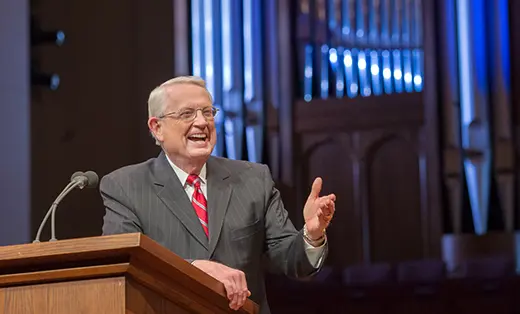
Pastor Chuck Swindoll explains the significance of David’s countercultural grace displayed in 2 Samuel 9.
Do you truly understand the extent of God’s grace?
Message Summary:
Message Key Facts:
- A Definition of Grace: Swindoll offers a specific, working definition: "Grace is a demonstration of love that is not deserved and can never be repaid." It operates apart from the response or ability of the individual receiving it.
- The "Kindness" of God: Swindoll notes that the word "kindness" in verse 1 is a translation of the Hebrew word hesed, which is better rendered as mercy or grace. It is deeper than soft tenderness; it is loyal love based on a covenant.
- The Two Promises: David’s actions were rooted in two promises he made years prior:
- To Jonathan (1 Samuel 20): That he would not cut off his lovingkindness from Jonathan’s house forever.
- To Saul (1 Samuel 24): That he would not destroy Saul's name or descendants.
- Lo-debar: Mephibosheth was found in a place called Lo-debar. Lo means "no" and debar comes from the root for "pasture." He was living in a barren wasteland of desolation, hiding from the King.
- The Cause of the Crippling: Swindoll references 2 Samuel 4:4 to explain Mephibosheth’s condition. At age five, upon hearing of Saul and Jonathan's deaths, his nurse fled in panic and dropped him, leaving him lame in both feet for life.
- The "Yes" Face: Swindoll uses an illustration of Thomas Jefferson carrying a man across a river because he had a "Yes face." Similarly, when Mephibosheth looked at David, he didn't see the "No" of judgment, but the "Yes" of grace.
- The Tablecloth of Grace: Swindoll asks listeners to imagine the supper table. While David’s other children (Absalom, Tamar, Solomon) were physically attractive, Mephibosheth hobbled in. However, once seated, "the tablecloth covered his feet," and he looked just like the other sons of the King. This pictures how God’s grace covers our infirmities and treats us as equal heirs.
- Analogies of Salvation: Swindoll lists several parallels between Mephibosheth and the believer:
- We were hiding from God (as Mephibosheth hid from David).
- We had nothing to offer and could not repay the King.
- We were taken from a barren place to a place of plenty.
- We were adopted into the family for the sake of Another (Jesus/Jonathan).
Message References:
- 2 Samuel 9: The primary narrative of David showing kindness to Mephibosheth.
- 1 Samuel 20:13–15: Jonathan asking David to promise kindness to his house forever.
- 1 Samuel 24:20–22: Saul asking David to swear he will not cut off his descendants.
- 2 Samuel 4:4: The historical account of how Mephibosheth became lame in his feet.
- 2 Samuel 9:8: Mephibosheth’s response to grace: "What is your servant that you should regard a dead dog like me?"