Overview:
Often, leaders share what they most want us to remember before they die.
We find the same in Joshua after he led the Israelites on their Canaanite conquest. He issued a call of faith so the Israelites would remember God’s grace and truth, which they began to witness in Egypt, so that they would live in loving obedience to Him.
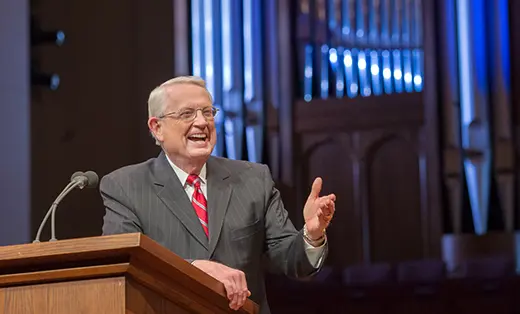
Chuck Swindoll walks us through Joshua’s final words to the Israelites and teaches us to cultivate a wholesome, worshipful respect for God.
Message Summary:
Message Key Facts:
- The Cycle of Civilization: Swindoll cites Alexander Tytler, who described the 200-year cycle of great civilizations: from bondage to spiritual faith, to courage, to liberty, to abundance, to complacency, to apathy, to dependency, and finally back to bondage. Swindoll places Israel (and modern society) at the vulnerable stage between abundance and complacency [20–21].
- The Definition of Grace: Swindoll defines grace as "what God does for us which we cannot do for ourselves, which we do not deserve and can never repay." He points out that in Joshua's review of history, God is the active subject ("I sent," "I plagued," "I gave") repeatedly, proving Israel's success was entirely due to God's grace [37–38].
- Nebuchadnezzar’s Lesson: To illustrate the danger of taking credit for God’s blessings, Swindoll retells the story of King Nebuchadnezzar from Daniel 4. The king boasted, "Is this not Babylon... which I myself have built?" and was immediately struck with madness, living like a beast for seven years until he acknowledged God’s sovereignty [47–51].
- Secret Idolatry: Swindoll highlights the shocking revelation in Joshua 24:14 that many Israelites were still secretly worshiping idols from Egypt and Mesopotamia. He applies this to modern believers, noting that while we may not have golden calves, we hide idols of reputation, materialism, and children in the "tents" of our hearts [56–58].
- Definitions of Fear and Service:
- Fear: A wholesome, worshipful respect for God accompanied by a hatred for sin.
- Serve: A willing, available obedience based on love and devotion [53–54].
- The "Car Salesman" Analogy: Swindoll compares Joshua’s demand for a covenant to a car salesman moving a customer from "kicking tires" to signing the contract. It is easy to verbally agree to serve God (as the Israelites did quickly), but Joshua demanded they go "on record" to make the commitment binding [72–74].
- Fighting the Wolves: Swindoll shares a story of a pastor attending a court hearing to protest a porn shop. When a lawyer asked why the shepherd wasn't with his sheep, the pastor replied, "Today I'm fighting the wolves." Swindoll uses this to argue that Christianity includes a militant side that must fight for righteousness [83–84].
Message References:
- Joshua 24:1–28: The primary text containing Joshua’s farewell address, the review of Israel’s history, and the renewal of the covenant.
- Joshua 24:15: The famous declaration: "Choose for yourselves today whom you will serve... but as for me and my house, we will serve the Lord."
- Daniel 4:28–37: The account of Nebuchadnezzar’s pride and subsequent humbling by God.
- Exodus 32:1–24: The narrative of the Golden Calf, used to illustrate how quickly people who say "we will obey" can fall into idolatry [67–70].
- Psalm 103:2: "Bless the Lord, O my soul, and forget none of His benefits".