Overview:
It was the beginning of the end. Jesus had taught His final lesson, eaten His last meal, shared one more peaceful moment with His friends before facing the death that awaited Him on the cross.
While Jesus may have been the Son of God, He still possessed a fully human nature. We see this humanity on full display in Matthew 26:31–56 as Jesus prepared Himself for His fate.
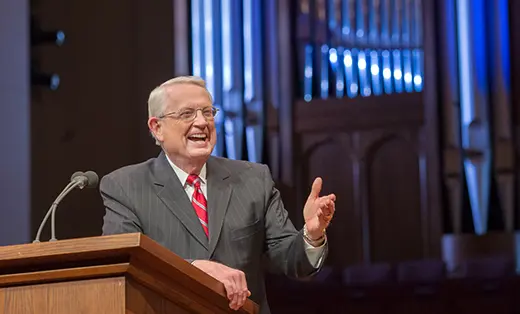
Come with reverence and awe to encounter Jesus in the garden of Gethsemane as Pastor Chuck Swindoll explores the desperate struggle Jesus faced.
Message Summary:
In this message centering on the agony of Matthew 26:31–56, Chuck Swindoll guides the listener into the "brutal part" of the Passion narrative known as Gethsemane. The scene opens with a prediction of denial: Jesus warns His disciples that they will all fall away. Peter, displaying his characteristic arrogance, declares, "Even if everyone else deserts you, I will never desert you"—a sentiment echoed by the other disciples, all of whom were unaware of their own weakness [5–7, 27–28]. Swindoll moves the narrative into the distress of the Garden of Gethsemane. He emphasizes the humanity of Jesus, who took Peter, James, and John with Him because He needed companionship in His darkest hour. While the disciples slept, Jesus experienced "stress of cosmic dimensions," wrestling with the "cup" of God's wrath. Swindoll vividly describes this cup not merely as physical death, but as a vessel brimming with the filth of humanity's sin and the horror of separation from the Father [23, 31, 35–36]. The battle was won not on the cross, but in the garden when Jesus finally prayed, "Your will be done". The message concludes with the deception of Judas and the desertion of the disciples. Judas arrives with a kiss—a sign of affection twisted into an act of betrayal. When the reality of the arrest sets in, the disciples flee, fulfilling the very prophecy they had denied hours earlier. Swindoll applies this to the modern believer using Jeremiah 12:5, asking: If we grow weary running with footmen in times of peace, how will we contend with horses in the "jungle" of future hardship? He challenges the congregation to move beyond passivity and arrogance, urging them to remember Gethsemane lest they too drift into spiritual slumber [42–45, 53–54].
Message Key Facts:
- Aunt Ernestine’s Painting: Swindoll recalls a childhood memory of a painting by his aunt depicting Jesus in the garden with blood on His face. His grandfather used this to explain Luke 22, where Jesus’ sweat became "like drops of blood," helping a young Swindoll understand the physical intensity of Jesus' spiritual agony [15–19].
- The Meaning of Gethsemane: The word Gethsemane means "Oil Press." Swindoll describes the location as a small, walled olive orchard with twisted trees, a place where the Son of God was "pressed" under the weight of the world's sin.
- The Cup of Wrath: Swindoll explains the "cup" Jesus prayed to remove. It was not just death, but a cup full of "all the brutality... whoring... blasphemy... and covetousness" of human history. Looking into the cup, Jesus "saw hell open for him and he staggered" [35–36].
- The Footmen and the Horses: Applying the disciples' failure to modern believers, Swindoll quotes Jeremiah 12:5: "If you have run with the footmen and they have wearied you, how could you contend with horses?" He uses this to warn that if believers compromise during times of relative ease ("the land of peace"), they will not survive the "jungle of the Jordan" (times of ruthless opposition) [42–44].
- The Alleyway Prayer: Swindoll shares a personal story of a time when his wife was ill, and he was financially destitute. He paced a dark alley behind his house, finally surrendering the situation to God. Like Jesus in the garden, the external situation didn't immediately change, but the internal battle ended once he surrendered his will [38–40].
- The Hymn "Lead Me to Calvary": The sermon concludes with a reading of the hymn by Jennie Evelyn Hussey, specifically the refrain: "Lest I forget Gethsemane, Lest I forget Thine agony... Lead me to Calvary." Swindoll uses this to anchor the memory of Jesus' surrender in the minds of the congregation [53–54].
- Imperfect Tense: Swindoll notes that the Greek verbs describing Jesus’ prayer are in the imperfect tense, indicating continued action. Jesus did not pray once; He was repeatedly falling on His face, getting up, and praying again throughout the ordeal.
Message References:
- Matthew 26:31–56: The primary text covering the prediction of denial, the prayer in Gethsemane, the betrayal by Judas, and the arrest [5–8].
- Zechariah 13:7: The prophecy Jesus quotes: "God will strike the shepherd and the sheep of the flock will be scattered".
- Jeremiah 12:5: "If you have run with the footmen and they have wearied you, how could you contend with horses?".
- Luke 22:44: The account of Jesus praying fervently until His sweat became like drops of blood.
- John 3:16: Referenced in the introduction regarding Jesus’ conversation with Nicodemus about God giving His only Son.