Overview:
A shepherd, a king, a warrior, a father, a poet . . . David lived a varied life, but there’s one thing for which he’s most remembered and praised: being a person after God’s own heart. That’s what distinguished him.
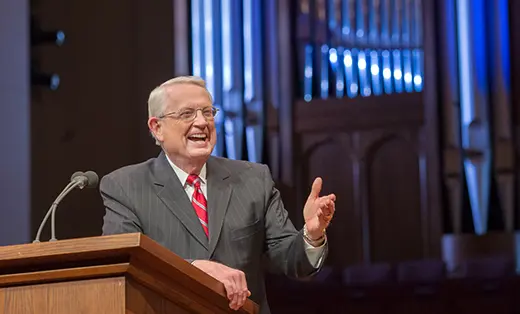
Pastor Chuck Swindoll teaches from 2 Samuel 6—a passage that paints a moving picture of this vital trait in David’s life.
The better you know where you stand before the Lord, the freer you can be. The freer you are before the Lord, the more confident you will become. So, what’s stopping you?
Message Summary:
Message Key Facts:
- A Man After God’s Heart: Swindoll defines this famous description of David (found in Acts 13:22) not as perfection, but as synchronization. When God looks right, David looks right. It means caring about the things God cares about, down to the smallest detail.
- Precepts vs. Principles: Swindoll distinguishes between a precept (like a 35 mph speed limit, which is rigid and non-negotiable) and a principle (like "drive carefully," which requires wisdom). David got into trouble because he treated a precept (how to move the Ark) like a flexible principle.
- The "New Cart" Mistake: David was a pragmatist who wanted to get the job done efficiently. He used a cart because it was convenient, but God had commanded that the Ark be carried by poles on the shoulders of the Kohathites. Swindoll warns that "expediency" often leads believers to disobey God's clear instructions.
- The Design of the Ark: Swindoll details the specific construction of the Ark—a wooden chest plated with gold, featuring a "Mercy Seat" and cherubim. Crucially, it had gold rings and poles designed specifically for human transport, proving God never intended it to be hauled by animals.
- Uzzah’s Death: Uzzah died not just because he touched the Ark, but because the entire process was irreverent. Swindoll notes that if they had done it right (carried on shoulders), the Ark never would have been unstable, and Uzzah never would have needed to touch it.
- The "Six Paces" Sacrifice: When David finally moved the Ark correctly, he stopped after only six steps to offer a sacrifice. Swindoll highlights this as the moment David realized that careful obedience is worth the effort, replacing his previous haste with worship.
- Dancing vs. Despising: The sermon contrasts David’s vertical focus (on the Lord) with Michal’s horizontal focus (on public opinion). Because Michal despised David’s emotional display of worship, she remained childless until her death, symbolizing the barrenness of a critical spirit.
- Freedom in Obedience: Swindoll argues that many view strict obedience as bondage, but David’s dancing proves the opposite: "When you obey, you are free." It is the person living in disobedience who is truly in bondage.
Message References:
- 2 Samuel 6:1–7: The narrative of moving the Ark on a cart and the death of Uzzah.
- Acts 13:22: Paul’s reference to David: "I have found David... a man after My heart, who will do all My will."
- 1 Chronicles 15:13–15: The parallel passage where David admits, "Because we did not seek Him according to the ordinance," and corrects his mistake by using Levites.
- Numbers 4 & 7 (Referenced): The original laws stating that the Kohathites must carry the holy objects on their shoulders.
- 2 Samuel 6:14: "And David was dancing before the Lord with all his might."
- 2 Samuel 6:21–22: David’s rebuttal to Michal: "It was before the Lord... I will be more lightly esteemed than this."