Overview:
Jesus concludes the last book of the Bible with an invitation to all who are thirsty—thirsty for truth, for love, for hope, for peace, for fellowship, for God.
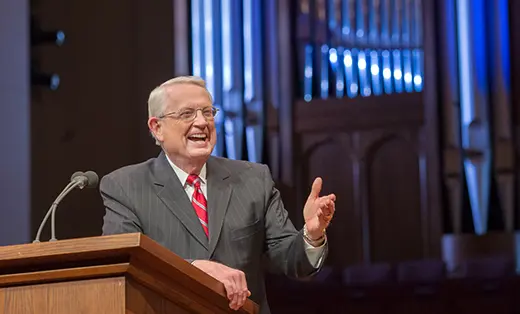
Pastor Chuck Swindoll explores how Jesus is the living water available for any who thirst and wish to take it! Study the last verses of the Bible with Pastor Chuck as he reviews Jesus’ promise in Revelation 22:17–21.
Even the best day on earth pales in comparison to the wonder and fulfillment of heaven. Look forward with great joy—your future in Christ is indescribable!
Message Summary:
In this concluding message on the book of Revelation, Chuck Swindoll examines the final five verses of the Bible (Revelation 22:17–21), focusing on the significance of "last words." Swindoll notes that last words are often the most important because they clarify, solidify, and summarize a life’s mission [4, 6–7]. Just as famous figures like Martin Luther King Jr. and the Apostle Paul left behind profound epitaphs, Jesus and the Apostle John close the canon of Scripture with urgent, lasting instructions [5–6]. Swindoll breaks the text down into four distinct movements. First, he highlights a universal invitation. The Spirit, the bride (the church), and the hearer all cry out "Come!"—an open-ended, unrestricted offer of the Water of Life to anyone who is thirsty, regardless of their background or past [9–12]. Second, Swindoll addresses a solemn warning regarding the sanctity of Scripture. He emphasizes that God cares deeply about specific words, warning that anyone who adds to or subtracts from the words of this prophecy faces divine judgment [13–15]. The message concludes with a comforting promise and a benediction of grace. Swindoll focuses on Jesus' final declaration, "Yes, I am coming quickly," clarifying that this indicates an imminent return that could happen at any moment. He applies this truth to three groups: it is a wake-up call for the apathetic, a command to relax for the anxious, and a warm welcome for the lonely. Swindoll ends with the moving story of John Todd, an orphan whose fear of a dark journey was quelled by a light in the window, illustrating the safety believers will find when they finally arrive home [21–23, 27–28].
Message Key Facts:
- The Power of Epitaphs: Swindoll illustrates the power of final words by citing famous epitaphs:
- Martin Luther King Jr.: "Free at last."
- Abraham Lincoln: "Now he belongs to the ages."
- The Apostle Paul: "I have fought the good fight... I have finished the course."
- Jesus: "He is not here; He is risen" [5–6].
- The Suicide Intervention: To illustrate the power of the invitation to "Come," Swindoll shares the story of a woman in a cheap motel room with a loaded gun in her mouth, ready to commit suicide. The radio clicked on, she heard the Gospel invitation, and she chose life. She later wrote to Swindoll saying she could "still taste the steel" in her mouth when remembering that moment of rescue.
- The Importance of Words: Swindoll defends a "slavishly literal" approach to Scripture by comparing it to other areas of life where specific words matter. We demand exact words in medical diagnoses, flight arrangements, pharmaceutical prescriptions, and legal contracts; therefore, we should expect God to be equally exacting with His life-and-death revelation [16–18].
- The "Deuteronomy" Connection: Swindoll links the warning in Revelation 22 to Deuteronomy 4:2, where Moses warns the Israelites not to add to or take away from the commands of the Lord. This confirms that from the beginning of the Bible to the end, God guards His specific vocabulary [15–16].
- "I Am Coming Quickly": Swindoll explains that the Greek phrase for "quickly" suggests imminence. It does not necessarily mean "soon" in terms of time elapsed, but "suddenly" or "at any moment" [21–22].
- The John Todd Story: The sermon closes with the story of John Todd, a 19th-century minister who was orphaned at age six. He was terrified to ride through the dark woods to his aunt's house, fearing she wouldn't be awake. Upon arrival, he found a candle in the window and a warm meal, a picture of how God waits for His children at the end of their life's journey [26–28].
Message References:
- Revelation 22:17–21: The primary text containing the invitation to come, the warning against altering Scripture, and the final promise of Jesus’ return.
- Deuteronomy 4:1–2: Moses’ warning to Israel not to add to or take away from the word of God.
- 2 Timothy 4:7: Paul’s final words: "I have fought the good fight, I have finished the course, I have kept the faith".
- Matthew 11:28: "Come to me, all who are weary..." referenced as the open invitation of Jesus.