Overview:
As in any relay, the moment of passing the baton is the most critical. If you let go too soon or too late the baton will fall. This is also true in life. Frequently, we’re good learners but terrible teachers. When it comes to passing on what we have lived and learned, we sometimes drop the baton ourselves—or worse yet, we never even attempt to hand it off. This final lesson on creating a legacy focuses on this critical element of mentoring—passing our legacy to those who will come after us. Unlike a relay, this passing of the legacy is not a moment but a lifelong attitude of mentoring others to carry on the tradition we received.
Message Summary:
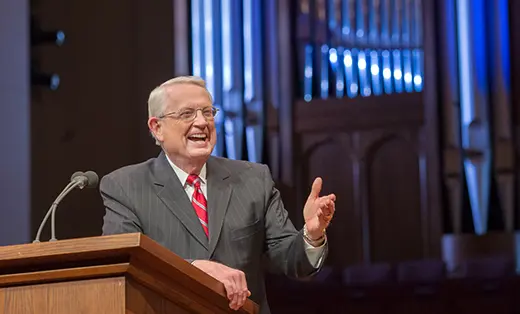
In this concluding message of the series on legacy, Chuck Swindoll uses the metaphor of a relay race to illustrate the critical nature of mentoring. Just as a race can be lost if a baton is dropped during the handoff, a spiritual legacy is at risk if believers fail to pass on what they have lived and learned to the next generation. Swindoll defines mentoring not as a single moment, but as a "lifelong attitude" of etching one’s positive formations in stone and writing criticisms in dust. Using the narrative of Acts 18, Swindoll traces the relationship between the Apostle Paul, the couple Aquila and Priscilla, and the eloquent speaker Apollos. This chapter serves as a case study for how the gospel spreads like a "spreading flame" through personal investment. Swindoll outlines six marks of a good mentor, showing how Paul invested in Aquila and Priscilla, who in turn invested in Apollos. The message concludes with a challenge for every believer to identify the influencers in their own lives—family, teachers, and mentors—and to actively seek out others to encourage. Swindoll emphasizes that the ultimate goal of mentoring is servanthood, illustrated by the epitaph of Dawson Trotman: "Always holding somebody up".
Message Key Facts:
- The Relay Race Metaphor: Swindoll posits that while we are often good learners, we can be "terrible teachers." The most critical point in a relay race is passing the baton; if the exchange fails, the race is lost. Mentoring is the act of ensuring this spiritual baton is successfully handed off.
- Definition of a Mentor: Citing Webster, Swindoll defines a mentor as a trusted counselor, guide, tutor, and coach.
- The "Six Marks" of a Good Mentor:
- Stays Close: Because a mentor cares, they do not operate from a distance. Paul lived and worked with Aquila and Priscilla. Benefit: The one being mentored feels valued.
- Talks Straight: Because a mentor is devoted to Scripture, they speak the truth even when it is difficult, just as Paul shook the dust from his garments when rejected. Benefit: The one being mentored becomes stronger.
- Hangs in There: Because a mentor takes the long view, they do not "cut and run" during conflict. Paul stayed in Corinth for a year and a half despite opposition. Benefit: The one being mentored becomes more faithful.
- Trusts When Absent: Because a mentor believes in the protegee, they are willing to leave them in charge. Paul left Aquila and Priscilla in Ephesus to establish the work there. Benefit: The one being mentored becomes more responsible.
- Addresses Weaknesses: Because a mentor is discerning, they correct error graciously. When Apollos preached incomplete theology, Aquila and Priscilla took him aside privately to explain the way of God "more accurately." Benefit: The one being mentored remains humble and teachable.
- Endorses Gifts: Because a mentor is an encourager, they delight in the success of the student. The believers in Ephesus encouraged Apollos to go to Achaia and wrote letters of reference for him. Benefit: The one being mentored is inspired to do their very best.
- Mentoring by Proxy: Swindoll notes that not all mentoring is direct instruction; much is learned by observation. Aquila and Priscilla learned from Paul simply by living and working alongside him in the tentmaking trade.
- "Tuesdays with Morrie": Swindoll uses the story of Mitch Albom and his professor Morrie Schwartz to illustrate that a student will "always find your way back" to the teacher who saw them as a "jewel that with wisdom could be polished".
Message References:
- Acts 18:1–3: Paul meets Aquila and Priscilla in Corinth and stays with them because they share the trade of tentmaking.
- Acts 18:5–11: Paul devotes himself to the Word, faces opposition from the Jews, receives a vision from the Lord not to be afraid, and settles in Corinth for a year and a half.
- Acts 18:18–21: Paul travels to Ephesus, bringing Aquila and Priscilla with him, and then leaves them there to continue his journey to Jerusalem.
- Acts 18:24–26: Apollos, an eloquent speaker knowing only the baptism of John, arrives in Ephesus; Aquila and Priscilla take him aside to explain the way of God more accurately.
- Acts 18:27–28: The believers encourage Apollos to go to Achaia, where he powerfully refutes the Jewish opposition in public debate using the Scriptures.